Car dealers · Radio advertising
The manufacturer already sold the car, so your spot sells the showroom.
Radio advertising for a dealership buys drive-time spots on the roads your showroom sits on, and because the model is already known, those thirty seconds carry the exchange offer and the delivery date instead. GullySales plans the flight around the dates families take delivery on and keeps its calls out of the portal lead pool.
Scope, fee, reporting and term are agreed in writing after we have read your brief and spoken to you.

What radio advertising means
Radio advertising is a spot, a mention or a sponsorship on a station your buyers listen to on the way to work. GullySales plans the station, band and frequency, and runs search on your own name during the flight so the listener who looks you up afterwards finds you.
Last updated 5 Oct 2026.
For car dealers
Where it usually goes wrong, and what we would do.
“Three dealers of the same brand want the same listener”
The national campaign sold the model. What is left for you to say on air is your offer, your delivery date and which side of the city you are on, because the buyer is choosing between showrooms rather than between cars.
“The flight stops where the delivery date starts”
Deliveries cluster on Dhanteras, Ugadi and the days a family treats as auspicious. Work backwards from the day a booking must close to be delivered on the date, and stop the spots there.
“The script belongs to the brand before it belongs to the station”
Most dealers work inside approved wording, supplied music and sometimes supplied audio with a tag for the dealer. Find out what you may say and what you must use before anybody books studio time.
“Radio calls arrive in two spikes a day”
Drive-time spots put enquiries on your desk around nine and again after seven, when the team is already working a queue of portal leads. Without its own line and someone briefed to answer it, the flight cannot be told apart from an ordinary week.
What we do
What we deliver for car dealers.
Every deliverable, what it covers for you, and the result it is there to produce. Nothing here is an extra.
Station and band plan for your side of the city
The stations and drive-time bands that cover the corridors feeding your showroom, chosen before a package with free spots in it is quoted.
Result: Spots run where people who can reach you are driving.
Flight dated back from the delivery date
A day by day schedule ending when bookings must close for delivery on the auspicious date, weighted to the morning and evening bands.
Result: Nothing airs in the week when nothing can be delivered.
Script cleared against the brand guidelines
Wording, claims and audio checked with the brand team before recording, including whether supplied audio has to be used and where the dealer tag may sit.
Result: The spot runs without a call from the brand team.
One on-air number into the sales desk
A line used on air and nowhere else, ringing the sales desk rather than the workshop, and logged with its own source in your lead system.
Result: A radio call is never filed as a portal lead.
Name and model covered on search during the flight
Search ads on your showroom name, the model and the city while the spots run, because a listener at a signal looks you up that evening.
Result: The search your spot caused reaches you, not the co-dealer.
Test drives and bookings tagged to the flight
Calls on the on-air line, home test drives given and bookings taken, counted week by week against the baseline recorded before the campaign.
Result: The flight is judged on test drives rather than on spot counts.
How the result is measured
- Spots aired against spots booked
- Branded search volume during the flight
- Calls quoting the on-air number
Recorded as a baseline before work starts, so every later report has an honest comparison.
What goes in a showroom spot
A thirty-second dealer spot has room for six things, and everything else stays off the air.
- Showroom name and side of the city
- Say the dealership name first and last, with the part of the city or the road it stands on. The buyer already knows the car and needs to know where to go.
- The model and one offer
- Name the model and one benefit the desk can honour, such as an exchange offer, with the date up to which it holds.
- The delivery date message
- Link the spot to the day families want the car, for example book by a given date for delivery on Dhanteras, with the booking cut-off said aloud.
- A road or landmark
- Name the junction or landmark drivers pass. Someone stuck at a signal can picture it, and that is worth more than a full address read at speed.
- The on-air number, read twice
- Give the campaign number slowly twice at the end, and tell the sales desk the name of the spot so the person who answers knows what the caller heard.
- Brand-required lines
- Add the dealer tag, the terms line and any disclaimer your manufacturer's guidelines require, and leave room for them in the script before it is timed.
Who it is for
This is written for these car dealers.
- Authorised new car dealerships for mass-market brands
- Premium and luxury car dealerships
- Electric vehicle dealers and experience centres
- Multi-brand pre-owned car dealers
- Manufacturer-certified used car outlets
- Commercial vehicle and taxi fleet dealers
- Dealer groups with several showrooms and workshops
- Rural and semi-urban dealer outlets
How it works
From your first message to the first report.
No open-ended retainer. Every step gives you something in writing.
First
Your brief
You tell us what you need in a few short steps: your business, what you want, where enquiries come from and how they are handled.
After the brief
A conversation and a written scope
We read it, then talk with whoever handles your enquiries. If you want our help, the scope, the fee and the reporting come in writing, and nothing starts before you have read them.
Before work starts
Baseline recorded
The numbers this work is meant to move, such as enquiries, quotations, orders, visits or renewals, written down so every later report has an honest comparison.
After the baseline
The first fix goes live
The fix we agreed to start with is put in place and measured against the baseline, whether that is a reply, a follow-up, a page, a listing or the handover between marketing and sales.
As agreed
Report against the baseline
What moved, what did not, and what changes next, in plain words. How often you get it is set in writing before work starts.
At renewal
Renew on the numbers
The term ends and you decide whether to continue from the results. The length is agreed in writing before anything starts.
How the radio advertising work runs
- 1
Fix the window
We agree what has to happen in these weeks, an admission deadline, a launch or a sale, because radio works in short flights.
- 2
Choose the station and the language
We match station, language and band to who you sell to, and cut the stations that only add a stray sighting.
- 3
Write and produce the spot
The script is written here and produced to the station's delivery format before the deadline, rather than on the station's template.
- 4
Book and hold the schedule
We coordinate the booking with the station or its agency and treat the written spot plan as the thing being bought.
- 5
Track and reconcile
Calls to the on-air number and brand search volume are watched through the flight, and the transmission proof is checked against the booking.
Why us
Why owners pick GullySales over an agency.
Marketing and sales, as one job
Most agencies stop at the enquiry. We also fix what happens after it: the reply, the follow-up, the quote and the CRM.
The person on the first call does the work
No account managers in between. You are never handed to someone you have not met.
A baseline before anything starts
Your numbers are written down on day one, so every later report compares against something honest.
The fee in writing, split three ways
Our time, your media spend and production on separate lines. You always see what goes to us.
No guarantees we cannot keep
The term is agreed in writing and never a default twelve months. We never promise a ranking or a lead count, because nobody controls those.
One office, and we say so
Nagarbhavi, Bengaluru. We work across India by call and WhatsApp and travel when a session needs to be in person.
#257, 3rd floor, Sri Nanjundeshwara Complex, Nagarbhavi 8th Block, Outer Ring Road. How we work.
Your brief
Tell us what you need, and we will read it before we call.
Eight short steps about your business, what you want and who decides. Most questions are a tap, and you can skip any you would rather answer on the call.
FAQ
Questions owners ask before they call.
Not here? More answers, or ask on WhatsApp.
Should the spot quote a discount?
How long should a festival flight run?
Should the spot mention finance or EMI?
Does radio suit a pre-owned car outlet?
How much does it cost?
How long is the contract?
Who will actually do the work?
What do you need from us?
What if we are not happy with the work?
From the blog
Further reading for car dealers.
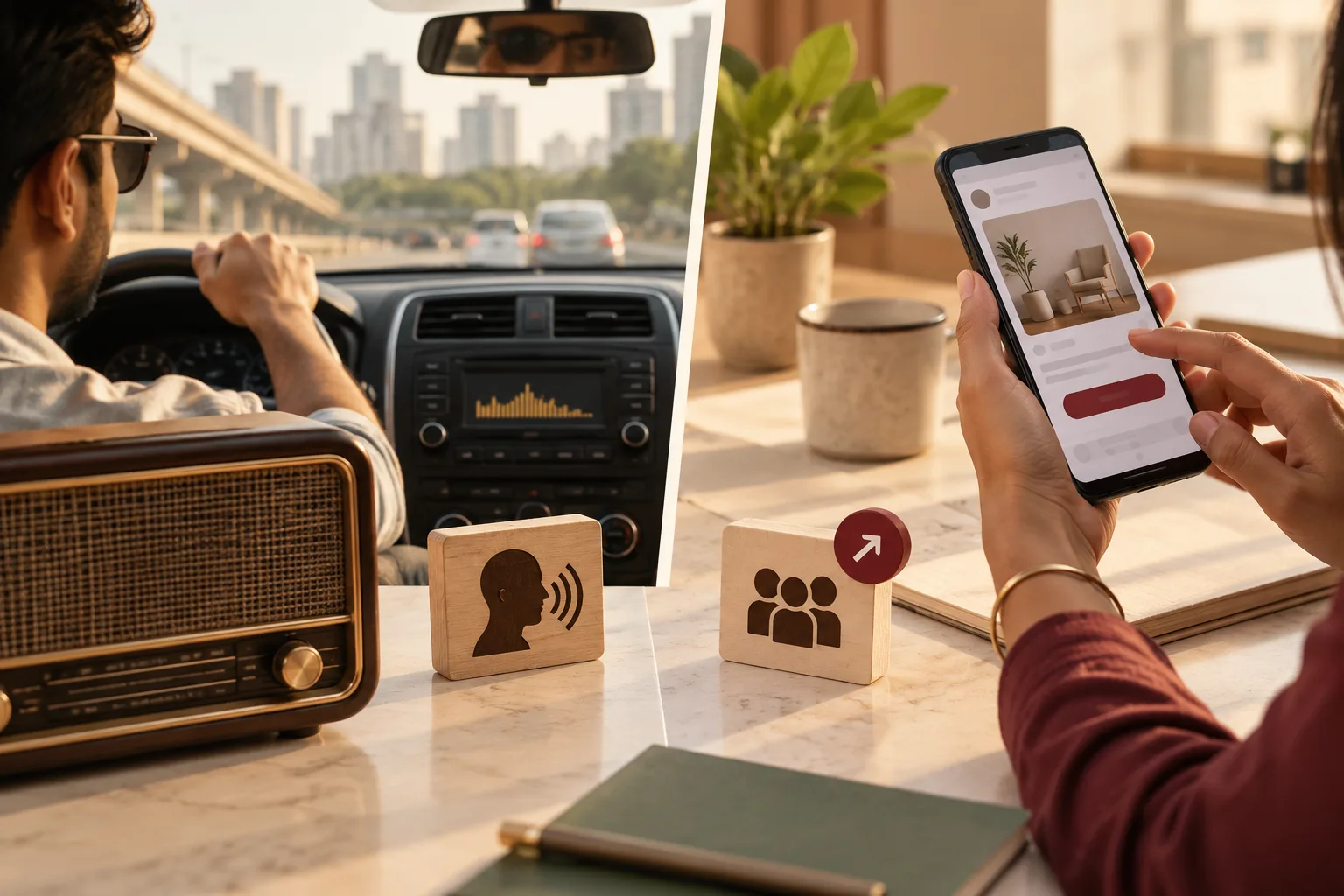 6 min read · 21 Sept 2026Radio advertising vs social media advertising: where should your money go?Radio reaches a driver who cannot click. Social reaches a thumb that can. One buys a name people remember, the other buys the enquiry itself.
 7 min read · 21 Sept 2026How to write a radio scriptA spot is heard once, by somebody at the wheel who cannot look at anything or write anything down. Time the words with a stopwatch, not on the page.
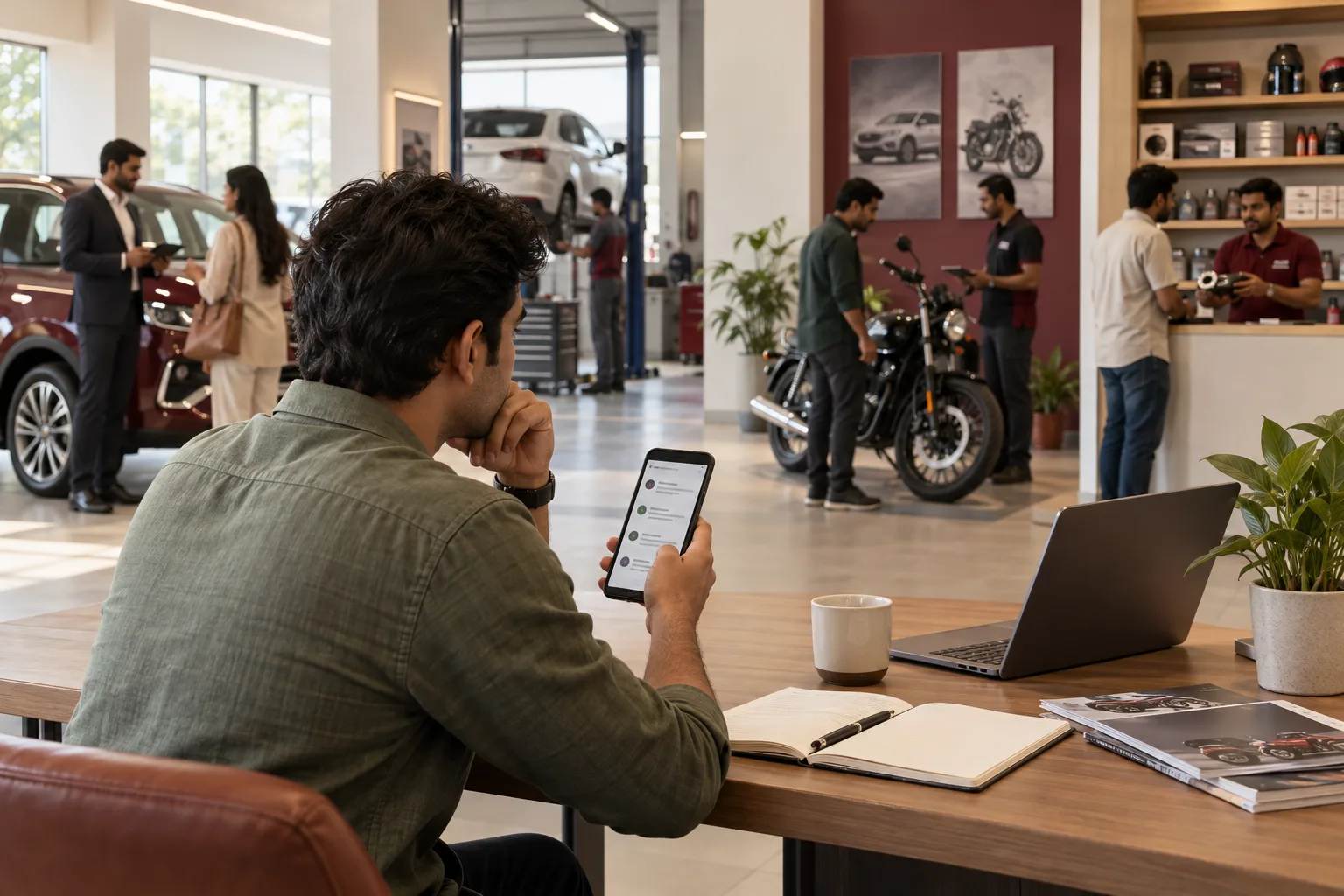 6 min read · 6 Oct 2026How buyers choose a showroom, workshop or parts counterCar, bike, repair and parts buyers send one enquiry to several sellers and pick the first clear answer. This post lists what each buyer checks, and where a dealer or workshop quietly loses them.
More for car dealers
Everything else we would do for you.
Closest to this: paid and media
Also for car dealers
Or start from the overview: sales and marketing for car dealers.
Your next practical step
Tell us what you are trying to grow, and we will read it before we call.
Eight short steps, mostly taps. Skip anything you would rather answer on the call.