Car dealers · Outdoor advertising
Buy the road that reaches your gate, not the one that reaches the co-dealer.
Outdoor advertising for a dealership is bought site by site on the roads leading to your showroom and your workshop, against another dealership carrying the same brand board across town. GullySales checks the facing and the lighting before booking, builds artwork to the manufacturer's manual, and gives the panel a number the sales desk answers.
Scope, fee, reporting and term are agreed in writing after we have read your brief and spoken to you.

What outdoor advertising means
Outdoor advertising is the hoarding, billboard, bus shelter or digital screen on a road your buyers already use. GullySales picks the sites from where your customers actually come from, coordinates the booking with the media owner, and gives the campaign a traceable route so it is not judged on guesswork.
Last updated 5 Oct 2026.
For car dealers
Where it usually goes wrong, and what we would do.
“A buyer who has chosen the model is only choosing a showroom”
He has watched the reviews and settled on the variant. What is left is which gate he turns into, and the flyover he takes to work every morning decides it. Every site on the list is judged against the other showroom's address.
“The manual takes longer than the mounting date allows”
How the logo sits, which model image is current and where the dealership name may appear are set by the manufacturer, and regional approval takes days. Artwork goes for clearance before the flex is ordered, not while the printer waits.
“People drive further to buy than to service”
The showroom catchment is wider than the workshop's, so a panel on the ring road can carry a model offer while the boards near the service bays carry a monsoon check-up. One road, two audiences, two messages.
“No hoarding ever appears in your lead source field”
The dealer management system will not credit a structure on a pole. A campaign line that rings the tele-calling desk, plus a question added to the walk-in register, is what puts a booking against a site.
What we do
What we deliver for car dealers.
Every deliverable, what it covers for you, and the result it is there to produce. Nothing here is an extra.
Site list judged against the rival showroom
Each panel assessed on whether it sits on the approach to your gate or to the other dealer of the same brand, with photographs taken from where a driver actually sits.
Result: The money goes on roads that end at your door.
Facing, lighting and cycle confirmed before the order
Which carriageway the structure faces, whether the back-lighting comes on in the evening, and the mounting and removal dates written into the booking.
Result: You know what you have bought before the invoice arrives.
Artwork cleared against the manufacturer's identity manual
The approved model image and brand treatment, the dealership name where the manual permits it, and the campaign number placed inside the safe area, sent for regional approval before printing.
Result: The panel goes up without a call from the brand office.
Separate sites for sales and for the workshop
A model or exchange offer on the showroom approach, and a service camp or accessories message on the roads around the service bays.
Result: Each structure talks to the person driving past it.
Mounting proof and mid-cycle checks
Dated photographs when the flex goes up and again during the cycle, with late, torn or unlit sites taken up with the media owner while it is still running.
Result: Display days paid for are display days delivered.
A number the tele-calling desk owns
One line printed on the outdoor sites alone, answered by the desk, entered in the same lead sheet as portal enquiries, with the walk-in register asking the same question.
Result: A booking can be traced to the site that started it.
How the result is measured
- Sites booked
- Proof of display received
- Enquiries quoting the campaign route
Recorded as a baseline before work starts, so every later report has an honest comparison.
How it is bought, and approved
A dealership buys outdoor site by site, and the manufacturer and the civic body clear it first.
- Manufacturer support for local advertising
- Some brands share the cost of dealer advertising. Ask the area manager what is reimbursable and get artwork approved before booking, because claims on unapproved flex can be refused.
- Which rival sits near the site
- Ask the media owner which nearby panels belong to another dealer of your brand or to a rival make. A face looking at their showroom sends your reader to them.
- Licence and landlord consent
- Each structure needs the civic body's licence and the owner's consent for the building or land. Ask to see both. Rules differ by city and change.
- Dusk visit for facing and lighting
- Stand where a buyer drives at dusk. Check the panel is lit, faces traffic heading towards the showroom, and is not hidden by a tree or a flyover.
- A separate small panel for the workshop
- Service customers live near the workshop. Buy a smaller panel on that road with the service number, and keep the sales number off it.
- Lead source in the dealer system
- Print a number only the tele-callers answer, and add 'hoarding' as a lead source in the dealer management system. Branded search for your showroom name is a second read.
Who it is for
This is written for these car dealers.
- Authorised new car dealerships for mass-market brands
- Premium and luxury car dealerships
- Electric vehicle dealers and experience centres
- Multi-brand pre-owned car dealers
- Manufacturer-certified used car outlets
- Commercial vehicle and taxi fleet dealers
- Dealer groups with several showrooms and workshops
- Rural and semi-urban dealer outlets
How it works
From your first message to the first report.
No open-ended retainer. Every step gives you something in writing.
First
Your brief
You tell us what you need in a few short steps: your business, what you want, where enquiries come from and how they are handled.
After the brief
A conversation and a written scope
We read it, then talk with whoever handles your enquiries. If you want our help, the scope, the fee and the reporting come in writing, and nothing starts before you have read them.
Before work starts
Baseline recorded
The numbers this work is meant to move, such as enquiries, quotations, orders, visits or renewals, written down so every later report has an honest comparison.
After the baseline
The first fix goes live
The fix we agreed to start with is put in place and measured against the baseline, whether that is a reply, a follow-up, a page, a listing or the handover between marketing and sales.
As agreed
Report against the baseline
What moved, what did not, and what changes next, in plain words. How often you get it is set in writing before work starts.
At renewal
Renew on the numbers
The term ends and you decide whether to continue from the results. The length is agreed in writing before anything starts.
How the outdoor advertising work runs
- 1
Draw the catchment
We agree the roads, junctions and neighbourhoods your buyer moves through. It is almost always a smaller area than an owner first says, and a clinic in Nagarbhavi does not need the whole of west Bengaluru.
- 2
Survey what is available
We work through the sites on offer inside that catchment and go and stand in front of the ones worth looking at.
- 3
Compare and book
Sites are compared on facing, visibility, illumination and cycle length, then booked through the media owner or their agency at a negotiated rate.
- 4
Print to specification
Artwork is made to the exact panel size and delivered ahead of mounting day, with a proof you approve before printing.
- 5
Monitor the cycle
We collect mounting and mid-cycle photographs, and take up anything late, torn or unlit with the media owner while the cycle is still running.
Why us
Why owners pick GullySales over an agency.
Marketing and sales, as one job
Most agencies stop at the enquiry. We also fix what happens after it: the reply, the follow-up, the quote and the CRM.
The person on the first call does the work
No account managers in between. You are never handed to someone you have not met.
A baseline before anything starts
Your numbers are written down on day one, so every later report compares against something honest.
The fee in writing, split three ways
Our time, your media spend and production on separate lines. You always see what goes to us.
No guarantees we cannot keep
The term is agreed in writing and never a default twelve months. We never promise a ranking or a lead count, because nobody controls those.
One office, and we say so
Nagarbhavi, Bengaluru. We work across India by call and WhatsApp and travel when a session needs to be in person.
#257, 3rd floor, Sri Nanjundeshwara Complex, Nagarbhavi 8th Block, Outer Ring Road. How we work.
Your brief
Tell us what you need, and we will read it before we call.
Eight short steps about your business, what you want and who decides. Most questions are a tap, and you can skip any you would rather answer on the call.
FAQ
Questions owners ask before they call.
Not here? More answers, or ask on WhatsApp.
Should the panel show the car or the offer?
Is a digital screen at the mall better than a hoarding?
Do we need the manufacturer's permission before we put up a hoarding?
What happens to the panel when the model or the offer changes mid-cycle?
How much does it cost?
How long is the contract?
How soon will we see results?
Who will actually do the work?
What do you need from us?
What if we are not happy with the work?
From the blog
Further reading for car dealers.
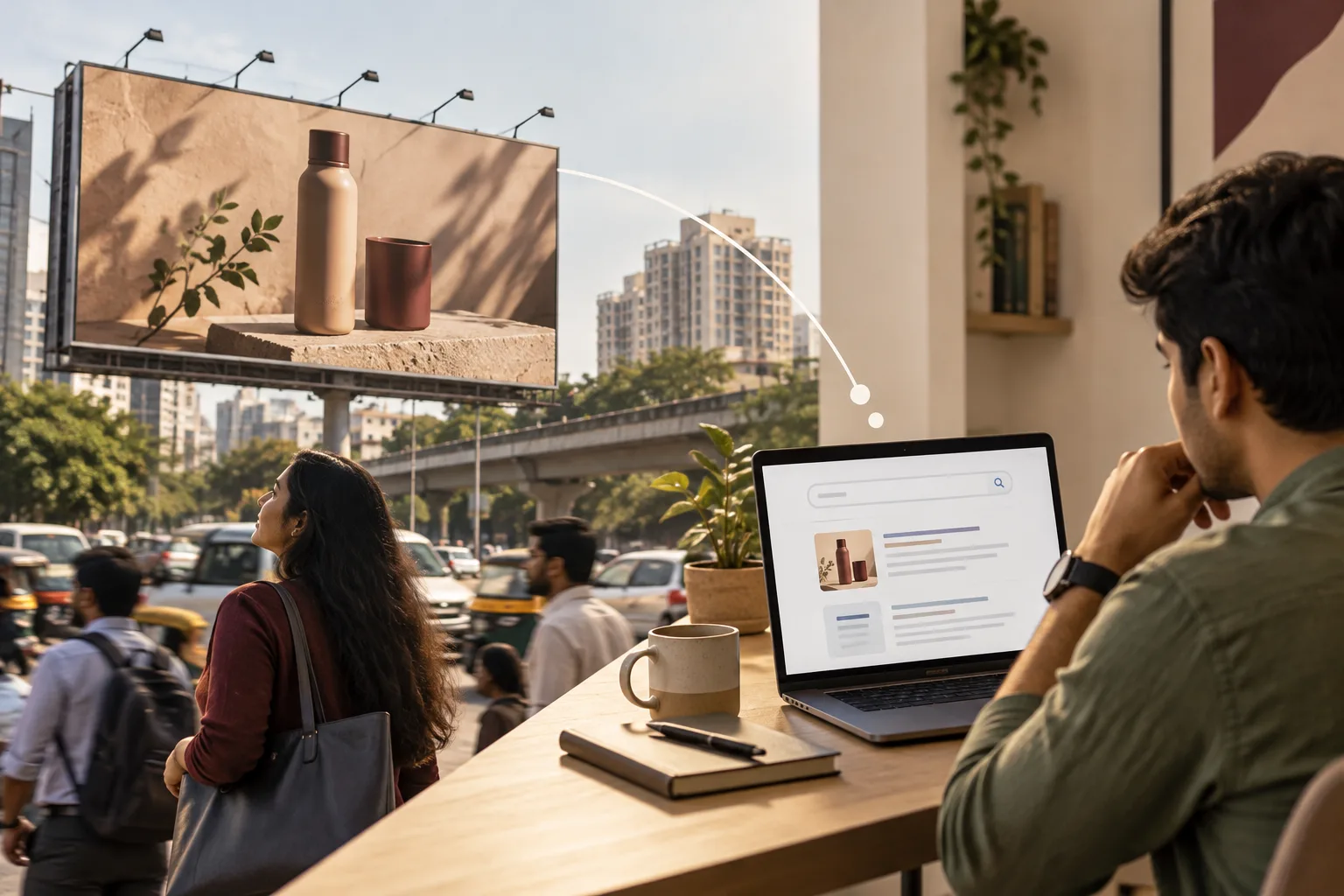 6 min read · 21 Sept 2026Google Ads vs outdoor advertising: capture demand or create it?Google Ads collects the demand that already exists. A hoarding creates the demand Google later collects, and then search takes the credit for it.
 6 min read · 11 Jun 2026How to advertise during the festive seasonThe festive season is bought in the monsoon. Book early, know why the rates rise, and match what you sell to the day people actually buy it.
 6 min read · 25 Nov 2025Should I use digital or offline advertising?Digital captures people already looking. Offline reaches people who never search. The trap is that only one of the two can prove it worked, so budgets drift.
More for car dealers
Everything else we would do for you.
Closest to this: paid and media
Also for car dealers
Or start from the overview: sales and marketing for car dealers.
Your next practical step
Tell us what you are trying to grow, and we will read it before we call.
Eight short steps, mostly taps. Skip anything you would rather answer on the call.