Two-wheeler service centres · CRM
Record every bike once, and the next service date is never a guess.
A CRM for a two-wheeler workshop is the single record of each rider, their bike, the work done and the odometer reading, so the next service is known and the reminder has something true to say. GullySales works on choosing a simple tool, filling it from the job card and keeping it current.
Scope, fee, reporting and term are agreed in writing after we have read your brief and spoken to you.

What CRM means
A CRM is the record where every enquiry, call and quote is kept against a customer, replacing separate notebooks, spreadsheets and memory. GullySales sets up or cleans an existing CRM and reports from it by enquiry outcome rather than by activity logged.
Also for two-wheeler service centres
- Follow-up systems for two-wheeler service centres
- Lead generation for bike workshops
- SEO for two-wheeler service centres
- Local SEO for two-wheeler service centres
- Reputation management for two-wheeler service centres
- WhatsApp marketing for two-wheeler service centres
- Review generation for two-wheeler service centres
- Customer retention for two-wheeler service centres
Sales and marketing for two-wheeler service centres, the overview.
Last updated 14 Nov 2026.
For two-wheeler service centres
Where it usually goes wrong, and what we would do.
“The job card is the real record, and it sits in a drawer”
Riders, models, readings and complaints are written on paper that nobody searches. When a rider returns, the mechanic starts from nothing, and the reminder cannot be sent because the number cannot be found.
“The bike is the record, not only the rider”
One household may bring a scooter, a motorcycle and a relative's bike. Each has its own service dates and history. A record held by phone number alone mixes them and sends the wrong reminder.
“A heavy tool is abandoned within weeks”
A workshop with a mechanic under every bike will not fill a long form. The fields have to match what the counter already writes, or the CRM becomes another register that nobody opens.
“Consent has to be captured at the counter”
A rider's number may be used for service reminders only if they agreed. The record needs a field for it, filled while the rider is standing there, not guessed afterwards.
What we do
What we deliver for two-wheeler service centres.
The work available for this need. We agree the deliverables and responsibilities for your engagement in writing.
A rider and bike record
A short layout holding name, number, bike model, registration, last reading, last service and consent.
Result: Every returning bike has one record.
Entry from the existing job card
A routine for copying the day's job cards into the record at closing, in the order the counter already works.
Result: The paper and the record agree at the end of each day.
Next-service dates stored with the bike
The date or reading at which the next service falls is saved against the bike and sorted so due jobs can be seen.
Result: You can list the bikes that are due without searching.
Consent captured at billing
A line the counter asks and records, with a plain version of what the rider is agreeing to.
Result: Each reminder goes only to a rider who agreed.
Tags for rider type and bike use
Tags for commuters, delivery riders and fleet bikes so messages fit the rider.
Result: You can send a delivery rider something different from a commuter.
Tool choice for your size
A short comparison of simple CRM tools in ordinary use in India, matched to your counter's habits.
Result: You pick a tool the counter will actually use.
How the result is measured
- Enquiries logged in the CRM
- Data completeness
- Reports generated from CRM data
Recorded as a baseline before work starts, so every later report has an honest comparison.
Fields worth keeping
A workshop record is built around the bike as much as the rider.
- Registration number and model
- Filled by the advisor at the first visit. It opens the bike's history and lets the next job card start from what was done before.
- Rider name and the number to call
- Filled at billing. If the owner and the person at the counter differ, keep both, so the estimate reaches the one who pays.
- Odometer reading at each visit
- Written from the dashboard at drop-off. It sets the next-service point and lets you spot a rider who stopped coming.
- Work done and parts fitted
- Copied from the job card by the person who bills. It answers a question about a past repair without hunting for the paper.
- Next service due
- Calculated from the last reading and date by the advisor. It is the field the reminder reads from.
- Consent to messages, with the date
- Ticked at billing with the rider present. Without it you may not send reminders, so keep it with the record.
Who it is for
This is written for these two-wheeler service centres.
- Independent two-wheeler workshops
- Multi-brand service centres
- Authorised service centres
- Workshops specialising in scooters
- Performance and customisation workshops
- Doorstep and pick-up service providers
- Electric two-wheeler service and battery specialists
- Workshops serving delivery riders and fleet owners
Before you decide
When this may not be the right fit.
- Job cards are still written in different hands or left in a drawer, so a tool would be filled with gaps
- No one at the counter has the few minutes to enter the record at billing, so the sheet would go stale within a short while
Before you decide
Agree the work. Know how to judge it.
CRM for bike workshops: use these checks to prepare, choose the scope, and review what changes.
Bring the right evidence
List the records your team uses and show how an enquiry becomes an order today. Bring examples of duplicate entries, missing owners, and reports that require manual correction.
Make the scope clear
Agree the stages, required fields, access roles, and integrations before configuring the system. Separate software subscriptions from setup, data work, and training.
Check the work in use
Ask the people who will use the CRM to complete a real handover and find the next action without help. Check that the management report can be traced back to individual records.
Know when to change course
If the process is unclear, buying a more complex CRM adds more places for confusion. Start with the minimum fields and rules the team can use consistently.
These are discussion points, not a fixed package. GullySales confirms the deliverables, responsibilities, fee, and term in writing after reading your brief and speaking with you.
Before we start
What to have ready before the work starts.
The records, access and decisions this work needs from two-wheeler service centres. Anything missing is noted in the written scope, with who will supply it.
- The existing job cards or billing export
- Whatever you keep today, paper or software, we need to see it. A billing export is easier to load than cards. If nothing exists beyond memory, the record starts from today and takes longer to be useful.
- Registration numbers on every card
- The registration number identifies the bike. Where the card lacks it, the counter must begin writing it. Without it, two riders with the same name merge into one record, and reminders go to the wrong person.
- A person to enter data at the counter
- Someone must have the job of filling the record each time a bike is billed. If everyone is told to, nobody does. We help you choose one person and give them a short, simple form.
- A decision on the tool
- Choose between a spreadsheet, a simple tool or your billing software, with our advice. The weight of the tool should match the size of your workshop. If you cannot decide, we start in a spreadsheet and move later.
- A safe place for rider data
- Rider names and numbers need a locked place, not an open sheet on a shared phone. Tell us who may see the record. Without this rule, we limit the record to what is needed for reminders.
How it works
How the CRM work runs
The work itself, in order. How an engagement starts, from your brief to a written scope, is set out on our method page.
- 1
Photograph the job card drawer
We start by seeing where your records live: the drawer, the notebook, the billing software. You show us how a card is filled in and what is left blank. We note which fields exist and which are missing, since the record we build can only be as good as the information the counter writes.
- 2
Design a record around the bike
A rider can own two bikes and a bike can change hands. We design a record where the bike is the main entry, with the rider attached, the registration number, the model, the last reading and the jobs done. You approve the fields. Fields nobody will fill in are dropped.
- 3
Enter the existing cards as a first load
We take the cards you hand over and enter them into the record, flagging gaps. You decide how far back to go. The first load is rough and is cleaned while the counter starts using the new entry, so work at the ramp is not held up.
- 4
Add a consent field at billing
At the billing desk, the counter asks whether the rider agrees to reminders and records the answer. We draft the sentence and you approve it. Riders who decline are marked so no message is sent to them.
- 5
Set the next-service date on every bike
From the last job and reading, each bike gets a due date or reading, according to the intervals you follow. You confirm those intervals. The list of bikes coming due is the first thing the counter reads when it plans reminders.
- 6
Check the record against the starting count
We compare repeat visits and reminders answered against the figures noted before the tool was in use. You tell us what the counter finds easy or hard. A tool that slows the ramp is changed or dropped, and we choose a lighter one.
Where this fits
Three pieces of sales work, in this order.
This work sits inside sales management. A target, a review routine and someone who owns the number.
Step 1
Sales audit
Find where deals are being lost and what to fix first.
Start here if you cannot say where orders are lost.
Step 2
Sales process design
One written way to sell, from first enquiry to repeat order.
Start here if every salesperson sells differently.
Step 3 · you are here
Sales management
A target, a review routine and someone who owns the number.
Start here if the team has targets and no routine.
FAQ
Questions owners ask before they call.
Not here? More answers, or ask on WhatsApp.
Is a spreadsheet enough?
Who should fill it in?
Where should we keep rider data safely?
Do we need to record two-wheelers that come only for a puncture?
Is a spreadsheet really enough for a small workshop?
Who owns the rider data if a staff member leaves?
How much does it cost?
How long is the contract?
How soon will we see results?
Who will actually do the work?
From the blog
Further reading for two-wheeler service centres.
 6 min read · 6 Oct 2026How buyers choose a showroom, workshop or parts counterCar, bike, repair and parts buyers send one enquiry to several sellers and pick the first clear answer. See what each buyer checks and where you lose them.
 5 min read · 6 Oct 2026How a two-wheeler workshop takes the first callThe first call from a rider decides whether the bike comes in. The questions to ask, what to write down and what to say about price on the phone.
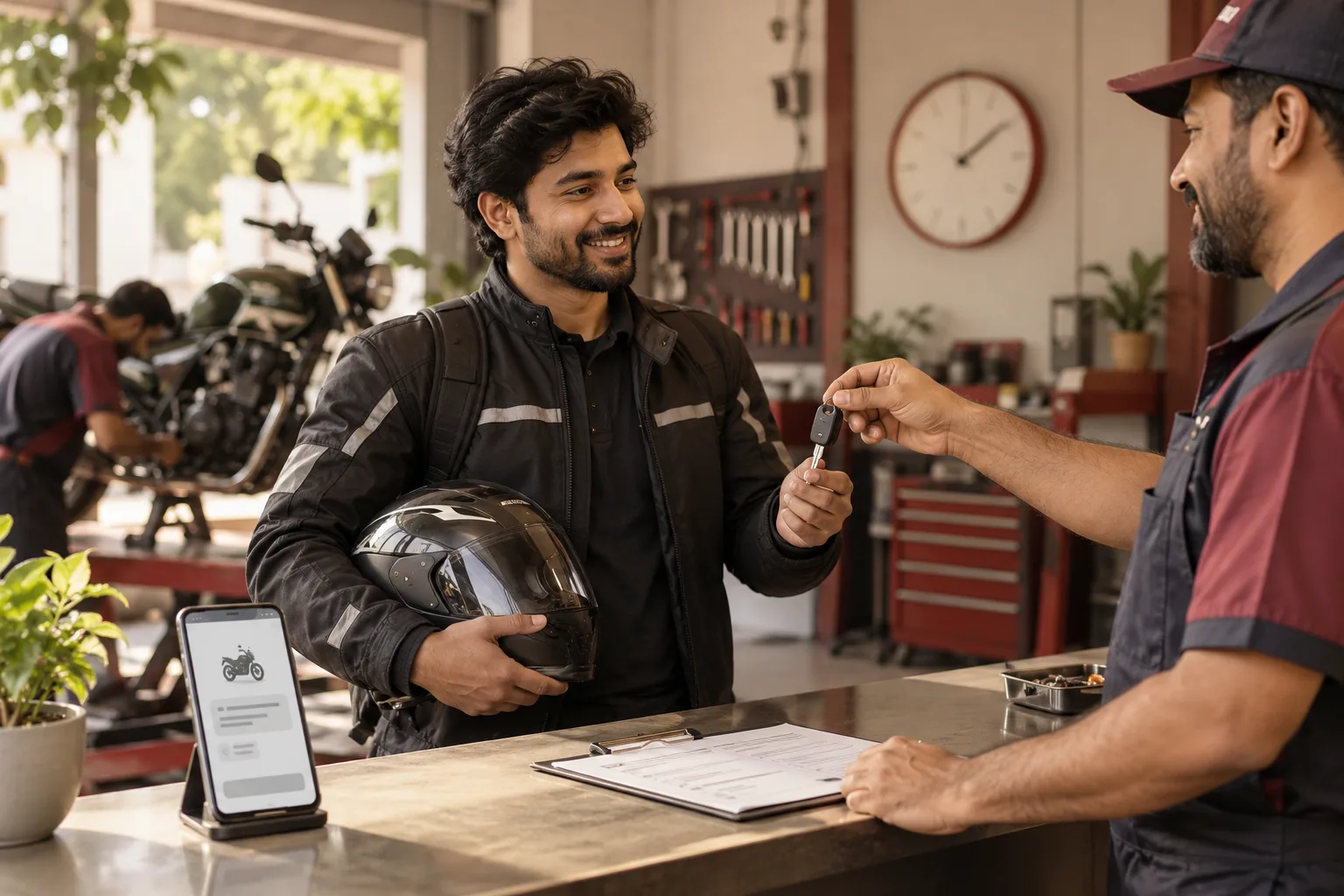 7 min read · 14 May 2026How bike workshops get riders to returnRiders return when the bill matches the estimate, the bike is ready on time and a message quotes the last reading. How a workshop builds that.
More for two-wheeler service centres
Related work to consider.
Closest to this: leads and follow-up
Also for two-wheeler service centres
Or start from the overview: sales and marketing for two-wheeler service centres.
Your next practical step
Tell us what you are trying to grow, and we will read it before we call.
Eight short steps, mostly taps. Skip anything you would rather answer on the call.