Two-wheeler service centres · Customer retention
Find out how many riders came back, from the job cards you already keep.
Customer retention for a two-wheeler service centre is bringing riders back for the next service, the tyre change and the repair after that. GullySales works out from your job cards who returned and who did not, then builds the reminder and the win-back call around them.
Scope, fee, reporting and term are agreed in writing after we have read your brief and spoken to you.

What customer retention means
Customer retention is keeping an existing customer buying again rather than losing them to a competitor after the first purchase, usually cheaper than winning a new customer. GullySales sets a routine of check-ins and renewal reminders aimed at customers before they show signs of leaving.
Also for two-wheeler service centres
- Referral marketing for two-wheeler service centres
- SEO for two-wheeler service centres
- Local SEO for two-wheeler service centres
- Reputation management for two-wheeler service centres
- WhatsApp marketing for two-wheeler service centres
- Review generation for two-wheeler service centres
- Follow-up systems for two-wheeler service centres
- Content marketing for two-wheeler service centres
Sales and marketing for two-wheeler service centres, the overview.
Last updated 14 Nov 2026.
For two-wheeler service centres
Where it usually goes wrong, and what we would do.
“A breakdown brings a rider who is never contacted again”
A puncture or a breakdown brings a rider who did not know you. Without a record and a follow-up, the rider never comes back for the service.
“Nobody works out the next service date”
The job card carries the date and the odometer reading, but the due date is never worked out, so no reminder is ever sent.
“The rider who stopped coming is noticed by accident”
A regular who has not been seen for a year is spotted only when somebody remembers them. By then they have a new workshop and a new habit.
What we do
What we deliver for two-wheeler service centres.
The work available for this need. We agree the deliverables and responsibilities for your engagement in writing.
A return register built from job cards
One line per rider and bike: name, number, bike, date of each visit, odometer reading and work done, typed from the job cards you hold.
Result: You can see who has come back and who has not.
A next-due date for each bike
An estimate worked out from the last reading and date, marked as an estimate and corrected when the rider says otherwise.
Result: A reminder can go out before the bike rattles.
A list of lapsed riders
Riders whose next service is overdue by a margin you set from your own records.
Result: The calls go to the right people.
A win-back call script
A short call that asks how the bike is running and whether anything went wrong last time, with a place to record the answer.
Result: You learn why riders left.
A split by first job
Riders grouped by what first brought them, periodic service, puncture, accident repair or parts, and compared for repeat visits.
Result: You see which first job leads to a regular.
A report against the baseline
Repeat riders, lapsed riders called and riders who returned, set beside the baseline recorded before the work began.
Result: You can tell whether more riders are coming back.
How the result is measured
- Retention rate
- Repeat purchase rate
- Customers won back
Recorded as a baseline before work starts, so every later report has an honest comparison.
Work it out from your records
A few counts from your job cards will show who comes back and who does not.
- Count the riders, not the jobs
- From a year of job cards, list each rider once against the bike number. Several jobs on one bike are one rider. This is your base, so settle it before anything else.
- Mark who came back at least once
- Beside each rider, mark whether there is a second visit after the first. Divide the riders with a second visit by all riders. Keep the answer as your own fraction, not a figure from elsewhere.
- Split by the first job
- Group riders by what brought them first: periodic service, puncture, accident repair or a part. Compare how many in each group returned. The group that rarely returns is where a reminder is missing.
- Find the gap between visits
- For riders who did return, compare the days between visits and the odometer readings. This shows your own service rhythm, and when a reminder should go out.
- List the lapsed riders
- A lapsed rider is one whose next service is overdue by a margin you choose. List them with the last job and the bike. These are riders for a call, not a mass message.
Who it is for
This is written for these two-wheeler service centres.
- Independent two-wheeler workshops
- Multi-brand service centres
- Authorised service centres
- Workshops specialising in scooters
- Performance and customisation workshops
- Doorstep and pick-up service providers
- Electric two-wheeler service and battery specialists
- Workshops serving delivery riders and fleet owners
Before you decide
When this may not be the right fit.
- Your job cards do not record the rider's number or the odometer reading, so there is nothing to count riders from yet
- You have one year of cards in a drawer and no time to type them into a sheet, so the count would be a guess
Before you decide
Agree the work. Know how to judge it.
Customer retention for two-wheeler service centres: use these checks to prepare, choose the scope, and review what changes.
Bring the right evidence
Review repeat orders, inactive customers, and reasons for leaving. Separate a normal buying interval from a customer who stopped because of an unresolved problem.
Make the scope clear
Choose the customer group and the reason to contact them. Agree how complaints, renewal decisions, and additional offers are handled, including when a sales message is inappropriate.
Check the work in use
Track the response through to a retained or repeat order, with discounts and service costs visible. Record why the customer returned rather than crediting every repeat purchase to the campaign.
Know when to change course
If customers leave because delivery is unreliable, fix that before offering a loyalty reward. Repeated promotions can hide the cause without improving the experience.
These are discussion points, not a fixed package. GullySales confirms the deliverables, responsibilities, fee, and term in writing after reading your brief and speaking with you.
Before we start
What to have ready before the work starts.
The records, access and decisions this work needs from two-wheeler service centres. Anything missing is noted in the written scope, with who will supply it.
- Job cards for at least two seasons
- A run covering the monsoon and the festival season shows when your riders really return. Cards may be paper or photographed. With less than that, we can build a register but cannot tell a lapsed rider from one who simply comes at a different time of year.
- Odometer readings written on the cards
- Next-due dates depend on the reading noted at the last visit. Where the card has none, we mark the bike as unknown and ask at the next visit. If readings were never recorded, the first stretch of work is simply getting the counter to write them.
- The manufacturer's service intervals you follow
- Tell us which interval you use for each model: the first free service, the routine services after it. We do not guess. A reminder sent for the wrong interval teaches riders to ignore messages, so any model you are unsure about waits until you confirm.
- A decision on who may call riders
- Choose the person who phones lapsed riders and confirm they have the time. Calls made by someone rushed read as a sales push. If no one has time, we reduce the list to the riders worth ringing first rather than send a thin message to all.
- Your view of why riders left
- Write down the three reasons you think riders stopped coming: price, delay, a bad job, a move. Your instinct frames the call script. If you cannot say, we begin the calls as plain enquiries about how the bike is running, and record what riders say.
How it works
How the customer retention work runs
The work itself, in order. How an engagement starts, from your brief to a written scope, is set out on our method page.
- 1
Copy job cards into one register
We take the job cards you hold and enter them into a single register with the rider, the bike, the date and the work done. You tell us how far back the cards go and where the gaps are. The register is rough at first and tidied as we go, and it shows who has actually returned.
- 2
Work out each bike's next service date
From the last job and the odometer reading on the card, we write the date or the reading at which each bike is next due, according to the manufacturer's own interval for that model. You confirm the intervals you follow. Bikes with no reading are marked so the counter asks at the next visit.
- 3
Mark the riders who stopped coming
We list riders whose bikes are past due with no visit recorded, and ask you to agree the line between a long gap and a lapse. Riders known to have sold the bike or moved away are crossed out. The remaining names are the people the workshop could have served, and did not.
- 4
Write the call a lapsed rider hears
We draft a short, honest call for the person who phones, based on the last job and the reason the rider might have left. You choose who calls, since a regular's mechanic may do it best. The script has no discount, no pressure and a clear way for the rider to say no.
- 5
Split returns by first job
We sort returning riders by the first thing they came for: a puncture, a breakdown, a routine service. You see which first jobs lead to a second visit and which do not. That tells you where a better handover or a reminder will matter, and where it will not.
- 6
Compare the register with the starting count
We count how many riders returned for a second and third visit and set it against the count taken before reminders began. You tell us which returns came from a call and which would have happened anyway. The figures stay in the register, in the workshop's own terms of repeat visits.
Where this fits
Three pieces of sales work, in this order.
This work sits inside sales process design, at stage 7, after the sale. The audit comes before it, and sales management keeps it running.
Step 1
Sales audit
Find where deals are being lost and what to fix first.
Start here if you cannot say where orders are lost.
Step 2 · you are here
Sales process design
One written way to sell, from first enquiry to repeat order.
Start here if every salesperson sells differently.
Step 3
Sales management
A target, a review routine and someone who owns the number.
Start here if the team has targets and no routine.
FAQ
Questions owners ask before they call.
Not here? More answers, or ask on WhatsApp.
When does a rider count as lapsed?
What do we say to a rider who stopped coming?
Who should make the calls?
Is a paper job-card register enough to start?
Is it right to call a rider who left on bad terms?
Do we offer a discount to win a rider back?
How much does it cost?
How long is the contract?
How soon will we see results?
Who will actually do the work?
From the blog
Further reading for two-wheeler service centres.
 6 min read · 6 Oct 2026How buyers choose a showroom, workshop or parts counterCar, bike, repair and parts buyers send one enquiry to several sellers and pick the first clear answer. See what each buyer checks and where you lose them.
 5 min read · 6 Oct 2026How a two-wheeler workshop takes the first callThe first call from a rider decides whether the bike comes in. The questions to ask, what to write down and what to say about price on the phone.
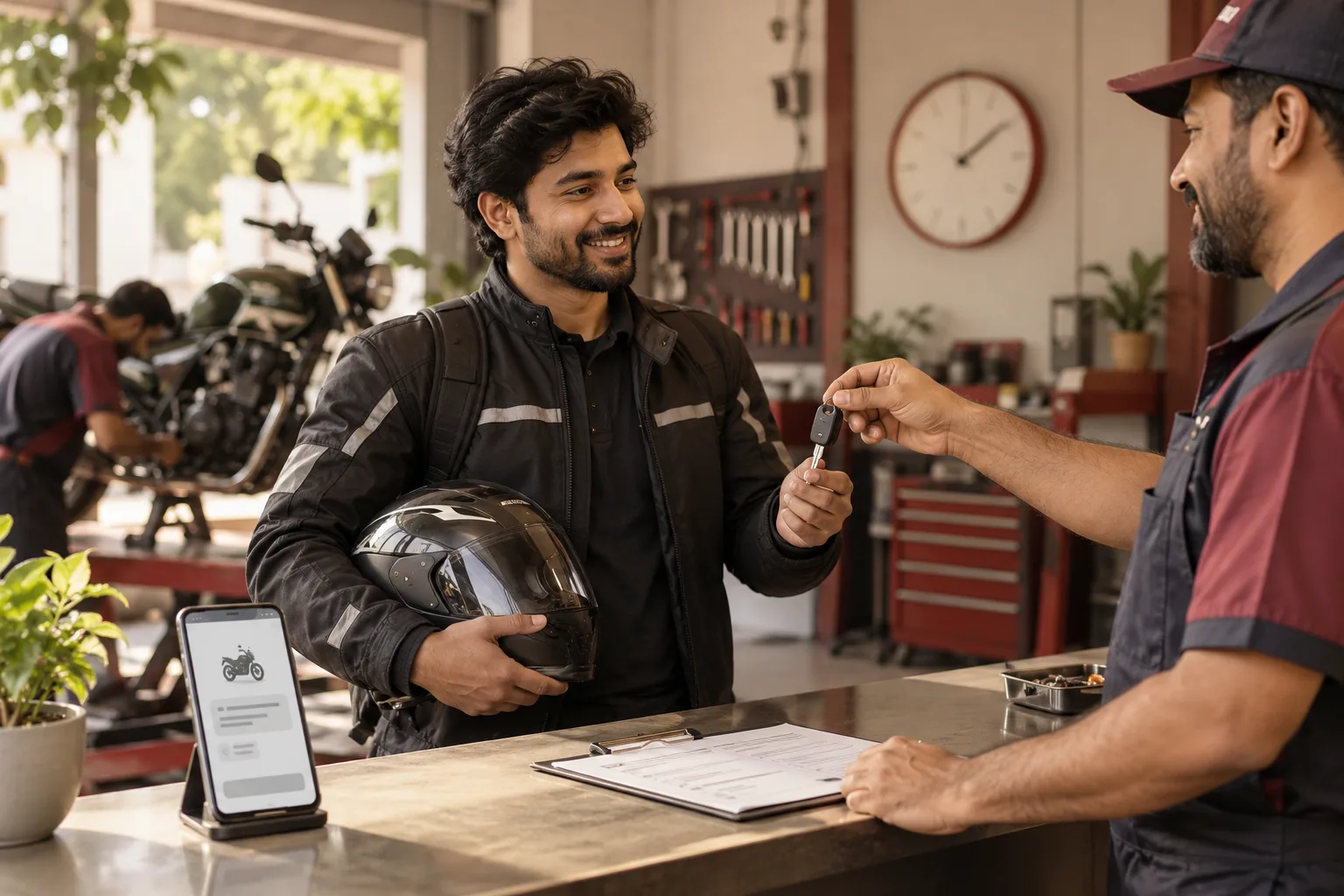 7 min read · 14 May 2026How bike workshops get riders to returnRiders return when the bill matches the estimate, the bike is ready on time and a message quotes the last reading. How a workshop builds that.
More for two-wheeler service centres
Related work to consider.
Closest to this: customers after the sale
Also for two-wheeler service centres
Or start from the overview: sales and marketing for two-wheeler service centres.
Your next practical step
Tell us what you are trying to grow, and we will read it before we call.
Eight short steps, mostly taps. Skip anything you would rather answer on the call.