Two-wheeler service centres · Local SEO
Show up on the map when a rider nearby needs a mechanic.
Local SEO for a two-wheeler service centre decides whether your workshop appears on Google Maps when a rider searches close to where they are. GullySales sets up and corrects the listing, the categories, the opening hours and the reviews that Maps looks at.
Scope, fee, reporting and term are agreed in writing after we have read your brief and spoken to you.

What local SEO means
Local SEO is the work of making your business show up for searches that name your town or locality, such as a service plus an area name. GullySales sets up locality pages, local citations and map listings so nearby customers find you before a competitor across town.
Also for two-wheeler service centres
- SEO for two-wheeler service centres
- Website development for two-wheeler service centres
- Reputation management for two-wheeler service centres
- WhatsApp marketing for two-wheeler service centres
- Review generation for two-wheeler service centres
- Customer retention for two-wheeler service centres
- Follow-up systems for two-wheeler service centres
- Referral marketing for two-wheeler service centres
Sales and marketing for two-wheeler service centres, the overview.
Last updated 14 Nov 2026.
For two-wheeler service centres
Where it usually goes wrong, and what we would do.
“The rider wants a workshop that is open now”
A search made at seven in the evening or on a Sunday goes to whichever workshop shows correct hours. A listing that says closed on a day you work loses that rider.
“The wrong category puts you among car garages”
A listing under car repair does not match a search for scooter service. The category and the services list tell Google what you actually do.
“Old listings point riders to the wrong lane”
A previous address or a former partner's phone number still sits on JustDial and in old map entries, so riders arrive at a shut shop or ring a dead number.
What we do
What we deliver for two-wheeler service centres.
The work available for this need. We agree the deliverables and responsibilities for your engagement in writing.
A Business Profile set up for a workshop
The primary category for two-wheeler repair, the services you really offer, the lunch break and the weekly off, and a description that names your lane and landmark.
Result: Maps shows the workshop for the jobs you do.
A photograph list for the workshop
A shot list: the signboard from the road, the front of the shop, the bays, the parts shelf and the waiting area, taken in daylight.
Result: A rider can recognise the place before arriving.
Name, address and phone made the same everywhere
One spelling of the workshop name, the lane and the landmark, and one number that is answered, across the Profile, JustDial, Sulekha and the website.
Result: Google finds the same workshop wherever it looks.
Old and duplicate listings found
A search for earlier addresses, spellings and numbers, then a claim or a request to remove each one.
Result: Riders stop arriving at an address you left.
A routine for the call and message buttons
A rule for who picks up the number on the Profile while the team is under bikes, and who returns the missed ones.
Result: Calls from Maps turn into jobs.
A Profile report against the baseline
Calls, direction requests and messages from the Profile, set beside the baseline recorded before the work began.
Result: You can see how many riders the map sends.
How the result is measured
- Map pack ranking
- Local search visibility
- Enquiries by locality
Recorded as a baseline before work starts, so every later report has an honest comparison.
What Google weighs here
Google judges a nearby workshop on a few things, and a workshop can work on each.
- Relevance: do you do what was searched
- Match the category and services to the jobs riders ask for: scooter service, bike repair, puncture, battery, tyre change. Remove any service you do not offer, such as car repair.
- Distance: how near the rider is
- You cannot move the workshop, but you can make the pin exact. Check it sits on your gate and not on the main road, and add the nearest landmark or metro station to the description.
- Prominence: how well known you are
- Reviews with real detail, photographs added over time and mentions on other sites all count. Reply to every review and keep the workshop photographs current.
- Hours that match the day
- Set the regular hours, the lunch break and the weekly off, and special hours for festival days. Check Google's current guidelines on how temporary closures are shown.
- Listings beyond Google
- JustDial, Sulekha and Apple Maps are where some riders look. Claim each one with the same details. Ignore callers who sell paid placement before you have claimed the free listing.
- Name, address and phone, letter by letter
- Compare the Profile, the signboard, the JustDial entry and the website. 'Road' against 'Rd' is minor. An old mobile number, or a shop name that changed, is the mismatch that costs jobs.
Who it is for
This is written for these two-wheeler service centres.
- Independent two-wheeler workshops
- Multi-brand service centres
- Authorised service centres
- Workshops specialising in scooters
- Performance and customisation workshops
- Doorstep and pick-up service providers
- Electric two-wheeler service and battery specialists
- Workshops serving delivery riders and fleet owners
Before you decide
When this may not be the right fit.
- Your workshop has no signboard or fixed address yet, so a listing would send riders to a place they cannot find
- You plan to add a keyword to the business name to rank higher, which the listing rules do not allow
Before you decide
Agree the work. Know how to judge it.
Local SEO for two-wheeler service centres: use these checks to prepare, choose the scope, and review what changes.
Bring the right evidence
Confirm the real business address, service area, contact details, and who controls the business listings. Keep examples of calls that came from the wrong location or asked for a service you do not provide.
Make the scope clear
Choose the locations you actually serve and the information each needs. Agree who approves listing changes, responds to enquiries, and keeps opening hours accurate.
Check the work in use
Check the journey from a local search to a call or enquiry on a phone. The address, service area, and description should agree across your website and listings.
Know when to change course
Do not create an office claim for a place where you only serve customers remotely. Clear service coverage is more useful than a misleading local presence.
These are discussion points, not a fixed package. GullySales confirms the deliverables, responsibilities, fee, and term in writing after reading your brief and speaking with you.
Before we start
What to have ready before the work starts.
The records, access and decisions this work needs from two-wheeler service centres. Anything missing is noted in the written scope, with who will supply it.
- Owner access to the Maps listing
- Whoever created the listing, or a verified owner, must be willing to grant us manager access. If the account belongs to a former partner or an employee who left, recovery has to be settled first. Without it we can advise, but we cannot correct a wrong pin or change opening hours.
- Photographs of the workshop from outside
- A phone camera is enough, provided the board, the lane and the entry are in daylight and the vehicles are not blocking the view. We use them so a rider recognises the place on arrival. Where no recent photographs exist, we plan a short photo visit before anything else is entered.
- The exact opening and closing routine
- Tell us the true hours, the lunch break, the day off and what happens on festival days. A rider who arrives at a shut gate leaves a poor review that outlasts any later correction. If hours change with the season, we agree who updates the listing and how that person is told.
- One working number that someone answers
- Pick the number that will go on the listing and confirm who answers it, including when hands are under a bike. A call that rings out is a lost job. If the owner's personal phone is the only option, we plan a missed-call reply before the number is published.
How it works
How the local SEO work runs
The work itself, in order. How an engagement starts, from your brief to a written scope, is set out on our method page.
- 1
Stand at the gate and photograph it
We ask for photographs taken as a rider would see the workshop on arrival: the board from the main road, the entry lane, the parking spot, the ramp and the waiting corner. We compare them with the pictures on your listing today. You tell us which angle misleads a stranger, and we plan the photograph list from that gap.
- 2
Confirm the owner and the listing
We find every listing that carries your workshop name, including old ones from a former landlord or a previous number, and ask you which are yours. You prove ownership by the route Google offers. We write down which listings are claimed, which are duplicates and which belong to a different shop, so that nothing is deleted by guesswork.
- 3
Match the listing to the board
Your signboard, your job card letterhead and your listing must give the same name, address and number. We lay the three side by side with you and settle the exact spelling, the opening hours including the lunch closure, and the day the workshop is shut. Any rider who calls the number must reach a person who can answer.
- 4
Post photographs and services you can honour
We load the photographs you approved and enter the services you want to be found for, choosing business types that put you among two-wheeler workshops, not car garages. You read the final entries aloud with us. Anything you cannot do on a busy Saturday comes off the list before the listing goes live.
- 5
Count calls from the profile
We take the calls, direction requests and messages recorded by the listing and set them against the figures noted before work began, and against what your counter notebook says. You tell us which riders arrived because of the map. The comparison shows whether the listing is working, and what to correct on it next.
Where this fits
Three pieces of sales work, in this order.
This work sits inside sales process design, at stage 1, prospecting and lead generation. The audit comes before it, and sales management keeps it running.
Step 1
Sales audit
Find where deals are being lost and what to fix first.
Start here if you cannot say where orders are lost.
Step 2 · you are here
Sales process design
One written way to sell, from first enquiry to repeat order.
Start here if every salesperson sells differently.
Step 3
Sales management
A target, a review routine and someone who owns the number.
Start here if the team has targets and no routine.
FAQ
Questions owners ask before they call.
Not here? More answers, or ask on WhatsApp.
We share the premises with another shop. Can we have a listing?
We run two workshops. Does each need a profile?
Can we put 'best bike service' in the business name?
A competitor has put up a fake workshop near us. What can we do?
What if the pin on the map is in the wrong lane?
Can we list a pick-up and drop service on the profile?
How much does it cost?
How long is the contract?
How soon will we see results?
Who will actually do the work?
From the blog
Further reading for two-wheeler service centres.
 6 min read · 6 Oct 2026How buyers choose a showroom, workshop or parts counterCar, bike, repair and parts buyers send one enquiry to several sellers and pick the first clear answer. See what each buyer checks and where you lose them.
 5 min read · 6 Oct 2026How a two-wheeler workshop takes the first callThe first call from a rider decides whether the bike comes in. The questions to ask, what to write down and what to say about price on the phone.
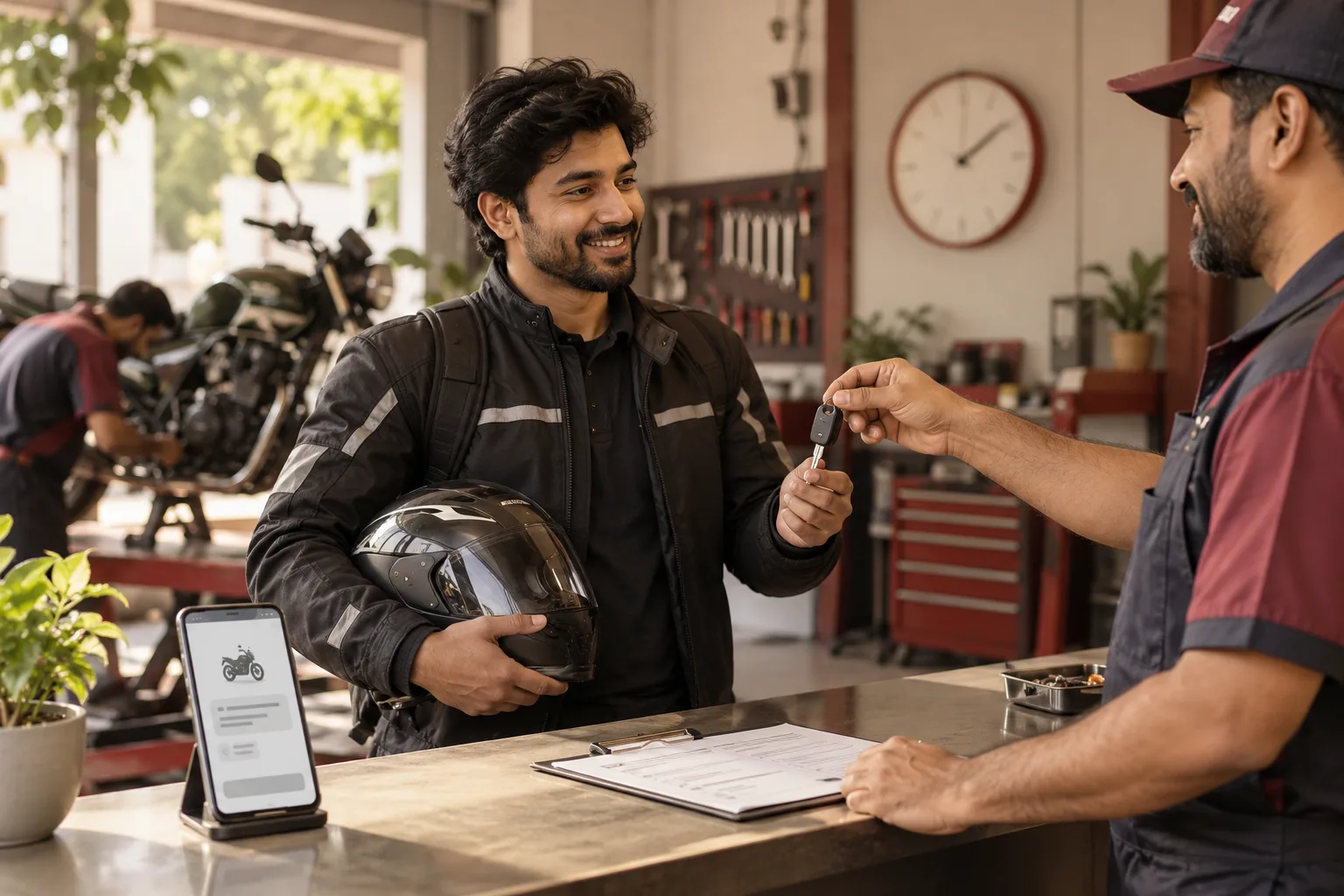 7 min read · 14 May 2026How bike workshops get riders to returnRiders return when the bill matches the estimate, the bike is ready on time and a message quotes the last reading. How a workshop builds that.
More for two-wheeler service centres
Related work to consider.
Closest to this: search and visibility
Also for two-wheeler service centres
- Reputation management for two-wheeler service centres
- WhatsApp marketing for two-wheeler service centres
- Review generation for two-wheeler service centres
- Customer retention for two-wheeler service centres
- Follow-up systems for two-wheeler service centres
- Referral marketing for two-wheeler service centres
Or start from the overview: sales and marketing for two-wheeler service centres.
Your next practical step
Tell us what you are trying to grow, and we will read it before we call.
Eight short steps, mostly taps. Skip anything you would rather answer on the call.