Two-wheeler service centres · Website
A workshop website that shows the address, the hours and what a service includes on one screen.
Website development for a two-wheeler service centre builds a small site that tells a rider where you are, when you are open, what you do and how to book, on a phone. GullySales builds it around the call button and the WhatsApp link, and sets up tracking for both.
Scope, fee, reporting and term are agreed in writing after we have read your brief and spoken to you.

What website means
A website is the page a customer lands on after searching, clicking an advert or scanning a code, and it decides whether they call or leave. GullySales builds and maintains sites that load quickly, explain the offer plainly and make the enquiry form or phone number easy to find.
Also for two-wheeler service centres
- SEO for two-wheeler service centres
- Local SEO for two-wheeler service centres
- Reputation management for two-wheeler service centres
- WhatsApp marketing for two-wheeler service centres
- Review generation for two-wheeler service centres
- Customer retention for two-wheeler service centres
- Follow-up systems for two-wheeler service centres
- Referral marketing for two-wheeler service centres
Sales and marketing for two-wheeler service centres, the overview.
Last updated 14 Nov 2026.
For two-wheeler service centres
Where it usually goes wrong, and what we would do.
“A brochure with no way to book”
A rider on a phone sees a gallery and a paragraph about passion for bikes, then has to hunt for a number.
“Riders on a phone and mobile data”
The site loads slowly, the map is buried and the rider goes back to the search results.
“Services listed without what they include”
Periodic service means nothing to a rider until the page says what is checked.
What we do
What we deliver for two-wheeler service centres.
The work available for this need. We agree the deliverables and responsibilities for your engagement in writing.
A top section that answers the first questions
Address, landmark, map link, opening hours, a call button and a WhatsApp link, all on the first screen of a phone.
Result: A rider finds you and reaches you in one tap.
A page for each main job
Periodic service, brakes, chain and clutch, battery, puncture and tyre, each saying what is done and what the rider should bring.
Result: The rider sees what they will get.
A booking path
A call button, a WhatsApp link with the message already typed, and a short form asking bike model, registration number and the problem.
Result: A rider can book without a phone call.
A page showing the workshop
Photographs of your own bays, the parts shelf and your team at work, taken with their agreement.
Result: Riders recognise a real workshop.
Tracking for calls and messages
Call and WhatsApp clicks and form submissions counted, so you know how many riders the site sends.
Result: You can tell whether the site works.
Domain and hosting in your name
The domain and the hosting registered to you, with the login held by you.
Result: The site is yours to move.
How the result is measured
- Page load time
- Bounce rate
- Enquiries from the website
Recorded as a baseline before work starts, so every later report has an honest comparison.
What the page must show
A rider looks for a few things on a workshop's site, and each should be easy to find.
- Address, landmark and map pin
- Put the full address, the nearest landmark and a map link in the top section. A rider on a phone, unsure of the lane, should reach the pin in one tap.
- Hours, weekly off and festival closures
- State the working hours, the lunch break, the weekly off and festival closures where a rider sees them. A rider who finds a shut shutter does not come back.
- What each service includes
- Say what is checked in a periodic service, what a brake job covers and what is charged extra. Riders compare this with the authorised centre before they call.
- How to book
- A call button, a WhatsApp link with 'Service for my bike' typed in, and a short form asking only model, number and problem. Check where each one reaches and who answers.
- Parts and brands you fit
- Name the oil, filters and parts brands you use, and say plainly where you offer an alternative to the original. Riders ask this first, and an honest list answers it.
- Photographs of your own bays
- Use photographs of your workshop, your mechanics at work and a finished job, with their permission. Stock photographs of someone else's garage lose a rider's trust.
Who it is for
This is written for these two-wheeler service centres.
- Independent two-wheeler workshops
- Multi-brand service centres
- Authorised service centres
- Workshops specialising in scooters
- Performance and customisation workshops
- Doorstep and pick-up service providers
- Electric two-wheeler service and battery specialists
- Workshops serving delivery riders and fleet owners
Before you decide
When this may not be the right fit.
- You do not yet have a number that someone answers during work hours, so a site with a call button would add to the missed calls
- The old site's domain is in a former builder's name and you cannot reach them, so sort that out before a new build
Before you decide
Agree the work. Know how to judge it.
Website development for two-wheeler service centres: use these checks to prepare, choose the scope, and review what changes.
Bring the right evidence
List the pages that support a buying decision and the actions visitors must complete. Keep examples of failed forms, unclear product information, and questions your team answers repeatedly.
Make the scope clear
Agree the page list, content ownership, integrations, and who controls the domain and hosting. Include redirects and existing search traffic in a redesign brief, before changing addresses.
Check the work in use
Complete a real enquiry journey on a phone and a laptop. Check that the confirmation appears, the enquiry reaches the right person, and tracking records the action once.
Know when to change course
If visitors can enquire but the team does not follow up, start with the sales handover. A larger website will not resolve that delay.
These are discussion points, not a fixed package. GullySales confirms the deliverables, responsibilities, fee, and term in writing after reading your brief and speaking with you.
Before we start
What to have ready before the work starts.
The records, access and decisions this work needs from two-wheeler service centres. Anything missing is noted in the written scope, with who will supply it.
- The domain and hosting login
- The domain must be registered in the workshop's name, with the login in the owner's hands. If an earlier agency or friend holds it, we help you recover it first. Without control of the domain, we cannot connect the new site, and you risk losing the address riders know.
- Photographs of the bay and the team
- Recent photographs of the workshop, taken in daylight, are the base of the page. Failing that, we arrange a visit to photograph the workshop. Stock pictures of unrelated garages mislead a rider who arrives at a different place, so we do not use them.
- The list of services and what each includes
- Write each main job with what is checked and what is optional. The page must match what the counter says. If the list is unclear, we draft it with your lead mechanic, and the site waits for that conversation.
- The workshop's true address and landmark
- Give the exact address, the nearest landmark and the way in from the main road. Wrong directions cost a visit. If your address has changed in the past, tell us, since old listings may still point to the earlier place.
- Someone to read the booking messages
- Name the person who reads bookings and replies. A form that goes to an unread inbox is worse than no form. If no one can be named, we replace the form with a call and message button that reach a phone someone carries.
How it works
How the website work runs
The work itself, in order. How an engagement starts, from your brief to a written scope, is set out on our method page.
- 1
Open the phone and search for the workshop
We begin with the screen a rider sees, on a mid-range phone and mobile data, searching for the workshop by name and by the job. You watch with us. We note what appears, what a rider can learn without scrolling and what is missing. The starting figures for calls and messages from the old site are taken in the same sitting.
- 2
Decide the first screen with the owner
The top of the page must give the address, the hours, a call button and a plain description of what a service includes. We show you rough versions and you choose one. The decision is yours, because only you know which question riders ask first and what answer you can honour.
- 3
Photograph the workshop for the page
We plan a short list of photographs: the board, the ramp, the waiting corner, the mechanics at work. You decide who may appear and arrange the day. Where the workshop is dim or cluttered, we ask that it be tidied first, so the picture shows the place as it is on a good day.
- 4
Write a page for each main job
Each main job gets a page with what is checked, what is replaced only with approval and what the estimate shows. Your lead mechanic reads each page. You supply the parts policy, because the page must match the counter. Pages for jobs you rarely do are left out.
- 5
Build the booking route and test it
We set up the booking form or the message button, and you test it by booking a service yourself. The enquiry must arrive where someone will read it. If the person who reads it is away, the page tells the rider when to expect a reply, in plain words with no fixed time promised.
- 6
Read calls and bookings against the old figures
After the site has run through a few busy periods, we compare calls, messages and bookings with the starting figures taken from the old site. You tell us which riders mentioned the site. We count what the workshop can verify at its counter, and revise the pages that bring nothing.
Where this fits
Three pieces of sales work, in this order.
This work sits inside sales process design, at stage 1, prospecting and lead generation. The audit comes before it, and sales management keeps it running.
Step 1
Sales audit
Find where deals are being lost and what to fix first.
Start here if you cannot say where orders are lost.
Step 2 · you are here
Sales process design
One written way to sell, from first enquiry to repeat order.
Start here if every salesperson sells differently.
Step 3
Sales management
A target, a review routine and someone who owns the number.
Start here if the team has targets and no routine.
FAQ
Questions owners ask before they call.
Not here? More answers, or ask on WhatsApp.
Do we need a site if we have a Google Business Profile?
Should the site be in Kannada or Hindi as well?
Why does the site have to load fast on a phone?
The agency that built our old site registered the domain. What now?
Can we edit the site ourselves afterwards?
How do we know if the site is bringing riders?
How much does it cost?
How long is the contract?
How soon will we see results?
Who will actually do the work?
From the blog
Further reading for two-wheeler service centres.
 6 min read · 6 Oct 2026How buyers choose a showroom, workshop or parts counterCar, bike, repair and parts buyers send one enquiry to several sellers and pick the first clear answer. See what each buyer checks and where you lose them.
 5 min read · 6 Oct 2026How a two-wheeler workshop takes the first callThe first call from a rider decides whether the bike comes in. The questions to ask, what to write down and what to say about price on the phone.
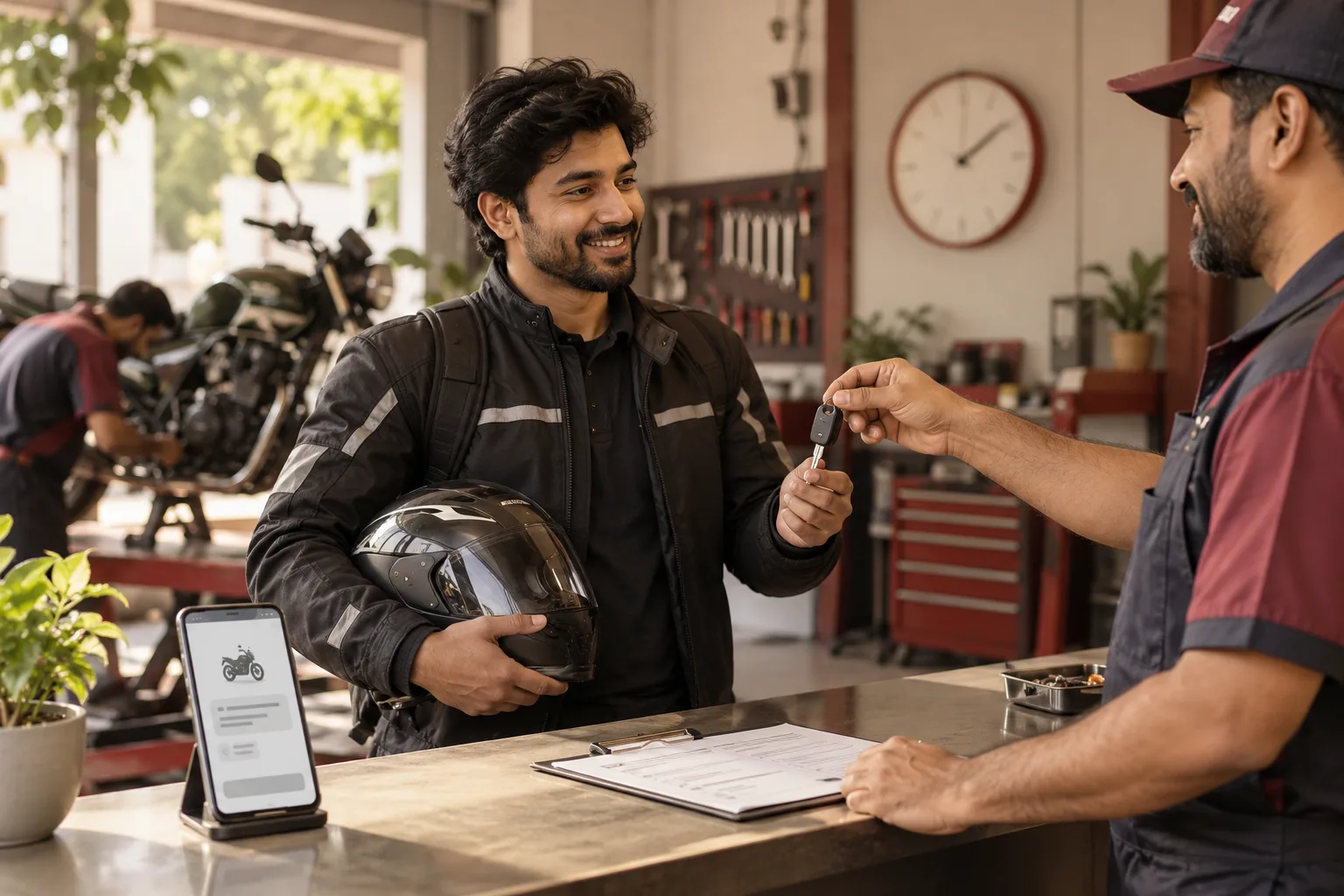 7 min read · 14 May 2026How bike workshops get riders to returnRiders return when the bill matches the estimate, the bike is ready on time and a message quotes the last reading. How a workshop builds that.
More for two-wheeler service centres
Related work to consider.
Closest to this: search and visibility
Also for two-wheeler service centres
- Reputation management for two-wheeler service centres
- WhatsApp marketing for two-wheeler service centres
- Review generation for two-wheeler service centres
- Customer retention for two-wheeler service centres
- Follow-up systems for two-wheeler service centres
- Referral marketing for two-wheeler service centres
Or start from the overview: sales and marketing for two-wheeler service centres.
Your next practical step
Tell us what you are trying to grow, and we will read it before we call.
Eight short steps, mostly taps. Skip anything you would rather answer on the call.