Hospitals · Review generation
Ask at discharge, and never write the review for the patient.
Review generation for a hospital is getting patients and families to write publicly about their experience: the moment of the ask, the person who asks, and the words used. Rules on medical advertising and patient testimonials restrict what a hospital may then do with it. GullySales sets up the ask and keeps its use inside what your compliance adviser allows.
Scope, fee, reporting and term are agreed in writing after we have read your brief and spoken to you.

What review generation means
In a clinic or practice a review is a public statement by a patient, and asking for one is restricted or unwise in several regulated professions. Review generation here is proof that does not depend on a patient writing in public: the professional listing kept accurate, the note back to the referring doctor, and a reply that never confirms somebody was a patient. GullySales sets that up and tracks what arrives without soliciting it.
Last updated 5 Oct 2026. Rules for this trade differ by state and professional body, and they change. We describe restrictions in general terms, so check the current position with your own council or adviser before you publish anything.
For hospitals
Where it usually goes wrong, and what we would do.
“The rules on testimonials are not the ones other trades follow”
Medical advertising and professional conduct rules restrict outcome claims and the use of patient testimonials, the position is not identical across states and councils, and it is revised. Put your wording to your medical director before it goes on a wall.
“Discharge is the moment, and the treating staff are the wrong askers”
A patient leaving after a good stay will write something. The ask belongs with the discharge desk or a patient relations coordinator, so nobody feels their care depended on agreeing.
“A review about the wait and the billing counter is still useful”
Families read about parking, the wait for a scan, the attitude at the counter and whether the estimate held. Those are the things a review may safely describe, and they are exactly what the next family wants to know.
What we do
What we deliver for hospitals.
Every deliverable, what it covers for you, and the result it is there to produce. Nothing here is an extra.
An ask at discharge, in wording your adviser has seen
Who asks, at what point in the discharge, and a form of words that stays clear of outcome claims and treatment advice.
Result: The ask is consistent and defensible.
A review link that opens in one tap
A short link and a printed code at the discharge desk and the billing counter, pointing at your Google Business Profile.
Result: Nobody willing is lost in a search.
Prompts about experience rather than outcome
Questions about admission, the wait, how things were explained and how billing went, sent with the link.
Result: Reviews describe what the hospital controls.
A written policy on what may be republished
What can go on the website, what needs written consent, and what should not be used at all, checked with your compliance adviser.
Result: Nobody puts a patient's words up without authority.
A reply routine for a complaint left in public
Who answers, within what limits, and how the conversation moves to a phone call without any treatment being discussed in public.
Result: A bad review gets a professional answer rather than a defence.
Reviews counted by department
New reviews sorted so maternity, orthopaedics and emergency each build their own proof, against the baseline recorded before the work starts.
Result: A family choosing a department finds reviews about it.
How the result is measured
- Reviews received
- Average rating
- Response rate to requests
Recorded as a baseline before work starts, so every later report has an honest comparison.
Asking patients for reviews
Ask at the discharge desk about the experience of the stay, and never about the outcome of the treatment.
- Discharge desk, not the ward
- A patient relations executive asks once the bill is settled and the family is leaving. Doctors and nurses asking at the bedside would put the patient under pressure.
- The person who handled admission and billing
- Ask the adult patient or the family member who dealt with admission and the bill. Never ask after an ICU stay, a bereavement or a family dispute.
- Wording about the experience
- Suggest the review mention admission, the waiting time, the room's cleanliness, how staff explained things and the billing counter. Treatment and results stay out.
- Outpatient and day-care visits
- A day-care procedure or an outpatient visit ends with a clear moment, the discharge slip, and an easy link to scan. Inpatient stays with complications are left alone.
- The compliance adviser reads the wording
- Your compliance adviser or the medical superintendent reads the request text once. Rules on advertising and patient testimonials differ by state and body, so check them before use.
- Replies that give nothing away
- Reply to a public complaint in general terms, never confirming that the person was admitted or naming a doctor, and invite them to contact the patient relations desk.
Who it is for
This is written for these hospitals.
- Multi-speciality hospitals
- Single-speciality hospitals, maternity, orthopaedic or eye
- Nursing homes
- Day-care surgery centres
- Corporate hospital chains with several branches
- Diagnostic-centre-led hospitals
- Hospitals attached to medical colleges
- Government-empanelled private hospitals
Not for
It is not the right fit if.
- Patient complaints about billing and waiting are unresolved, and a request for reviews would invite them in public.
- You plan to offer a gift or a discount for a review, which is not an acceptable way to collect one.
- The treating staff are the ones asked to request reviews, which puts the patient in an awkward position at discharge.
How it works
How the review generation work runs
The work itself, in order. How an engagement starts, from your brief to a written scope, is set out on our method page.
- 1
Find the moment to ask
We walk through one customer's visit with you and pick the point where the job is done and the customer is still in front of you or holding the phone.
- 2
Read your current reviews
We read every review you have, count how many were answered, and note what customers praise in their own words. We also check that your name, address and phone on Google match your signboard.
- 3
Set up the ask
Link, QR code, message wording and a short briefing for the team. We write down what staff must never do: offer a discount, choose who to ask, or post a review themselves.
- 4
Answer every review
Each incoming review is answered by the routine set down in writing. A complaint is answered by the person who can fix it, with your approval where you want it.
- 5
Count and adjust
We count how many customers were asked and how many reviewed. If few reply, we move the moment or the person asking before touching the wording.
Proof
What happened when owners fixed this.
Real clients, the work we did, and the result as it was recorded. Where no number was recorded, none is claimed.
Chord Road Hospital
- Situation
- Patients who knew the hospital trusted it. Patients who searched for a department or a treatment in the area did not find it.
- What we did
- Website rebuilt around patient needs
- Search visibility
- Social media on a schedule
- Review management
- Result
- Organic traffic increased 60% within six months
- Online appointment bookings increased 40%
- Social following grew 45%, and engagement on it rose 70%
Nanda Arthritis and Rheumatology Center
- Situation
- There was no website, so a patient looking for a rheumatologist had no way to learn about the centre. Enquiries were few, and the ones that arrived came by word of mouth.
- What we did
- A website for patients
- Search work
- Google Business and reviews
- Lead capture and advertising
- Result
- No numbers were recorded for this engagement. The work is described in full in the case study.
Also worked with
Curtain Label · Difesa Security Services · Felicity Inn · Hands On CSR · Implevista · Kambar Group · Kalessi · Kerur Pain Clinic · LL Trust · Lucky Deals · Natural Gases · NavaShakthi Souhardha · NewCom Logistics · Proton Technical Services · SB Engineering · Shakthi Foundation · Shakthi Group · Urbanest · Insyde Studio · Venkateshwara Laser Tech · Vivara Studios
Where this fits
Three pieces of sales work, in this order.
This work sits inside sales process design, at stage 7, after the sale. The audit comes before it, and sales management keeps it running.
Step 1
Sales audit
Find where deals are being lost and what to fix first.
Start here if you cannot say where orders are lost.
Step 2 · you are here
Sales process design
One written way to sell, from first enquiry to repeat order.
Start here if every salesperson sells differently.
Step 3
Sales management
A target, a review routine and someone who owns the number.
Start here if the team has targets and no routine.
FAQ
Questions owners ask before they call.
Not here? More answers, or ask on WhatsApp.
Are we allowed to publish patient testimonials?
Should we give an incentive for a review?
Many of our patients are not comfortable in English. How do we ask?
Should we ask for reviews on Google and a doctor directory like Practo?
How much does it cost?
How long is the contract?
How soon will we see results?
Who will actually do the work?
What do you need from us?
What if we are not happy with the work?
From the blog
Further reading for hospitals.
 6 min read · 6 Oct 2026What healthcare buyers check before they choose youA patient, a referring doctor and a hospital purchase team each check something different before choosing a provider. This post lists what each one looks at and where a clinic, lab or supplier loses them.
 8 min read · 21 Sept 2026How to advertise to Gen XThe forty-five to sixty year old Indian buyer researches online and then rings you. Age is the one thing you can actually buy on a platform, and on its own it tells you almost nothing.
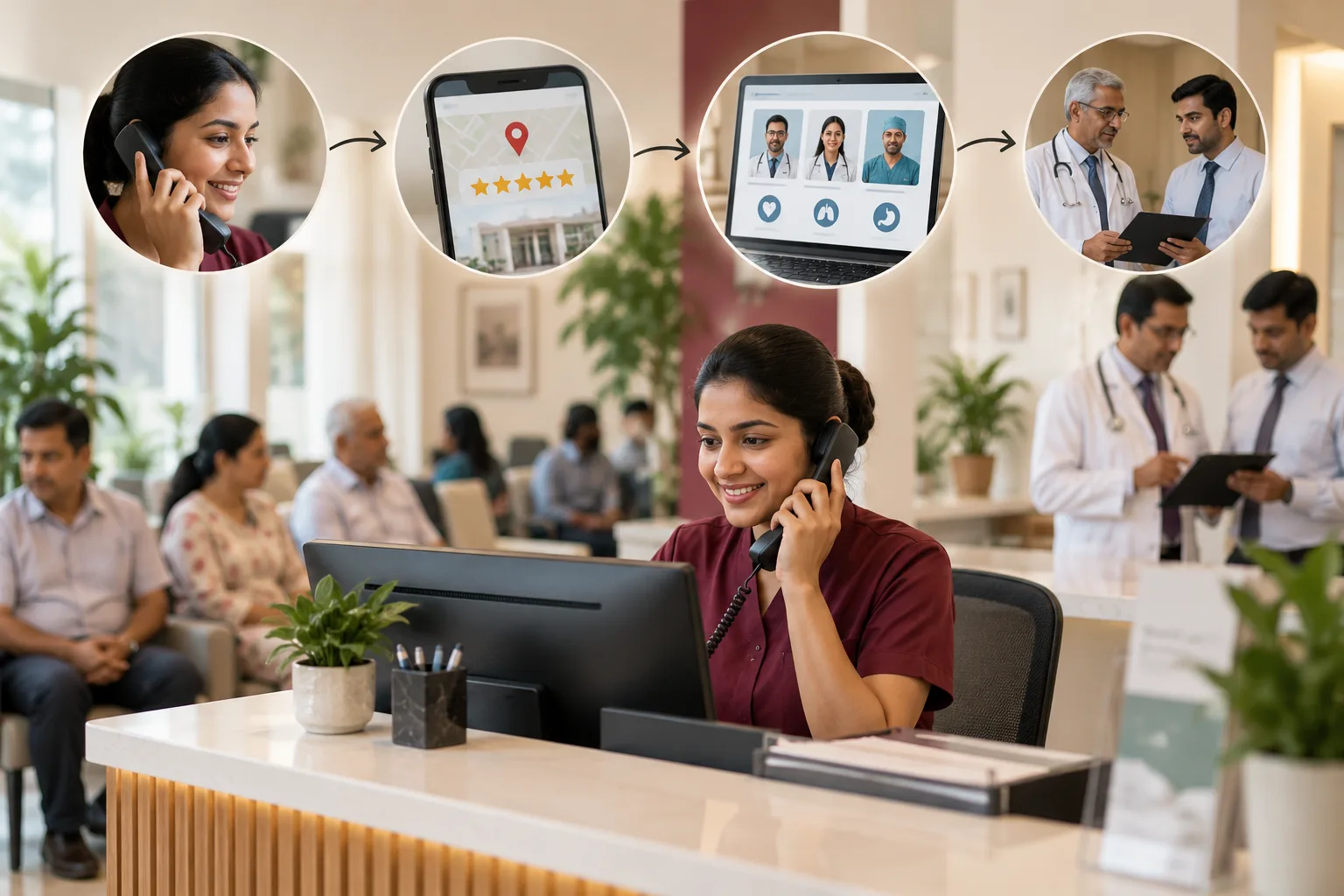 7 min read · 7 Jul 2026How to increase OPD patients: a practical plan for hospitals and clinicsMore OPD patients come from answering every call, a Maps profile with fresh reviews, a page per speciality and doctors who refer to you. The order of work that fills the outpatient desk.
More for hospitals
Everything else we would do for you.
Closest to this: reputation
Also for hospitals
Or start from the overview: sales and marketing for hospitals.
Your next practical step
Tell us what you are trying to grow, and we will read it before we call.
Eight short steps, mostly taps. Skip anything you would rather answer on the call.