Real estate developers and brokers · Review generation
A buyer reads about your last project before visiting this one.
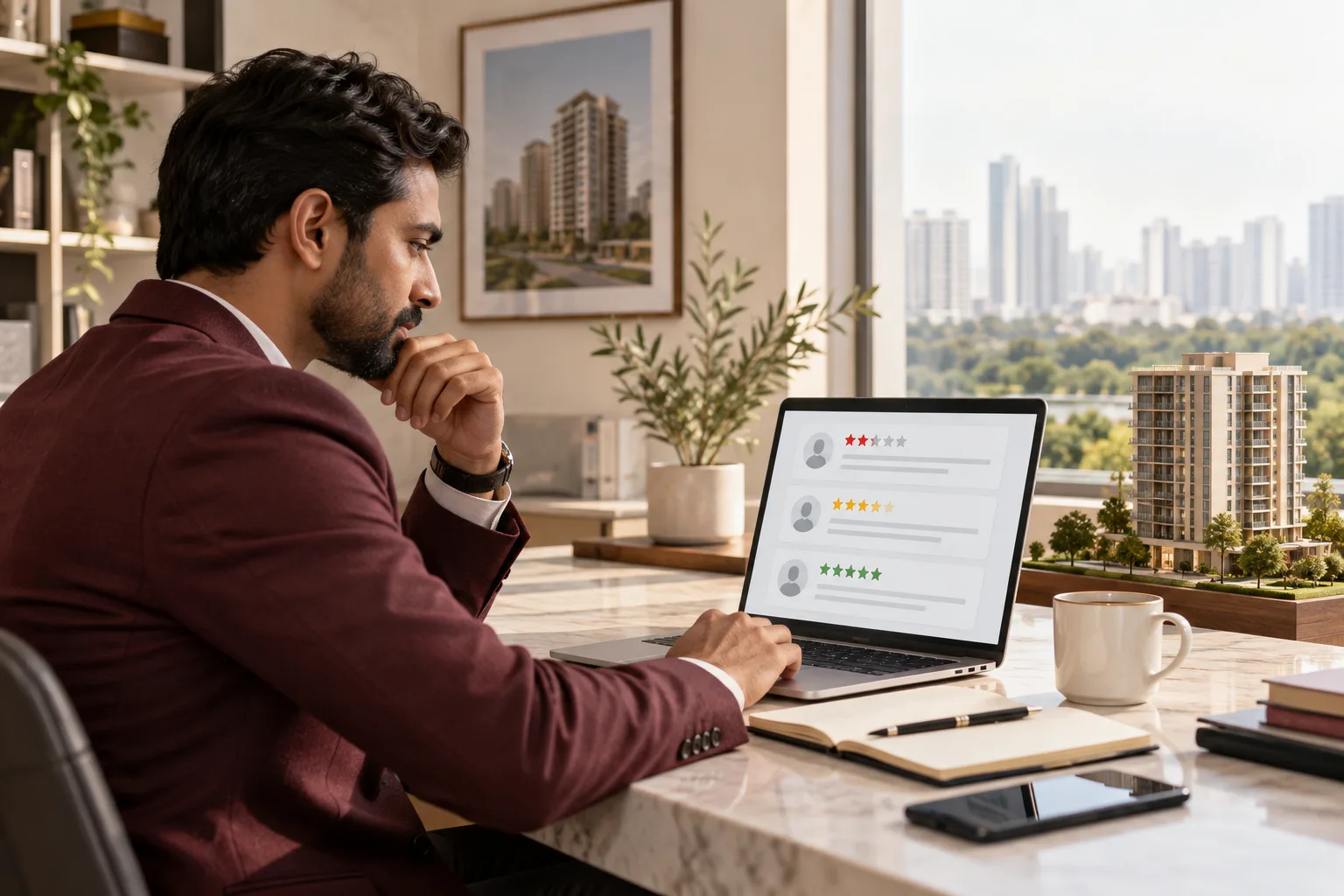
Review generation in real estate is asking buyers and residents to write publicly, at moments that are not the middle of a possession argument. Reviews carry unusual weight here because the purchase is large and cannot be undone. GullySales fixes who asks, when, and how a hard review gets answered.
Scope, fee, reporting and term are agreed in writing after we have read your brief and spoken to you.

What review generation means
Review generation is the routine of asking satisfied customers to leave a Google or platform review at the moment they are happiest, rather than hoping they remember later. GullySales builds the request into your existing follow-up steps and tracks how many turn into a review.
Also for real estate developers and brokers
- Reputation management for real estate developers and brokers
- Cinema advertising for real estate developers and brokers
- Newspaper advertising for real estate developers and brokers
- Outdoor advertising for real estate developers and brokers
- Radio advertising for real estate developers and brokers
- SEO for real estate developers and brokers
- PPC ads for real estate developers and brokers
- Lead generation for real estate developers and brokers
Sales and marketing for real estate developers and brokers, the overview.
Last updated 5 Oct 2026. Rules for this trade differ by state and professional body, and they change. We describe restrictions in general terms, so check the current position with your own council or adviser before you publish anything.
For real estate developers and brokers
Where it usually goes wrong, and what we would do.
“Your last project's reviews sell this one”
A buyer looking at a launch has nothing to read about it, so the buyer reads about the tower you handed over three years ago. That project's residents are effectively your sales material.
“There are two good moments, and possession is not one of them”
Ask at booking, while the buyer is pleased with the treatment received, and again once the family has lived there a while and the place has settled. At possession the buyer is counting snags.
“What a review may claim is not entirely up to you”
RERA governs what may be advertised about a project, and a review you asked for and then republished can be read as advertising. Have your legal adviser look at how reviews and testimonials are used on your pages.
What we do
What we deliver for real estate developers and brokers.
Every deliverable, what it covers for you, and the result it is there to produce. Nothing here is an extra.
An ask at booking, in wording your adviser has seen
Who asks, at what point in the booking, and a form of words about the buying experience rather than about returns or appreciation.
Result: The ask is consistent and defensible.
A second ask for residents who have settled in
A request to owners in a handed-over project about the locality, the maintenance and how the association runs.
Result: Your finished projects carry proof for the new one.
A one-tap review link for each handed-over project
Prepared for the Google Business Profile of the office and of every project you have completed, and saved on the team's phones.
Result: Nobody willing is lost to a search.
Prompts that get the specifics written
Questions about the site visit, the paperwork, the handover and the locality, so reviews say what the next buyer wants to know.
Result: Reviews read like a project rather than a rating.
A reply routine for the possession-delay review
Who answers, what is admitted, and how the conversation moves off the review page, agreed with whoever handles your compliance.
Result: A hard review gets a straight answer, not an argument.
Reviews put where the buyer is looking
Owner reviews placed on the project page and the locality page, with permission recorded.
Result: Proof sits where the search lands.
How the result is measured
- Reviews received
- Average rating
- Response rate to requests
Recorded as a baseline before work starts, so every later report has an honest comparison.
Asking for reviews the right way
For a home that costs lakhs or crores, the ask follows the booking and the settling in, not the snags.
- Booking day
- When the booking is made and the visit went well, the sales executive who dealt with the buyer asks, in wording your adviser has seen.
- After settling in
- Ask residents after they have settled in and the society is working, not at possession, when they are counting snags.
- The association's secretary
- Write to the secretary or treasurer on the association's own letter instead of posting in the residents' group.
- Channel partners and brokers
- Ask the buyers a broker brought, not the broker's staff. Never post a review in a buyer's name.
- Plots and villas
- Ask after registration and after the boundary is shown on site, not while mutation or khata is pending.
- Your own team
- Tell the sales team that nobody writes reviews for buyers. Have your legal adviser read how reviews are republished, given the rules on advertising projects.
Who it is for
This is written for these real estate developers and brokers.
- Residential apartment developers
- Villa and plotted development builders
- Commercial and office space developers
- Independent brokers and channel partner networks
- Redevelopment and rehabilitation projects
- Plot and land aggregators
- NRI-focused residential projects
- Affordable and mid-income housing developers
- Luxury and premium residential developers
Not for
It is not the right fit if.
- A possession delay is open for this project, and an ask now would invite the loudest review first.
- You plan to offer a gift for a review, which platforms and the regulator may treat as a problem.
- No one will answer a negative review, and an unanswered one is read as indifference.
How it works
How the review generation work runs
The work itself, in order. How an engagement starts, from your brief to a written scope, is set out on our method page.
- 1
Find the moment to ask
We walk through one customer's visit with you and pick the point where the job is done and the customer is still in front of you or holding the phone.
- 2
Read your current reviews
We read every review you have, count how many were answered, and note what customers praise in their own words. We also check that your name, address and phone on Google match your signboard.
- 3
Set up the ask
Link, QR code, message wording and a short briefing for the team. We write down what staff must never do: offer a discount, choose who to ask, or post a review themselves.
- 4
Answer every review
Each incoming review is answered by the routine set down in writing. A complaint is answered by the person who can fix it, with your approval where you want it.
- 5
Count and adjust
We count how many customers were asked and how many reviewed. If few reply, we move the moment or the person asking before touching the wording.
Where this fits
Three pieces of sales work, in this order.
This work sits inside sales process design, at stage 7, after the sale. The audit comes before it, and sales management keeps it running.
Step 1
Sales audit
Find where deals are being lost and what to fix first.
Start here if you cannot say where orders are lost.
Step 2 · you are here
Sales process design
One written way to sell, from first enquiry to repeat order.
Start here if every salesperson sells differently.
Step 3
Sales management
A target, a review routine and someone who owns the number.
Start here if the team has targets and no routine.
FAQ
Questions owners ask before they call.
Not here? More answers, or ask on WhatsApp.
Should we offer something in return for a review?
A buyer has posted about a possession delay. What do we do?
Buyers write on portal forums and builder-review sites, not only Google. Do we answer those too?
Should we ask a buyer whose loan or registration is still pending?
How much does it cost?
How long is the contract?
How soon will we see results?
Who will actually do the work?
What do you need from us?
What if we are not happy with the work?
From the blog
Further reading for real estate developers and brokers.
 7 min read · 21 Sept 2026How to advertise to millennialsIn 2026 this group is 30 to 45, with an EMI and a school admission. The birth year tells you nothing useful; the life event tells you when the money moves.
 7 min read · 8 Jul 2026How real estate developers manage online reputationReal estate developers manage online reputation by owning the record a buyer finds: a page per delivered project, named replies to every complaint, reviews asked at the right moments, and a weekly watch on buyer groups.
 7 min read · 19 Mar 2024Building trust online: reputation management for real estate developersReal estate reputation management is what a buyer finds when they search your name with the words review, complaint and possession. Here is how to fix it.
More for real estate developers and brokers
Everything else we would do for you.
Closest to this: reputation
Also for real estate developers and brokers
- Cinema advertising for real estate developers and brokers
- Newspaper advertising for real estate developers and brokers
- Outdoor advertising for real estate developers and brokers
- Radio advertising for real estate developers and brokers
- SEO for real estate developers and brokers
- PPC ads for real estate developers and brokers
Or start from the overview: sales and marketing for real estate developers and brokers.
Your next practical step
Tell us what you are trying to grow, and we will read it before we call.
Eight short steps, mostly taps. Skip anything you would rather answer on the call.