Real estate developers and brokers · Reputation management
Buyers read the possession delay thread before they read your brochure.
Reputation management for a developer or broker is what owners of your last project write in forums and buyer groups, and what a shortlisting family finds on searching your name. GullySales watches the mentions, gets complaints answered on record, and builds reviews from owners who have their keys.
Scope, fee, reporting and term are agreed in writing after we have read your brief and spoken to you.

What reputation management means
Reputation management is watching what is said about your business across Google, social media and review sites, and responding to it before it changes a buyer's mind. GullySales monitors mentions, drafts responses to negative reviews and flags recurring complaints back to your team.
Also for real estate developers and brokers
- Review generation for real estate developers and brokers
- Cinema advertising for real estate developers and brokers
- Newspaper advertising for real estate developers and brokers
- Outdoor advertising for real estate developers and brokers
- Radio advertising for real estate developers and brokers
- SEO for real estate developers and brokers
- PPC ads for real estate developers and brokers
- Lead generation for real estate developers and brokers
Sales and marketing for real estate developers and brokers, the overview.
Last updated 5 Oct 2026. Rules for this trade differ by state and professional body, and they change. We describe restrictions in general terms, so check the current position with your own council or adviser before you publish anything.
For real estate developers and brokers
Where it usually goes wrong, and what we would do.
“Your last project's owners are your loudest publishers”
A buyer group from a delivered tower discusses the lift, the club house and the handover delay. That thread outranks your launch page within weeks.
“A complaint filed against you is a public record”
Buyers search the builder's name beside the word complaint. What they find carries no context unless you have published your own account of it.
“Your sales office has reviews nobody has read”
Families rate the visit: the pushy calls, the parking, the executive who never rang back. That listing sits beside every locality search.
What we do
What we deliver for real estate developers and brokers.
Every deliverable, what it covers for you, and the result it is there to produce. Nothing here is an extra.
Alerts on the builder, the projects and the directors
Watches on search, the property forums, buyer groups, review sites and the consumer complaint portals where your name turns up.
Result: You read a thread before a buyer does.
A written reply for a delay or a handover dispute
A short factual response carrying a date, agreed with your legal adviser, sent through the association channel as well as posted where it was raised.
Result: Your version of the position exists in writing.
Your own account of a complaint anybody can find
A plain page covering what was raised, what has been done and where it now stands, so a searching buyer finds your side beside the record.
Result: A buyer reads two accounts instead of one.
Sales office reviews answered and asked for
Replies to reviews about the visit, the calls and the parking, and a routine for asking families who enjoyed the experience to write one.
Result: The listing beside every locality search improves.
Handover week turned into reviews and references
The ask made while keys are being given, with permission recorded, plus a short list of owners willing to speak to a new buyer.
Result: Delivered buildings work for the next launch.
A note on what keeps returning
Mentions found, what was replied, and the complaints that repeat, such as a club house date or a maintenance charge, against the baseline.
Result: A repeating complaint reaches the project team.
How the result is measured
- Average rating
- Response time to reviews
- Negative mentions resolved
Recorded as a baseline before work starts, so every later report has an honest comparison.
What to do with each review
How to answer a buyer, an owners' group or a broker's client posting about a project.
- Praise from a buyer after possession
- Thank them and name the project and the tower. Ask whether they would say what they liked, such as the handover or the clubhouse. Check that they have taken possession before you ask.
- Complaint about a delay in possession
- State the date, the status of construction and the reason, and name the person who will call. Check it against the RERA project page and your own site progress record, and keep the public message the same.
- Complaint about the carpet area or a price change
- Reply that the agreement for sale and the payment plan are the reference, and offer a meeting. Keep the brochure, the agreement and the demand letters for each buyer in one place.
- Owners' group or WhatsApp group complaints
- Reply once, politely, with the status and a date for the next update. Do not argue in the group. Offer a meeting with the project head and a minute of the points agreed.
- Review about a broker or a channel partner
- Say you will check what the buyer was told, and speak to the partner. Check the booking form and the partner's brief against what was said. Remind partners to share only the approved price sheet.
- Review that looks fake or from a rival
- Match the name against your site visit and booking records. If nothing matches, report it through the platform's own process and reply once, stating you cannot find the person.
Who it is for
This is written for these real estate developers and brokers.
- Residential apartment developers
- Villa and plotted development builders
- Commercial and office space developers
- Independent brokers and channel partner networks
- Redevelopment and rehabilitation projects
- Plot and land aggregators
- NRI-focused residential projects
- Affordable and mid-income housing developers
- Luxury and premium residential developers
Not for
It is not the right fit if.
- A possession delay is open and no reply has been agreed with your adviser, so a public answer would add risk.
- You expect reviews to be removed, which platforms do not do for ordinary complaints.
- No one is named to read the forums, and a thread that grows would be seen by the buyer first.
How it works
How the reputation management work runs
The work itself, in order. How an engagement starts, from your brief to a written scope, is set out on our method page.
- 1
Search your name as a stranger would
We search the business, its main product names and the owner's name, on a phone and a laptop, and record what appears.
- 2
Catalogue every mention
Reviews, news, listings, social posts and forum threads are sorted into accurate and positive, accurate and negative, and wrong. Each group gets a different action.
- 3
Agree the replies and the owner of each
Replies are drafted and approved by you. Anything involving a refund, a clinical matter, a legal claim or a named employee goes to the right person in your business before anything is posted.
- 4
Fix what you control
Listings, profile details and your own pages are corrected, and pages worth ranking for your name are strengthened with accurate information.
- 5
Monitor and report
The agreed places are checked on the agreed schedule. The name search is repeated and compared with the first record.
Where this fits
Three pieces of sales work, in this order.
This work sits inside sales management. A target, a review routine and someone who owns the number.
Step 1
Sales audit
Find where deals are being lost and what to fix first.
Start here if you cannot say where orders are lost.
Step 2
Sales process design
One written way to sell, from first enquiry to repeat order.
Start here if every salesperson sells differently.
Step 3 · you are here
Sales management
A target, a review routine and someone who owns the number.
Start here if the team has targets and no routine.
FAQ
Questions owners ask before they call.
Not here? More answers, or ask on WhatsApp.
An owners' group is posting about a delay. Do we reply there?
Can we get reviews from buyers who have taken possession?
A review says the project is not RERA registered. How do we answer?
Should the same person reply to forum posts and reviews?
How much does it cost?
How long is the contract?
How soon will we see results?
Who will actually do the work?
What do you need from us?
What if we are not happy with the work?
From the blog
Further reading for real estate developers and brokers.
 7 min read · 8 Jul 2026How real estate developers manage online reputationReal estate developers manage online reputation by owning the record a buyer finds: a page per delivered project, named replies to every complaint, reviews asked at the right moments, and a weekly watch on buyer groups.
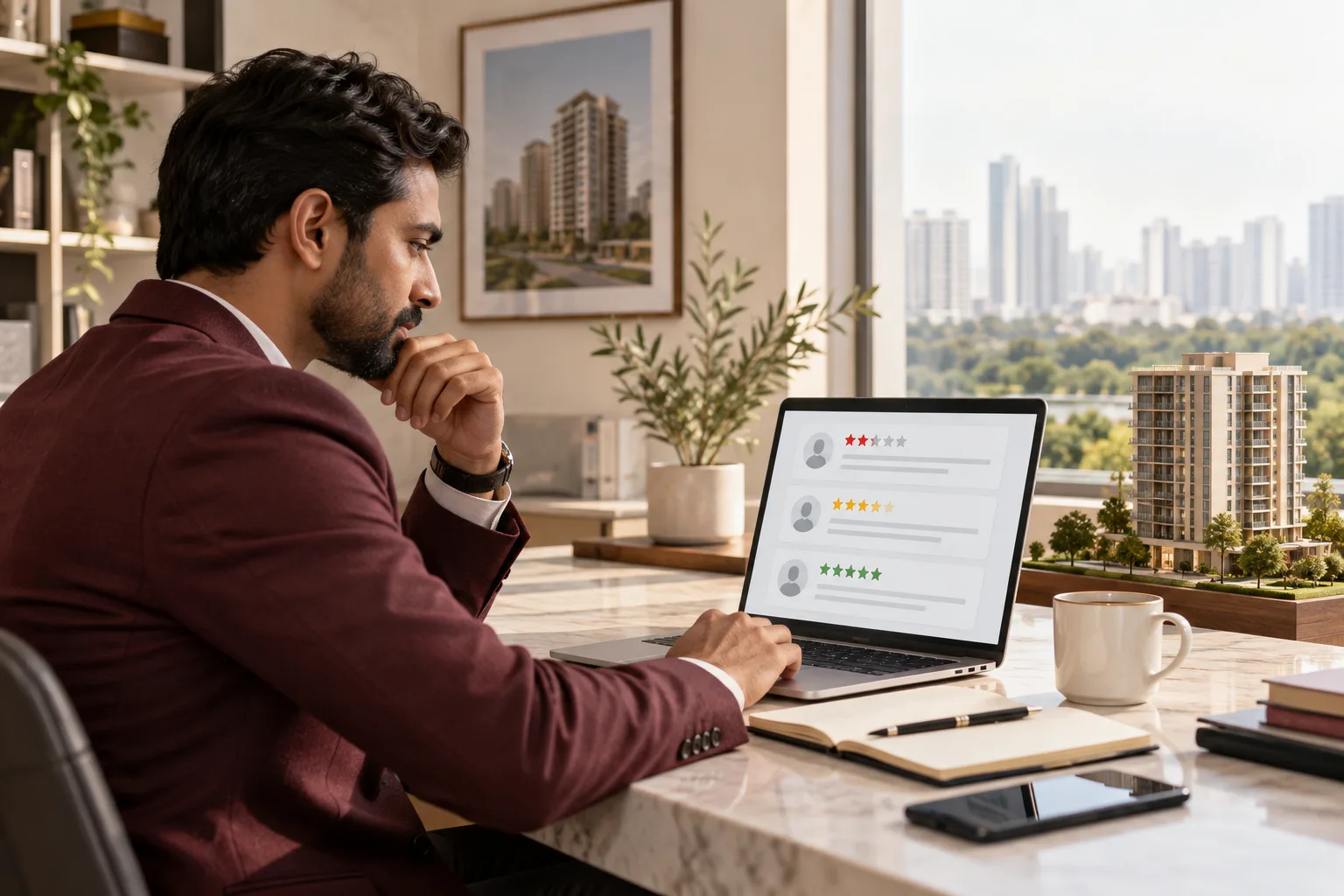 7 min read · 19 Mar 2024Building trust online: reputation management for real estate developersReal estate reputation management is what a buyer finds when they search your name with the words review, complaint and possession. Here is how to fix it.
 6 min read · 10 Oct 2026How real estate businesses can qualify leads before site visitsSix questions asked on WhatsApp or a short call decide whether a buyer deserves a site visit, and they protect your sales team's weekends for the visits that count.
More for real estate developers and brokers
Everything else we would do for you.
Closest to this: reputation
Also for real estate developers and brokers
- Cinema advertising for real estate developers and brokers
- Newspaper advertising for real estate developers and brokers
- Outdoor advertising for real estate developers and brokers
- Radio advertising for real estate developers and brokers
- SEO for real estate developers and brokers
- PPC ads for real estate developers and brokers
Or start from the overview: sales and marketing for real estate developers and brokers.
Your next practical step
Tell us what you are trying to grow, and we will read it before we call.
Eight short steps, mostly taps. Skip anything you would rather answer on the call.