Real estate developers and brokers · Cinema advertising
Buy the screens your buyer's family already drives to on Sunday.
Cinema advertising for a project buys on-screen time at the multiplexes inside its catchment, week by week, as a slide or a short film. GullySales chooses the screens by where upgrading families already live, reads the release calendar before booking, and puts a QR code on the slide that opens a site visit page.
Scope, fee, reporting and term are agreed in writing after we have read your brief and spoken to you.

What cinema advertising means
Cinema advertising is a slide or a film before the show at screens near your business, plus the lobby around them. GullySales chooses the screens by catchment rather than by chain, and puts a QR code on the slide so the spend can be judged.
Also for real estate developers and brokers
- Newspaper advertising for real estate developers and brokers
- Outdoor advertising for real estate developers and brokers
- Radio advertising for real estate developers and brokers
- PPC ads for real estate developers and brokers
- SEO for real estate developers and brokers
- Lead generation for real estate developers and brokers
- Digital marketing for real estate developers and brokers
- Reputation management for real estate developers and brokers
Sales and marketing for real estate developers and brokers, the overview.
Last updated 5 Oct 2026. Rules for this trade differ by state and professional body, and they change. We describe restrictions in general terms, so check the current position with your own council or adviser before you publish anything.
For real estate developers and brokers
Where it usually goes wrong, and what we would do.
“Your buyer already lives a few kilometres away”
Look at the addresses on your last twenty bookings. In a mid-income launch they cluster inside one corridor, and the mall those families take their children to sits in the same corridor.
“The release week decides who is in the hall”
A screen is priced the same in the week of a big release and in the fourth week of a film nobody is going to see. Ask what is scheduled before the weeks are fixed.
“The slide cannot carry the price sheet”
Four storeys high and ten seconds long leaves room for the project, the locality, the configuration and a code to scan. The rest belongs on the page that code opens.
“The registration number has to stay readable”
A property advertisement carries the project's RERA registration number, which on a cinema slide means readable from the back row. Your legal adviser confirms what your state authority asks of this format.
What we do
What we deliver for real estate developers and brokers.
Every deliverable, what it covers for you, and the result it is there to produce. Nothing here is an extra.
Screen list drawn from your own booking sheet
The properties your recent buyers actually travel to, taken from the addresses in your enquiry and booking records rather than from a chain-wide package.
Result: You buy halls inside the corridor you sell in.
Release calendar read before the weeks are fixed
What is scheduled in each candidate week, checked with the property before booking, so full rate is not paid for a quiet hall.
Result: The campaign runs in weeks that are worth paying for.
A slide built for the back row
One line, the project, the locality and a code big enough to scan from a seat, with the registration number placed where it stays legible.
Result: A family can act on it before the film begins.
Scan page made for this campaign only
The code opens a page used nowhere else, carrying the configurations, the location map and a site visit slot instead of your home page.
Result: Every scan arrives as an enquiry with a date on it.
Lobby space taken from whoever owns it
A standee or a scale model outside the screen is allotted by the mall's marketing team, with its own deposit and rules, not by the cinema.
Result: The foyer is negotiated with the party that controls it.
Site visit register that asks the question
Every family reaching the sales office is asked where they first heard of the project, and the answer is logged beside the lead source.
Result: Cinema is judged on visits rather than on a hunch.
Screens and weeks reconciled after the run
What ran, where and for how long, read against the booking, with scans counted screen by screen and week by week.
Result: The next round drops the screens that gave nothing.
How the result is measured
- Screens and weeks run
- Scans by screen
- Enquiries traced to the cinema route
Recorded as a baseline before work starts, so every later report has an honest comparison.
Brief for the cinema slide
Fill in these six lines before the designer starts the slide.
- Project name and locality
- One line carrying the project's name and the locality buyers know it by. Use the name on the RERA certificate so it matches the registration number on the slide.
- Configuration line
- State the apartment types, such as 2 and 3 BHK, or the plot type. Keep it to what is actually open for sale on the day the weeks begin.
- RERA registration number
- Take the number from your registration certificate and set it at a size your legal adviser confirms is legible. Do not retype it from memory.
- One call to action
- A single instruction such as scan to book a Saturday site visit. A second instruction splits attention in a dark hall, so pick the one that matters.
- Construction stage in words
- Say the stage as it truly stands, such as structure complete or foundation under way. A buyer who visits and sees something different loses trust at once.
- Source label on the code
- Set a label on the scan link so that every enquiry arriving through it is tagged to the cinema in your lead system.
Who it is for
This is written for these real estate developers and brokers.
- Residential apartment developers
- Villa and plotted development builders
- Commercial and office space developers
- Independent brokers and channel partner networks
- Redevelopment and rehabilitation projects
- Plot and land aggregators
- NRI-focused residential projects
- Affordable and mid-income housing developers
- Luxury and premium residential developers
Not for
It is not the right fit if.
- Your sales office is closed on the weekend, so a family who saw the slide on Saturday would find no one to visit.
- The project is far from any screen your buyers use, so the slide would play to people who will not drive that distance.
- You have not fixed a registration and approvals statement, and cinema space has no room to correct it later.
How it works
How the cinema advertising work runs
The work itself, in order. How an engagement starts, from your brief to a written scope, is set out on our method page.
- 1
Fix the catchment
We start from how far your customer travels to reach you, which for a clinic or a restaurant is short and decides the screen list on its own.
- 2
Read the release weeks
We check what is scheduled in the campaign window and time the buy to the weeks with something worth watching in the hall.
- 3
Build the creative
The slide or the film is made for a screen four storeys high and cut to the duration being bought.
- 4
Coordinate the booking
We place the buy with the cinema or its appointed agency and confirm the screens, the position and the delivery date in writing.
- 5
Count what came back
Scans, code use and calls are read against the weeks and the screens, and the next round drops the screens that gave nothing.
Where this fits
Three pieces of sales work, in this order.
This work sits inside sales process design, at stage 1, prospecting and lead generation. The audit comes before it, and sales management keeps it running.
Step 1
Sales audit
Find where deals are being lost and what to fix first.
Start here if you cannot say where orders are lost.
Step 2 · you are here
Sales process design
One written way to sell, from first enquiry to repeat order.
Start here if every salesperson sells differently.
Step 3
Sales management
A target, a review routine and someone who owns the number.
Start here if the team has targets and no routine.
FAQ
Questions owners ask before they call.
Not here? More answers, or ask on WhatsApp.
Does cinema work for a plotted development outside the city?
Can the cinema tell us how many people saw the slide?
Can the slide show a render of the building?
What should happen to a scan that arrives late at night?
How much does it cost?
How long is the contract?
How soon will we see results?
Who will actually do the work?
What do you need from us?
What if we are not happy with the work?
From the blog
Further reading for real estate developers and brokers.
 6 min read · 10 Oct 2026How real estate businesses can qualify leads before site visitsSix questions asked on WhatsApp or a short call decide whether a buyer deserves a site visit, and they protect your sales team's weekends for the visits that count.
 5 min read · 6 Oct 2026How buyers shortlist a property or construction firmProperty and construction buyers take a name from a broker, an architect, a bank or a relative before they see your ad. This post covers who gives that name and what keeps you on the list.
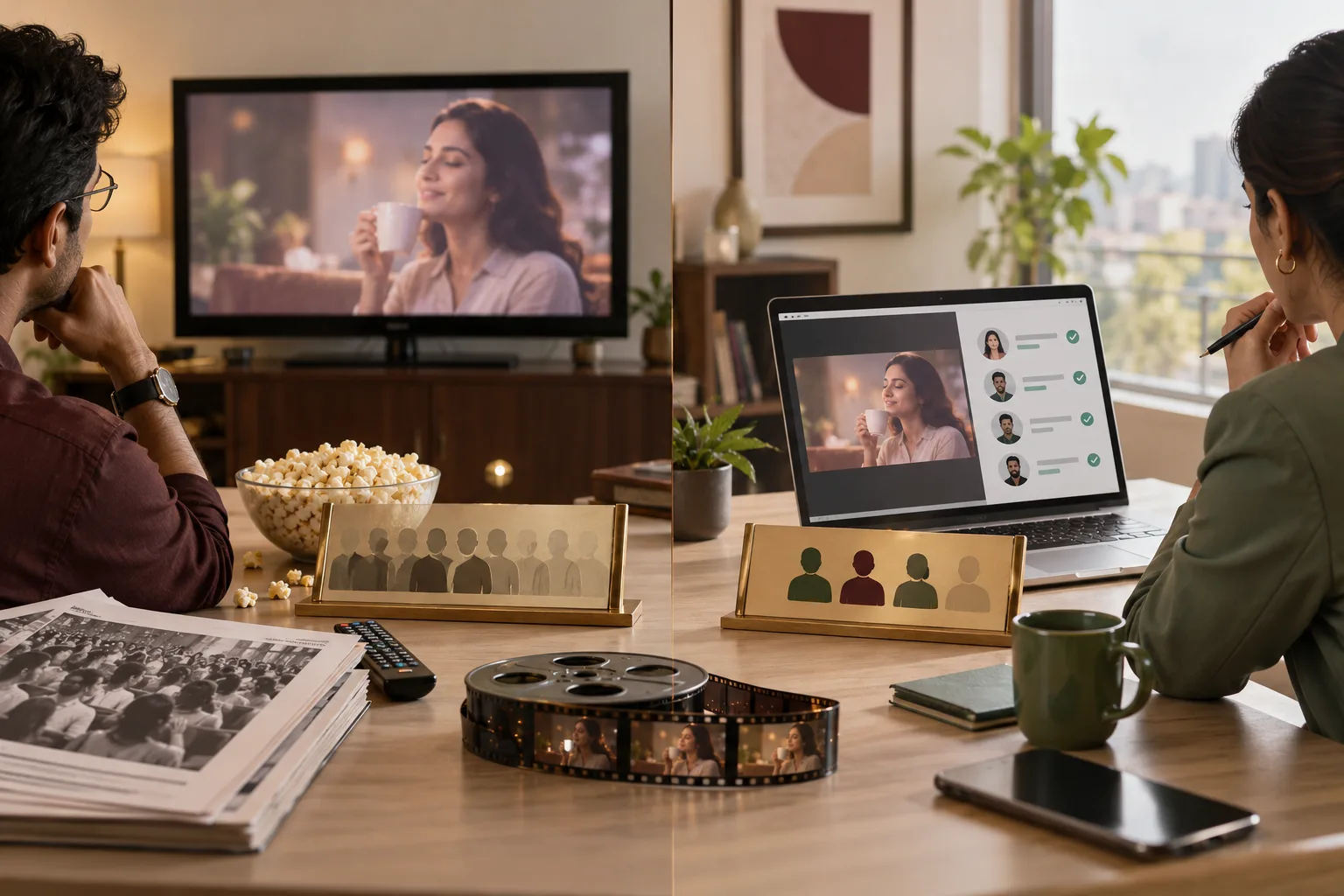 6 min read · 21 Sept 2026TV advertising vs OTT advertising: what are you actually buying?Television sells slots against ratings and prices the wastage in. OTT sells impressions to chosen people and charges for the choosing. Same film, two shops.
More for real estate developers and brokers
Everything else we would do for you.
Closest to this: paid and media
Also for real estate developers and brokers
- SEO for real estate developers and brokers
- Lead generation for real estate developers and brokers
- Digital marketing for real estate developers and brokers
- Reputation management for real estate developers and brokers
- Local SEO for real estate developers and brokers
- Branding and identity for real estate developers and brokers
Or start from the overview: sales and marketing for real estate developers and brokers.
Your next practical step
Tell us what you are trying to grow, and we will read it before we call.
Eight short steps, mostly taps. Skip anything you would rather answer on the call.