Electronics and appliance stores · Outdoor advertising
The board that earns its money is the one before your turning.
Outdoor advertising for an appliance store is your own lit shopfront, the directional board at the junction before your turning, and a few panels on the roads that bring customers towards you. GullySales gets the summer cycle mounted before the heat arrives and keeps one category on each panel.
Scope, fee, reporting and term are agreed in writing after we have read your brief and spoken to you.
What outdoor advertising means
Outdoor advertising is the hoarding, billboard, bus shelter or digital screen on a road your buyers already use. GullySales picks the sites from where your customers actually come from, coordinates the booking with the media owner, and gives the campaign a traceable route so it is not judged on guesswork.
Also for electronics and appliance stores
- Newspaper advertising for electronics and appliance stores
- PPC ads for electronics and appliance stores
- SEO for electronics and appliance stores
- Lead generation for electronics and appliance stores
- Digital marketing for electronics and appliance stores
- Reputation management for electronics and appliance stores
- Local SEO for electronics and appliance stores
- Branding and identity for electronics and appliance stores
Sales and marketing for electronics and appliance stores, the overview.
Last updated 5 Oct 2026.
For electronics and appliance stores
Where it usually goes wrong, and what we would do.
“A price on a board loses to the phone in their hand”
The family reading your panel can open Flipkart in four seconds. Advertise what an app cannot deliver: the air conditioner fitted tomorrow morning, the old one taken away, the EMI settled at your counter in twenty minutes.
“A display cycle is a month, and the season is six weeks”
Printing, permission and mounting eat a week before anything appears. Book in April and your panels reach the road in May, talking to households that decided where to buy during the first hot nights.
“The last five hundred metres is the part nobody buys”
People drive past showrooms they could not turn into. A board at the junction naming the turning, and a shopfront still lit at nine, work harder than a landmark site on a road that leads nowhere near you.
“One category to a panel”
A board carrying televisions, refrigerators, washing machines and phones reads as a shop sign and is remembered as nothing. Give the panel the category the season is about and let the rest wait for their own months.
What we do
What we deliver for electronics and appliance stores.
Every deliverable, what it covers for you, and the result it is there to produce. Nothing here is an extra.
Shopfront and directional signage review
What the front says after dark, whether the board at the junction names the turning, and whether the lights actually come on at seven.
Result: People stop driving past a store they could not find.
Approach road sites chosen with the turn in mind
Panels on the carriageway that carries customers towards you, with the last board placed before the junction rather than after it.
Result: The board is read by somebody who can still turn in.
Mounting date set ahead of the season
The display cycle, the print run and the permission worked backwards so the flex is on the structure before the first hot week rather than during it.
Result: You are on the road while households are still deciding.
One category, one offer and one line per panel
The installation promise, the exchange figure or the EMI offer, stated the way the counter will apply it, with type readable at road speed.
Result: A driver takes away something they can act on that evening.
A number answered at the counter
One line printed on outdoor alone and picked up in the store, so a call about the offer is recorded against a panel instead of disappearing into the shop landline.
Result: The boards produce something you can count.
The billing question, read
One line in the billing routine asking where the customer saw the offer, tallied against the display cycle and the baseline taken before it started.
Result: You learn which board filled the store and which one to drop.
How the result is measured
- Sites booked
- Proof of display received
- Enquiries quoting the campaign route
Recorded as a baseline before work starts, so every later report has an honest comparison.
How it is bought, and approved
An appliance store buys outdoor near its own door, and the landlord and the civic body clear it first.
- Your own fascia first
- Your lit fascia and glow sign sit under the building owner's lease and the local body's signage rules. Check the licence and the lease before replacing them.
- A board at the turn
- Boards at the junction before your turning go on someone's wall or pole. Ask the owner for written consent and the licence for that structure.
- Brand support
- Brands can support display and festive boards at dealer stores. Ask each brand's area executive which artwork and sites it will approve before you book.
- Dates on the order
- Put the mounting, display and removal dates on the order, so the panel is up before the cooling or festive season and not after it.
- Facing and lighting
- Evening shoppers drive towards you after work. Check the panel is lit and faces traffic heading to the store, not away from it.
- A field at the billing counter
- Print a store number or an offer code, and add a 'saw the board' field at billing so the counter records it with the invoice.
Who it is for
This is written for these electronics and appliance stores.
- Multi-brand consumer electronics showrooms
- Home appliance stores
- Mobile phone and accessories retailers
- Home theatre and audio specialists
- Telecom counters selling SIM, broadband and DTH connections
- Brand-exclusive stores run by franchisees
- Kitchen appliance and small appliance retailers
- Electronics stores with service and repair centres
Not for
It is not the right fit if.
- Your store has no parking or easy stop near the board, so a driver who reads it cannot act on it
- The site on offer is far from your delivery and installation area and would reach families you cannot serve
How it works
How the outdoor advertising work runs
The work itself, in order. How an engagement starts, from your brief to a written scope, is set out on our method page.
- 1
Draw the catchment
We agree the roads, junctions and neighbourhoods your buyer moves through. Owners first name a wider area than their buyers travel, and a clinic in Nagarbhavi does not need the whole of west Bengaluru.
- 2
Survey what is available
We work through the sites on offer inside that catchment and go and stand in front of the ones worth looking at, at the hour your buyer passes. A site that reads well at noon can be dark and hidden by a tree at seven.
- 3
Compare and book
Sites are compared on facing, visibility, illumination, paperwork and cycle length, then booked through the media owner or their agency at a negotiated rate. The booking is written down: site address, size, lit or unlit, start date and cycle.
- 4
Print to specification
Artwork is made to the exact panel size and delivered ahead of mounting day, with a proof you approve before printing.
- 5
Monitor the cycle
We collect mounting and mid-cycle photographs, and take up anything late, torn or unlit with the media owner while the cycle is still running.
Where this fits
Three pieces of sales work, in this order.
This work sits inside sales process design, at stage 1, prospecting and lead generation. The audit comes before it, and sales management keeps it running.
Step 1
Sales audit
Find where deals are being lost and what to fix first.
Start here if you cannot say where orders are lost.
Step 2 · you are here
Sales process design
One written way to sell, from first enquiry to repeat order.
Start here if every salesperson sells differently.
Step 3
Sales management
A target, a review routine and someone who owns the number.
Start here if the team has targets and no routine.
FAQ
Questions owners ask before they call.
Not here? More answers, or ask on WhatsApp.
Can we put the price on the board?
Which board should we fix first?
Can we show a brand's logo and the model on our board?
Is branding an auto or a van better than a fixed board for the festive sale?
How long is the contract?
How soon will we see results?
Who will actually do the work?
What do you need from us?
What if we are not happy with the work?
From the blog
Further reading for electronics and appliance stores.
 6 min read · 11 Jun 2026How to advertise during the festive seasonThe festive season is bought in the monsoon. Book early, know why the rates rise, and match what you sell to the day people actually buy it.
 8 min read · 21 Sept 2026How to advertise to retail business ownersA shop owner is behind the counter from ten to nine and cannot leave it. That single fact rules out most media, and it makes the lean afternoon hour and the distributor's salesman worth more than any campaign.
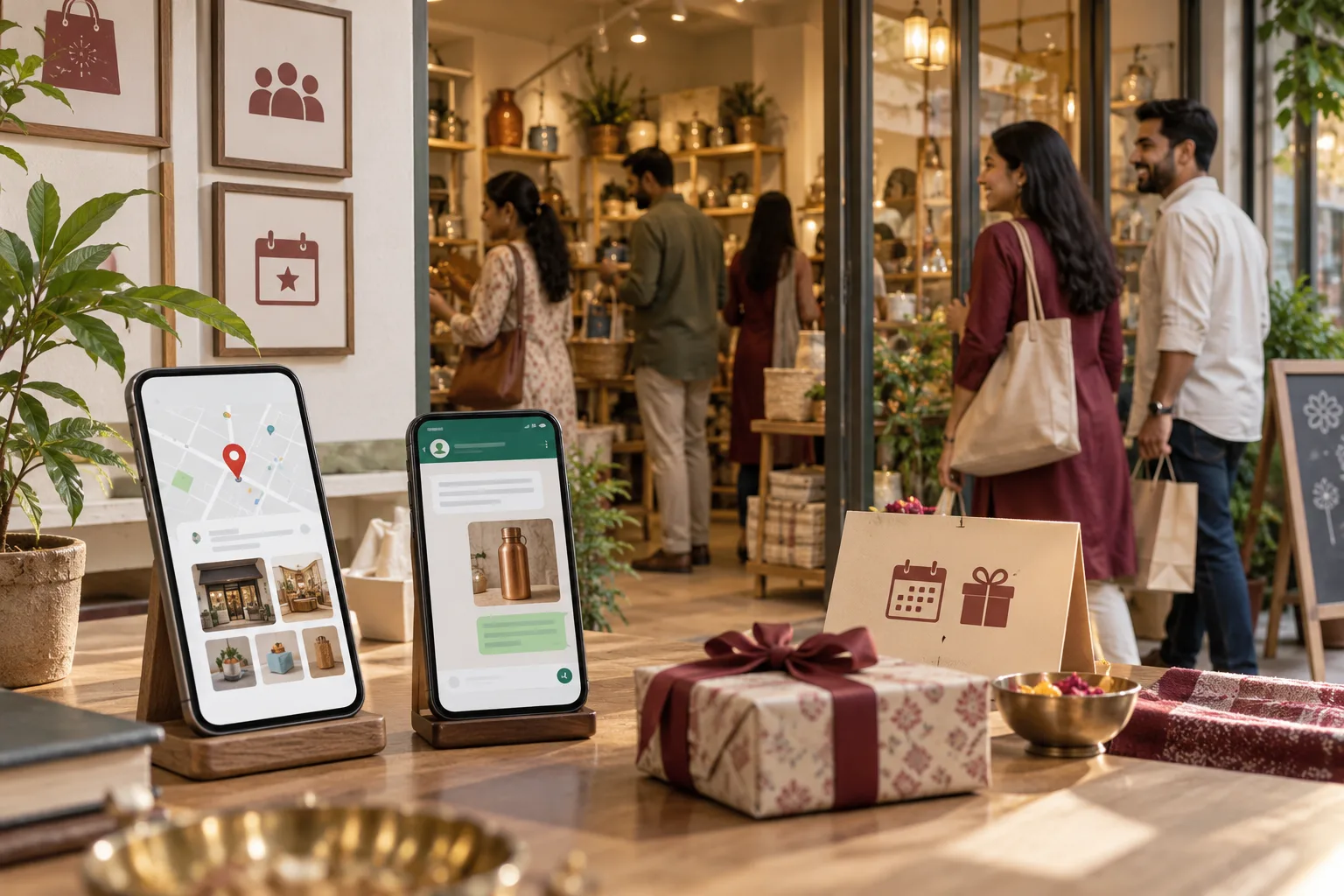 6 min read · 22 May 2026How to increase footfall in a retail storeBe found on Maps for what you stock, give past customers a reason to come back on WhatsApp, and run promotions tied to dates people already shop for.
More for electronics and appliance stores
Everything else we would do for you.
Closest to this: paid and media
Also for electronics and appliance stores
- SEO for electronics and appliance stores
- Lead generation for electronics and appliance stores
- Digital marketing for electronics and appliance stores
- Reputation management for electronics and appliance stores
- Local SEO for electronics and appliance stores
- Branding and identity for electronics and appliance stores
Or start from the overview: sales and marketing for electronics and appliance stores.
Your next practical step
Tell us what you are trying to grow, and we will read it before we call.
Eight short steps, mostly taps. Skip anything you would rather answer on the call.