Jewellery retailers · Store footfall campaigns
Give the neighbourhood a dated reason to walk into the showroom, and count who came.
A store footfall campaign for a jewellery retailer gives the families around the showroom a dated, honest reason to visit, through local media and a counter ready to receive them. GullySales builds the catchment, the offer sheet, the local placements and the visit register that links a walk-in to the campaign.
Scope, fee, reporting and term are agreed in writing after we have read your brief and spoken to you.

What store footfall campaigns means
Store footfall campaigns use local advertising and a dated offer to bring buyers into a shop, showroom, or branch. GullySales plans the catchment and media, prepares the counter team, and connects campaign codes with visit records and bills so you can compare the response with your store's starting position.
Also for jewellery retailers
- Cinema advertising for jewellery retailers
- Google Ads for jewellery retailers
- Newspaper advertising for jewellery retailers
- Outdoor advertising for jewellery retailers
- Radio advertising for jewellery retailers
- Billboard advertising for jewellery stores
- Facebook and Instagram ad copywriting for jewellery retailers
- Retargeting ad copywriting for jewellery retailers
Sales and marketing for jewellery retailers, the overview.
Last updated 14 Nov 2026.
For jewellery retailers
Where it usually goes wrong, and what we would do.
“The reason to visit must be specific to jewellery”
A leaflet that says sale does nothing for a buyer who is comparing designs across three showrooms. The reason to come in might be a bridal collection preview, a gold exchange evaluation day, a hallmarked silver gift range or a wedding-shopping appointment with a stylist. Whatever it is, it needs a start date, an end date and terms the counter can honour on the day, otherwise the visitor feels misled.
“The catchment is smaller than the owner imagines”
A showroom draws the bulk of its walk-ins from the roads around it, the apartment clusters and the wedding-shopping streets on the way. Spreading a campaign over the whole city wastes the budget on families who will buy from a showroom closer to home. A catchment map built from customer pin codes and travel routes shows where the leaflets, inserts and radius ads should go.
“A crowded showroom can spoil the visit”
A footfall campaign that works can overwhelm a counter staffed for a normal day. A bridal buyer who waits for a salesperson, or who cannot see a design because the display is crowded, leaves for the next showroom. Staffing, appointment slots and the security routine of a gold counter must be planned before the campaign, because they decide whether a visit becomes an order.
“Counting visits needs a method before launch”
Without a method, a busy week looks like a campaign success and a quiet one looks like a failure. The counter needs a register of walk-ins, a question about how each visitor heard of the offer and a link to the bill where a purchase follows. Wedding seasons and festivals lift visits regardless of advertising, and the register must mark them so the comparison stays honest.
What we do
What we deliver for jewellery retailers.
The work available for this need. We agree the deliverables and responsibilities for your engagement in writing.
Catchment map for the showroom
A map of the roads, apartment clusters and wedding-shopping routes from which the showroom's buyers already come, built from customer pin codes and the owner's own knowledge. It names the areas the campaign will cover and the areas it will leave alone, so the budget stays near the counter.
Result: Each local placement can be traced to an area on the map.
Approved offer sheet
The reason to visit, written down with its dates, eligibility, redemption terms and the stock or services behind it. The store manager signs it off against what the counter can honour, including any gold exchange evaluation terms. Wording that touches hallmarking or purity is checked by the owner's adviser before release.
Result: Counter staff hold one written offer and give the same answer to every visitor.
Local media plan
A list of the notice boards, inserts, radius ads, auto-rickshaw panels and local print pages chosen for the catchment, each with its cost, its supplier's terms and its response code. The owner approves the list before any booking is made, and unavailable placements are shown as unconfirmed.
Result: Every booking has an approved line in the plan and a code on its artwork.
Campaign artwork
The offer adapted to each chosen medium, with the showroom address, a clear instruction to visit and the dates. Gold tones are tested on the stock or screen used. Proofs go to the owner so the dates and terms are read once more before printing and posting.
Result: Printed and posted pieces match the approved offer sheet word for word.
Visit register and counter briefing
A simple sheet or form for walk-ins, enquiries, appointments and bills, with a field for the response code or the answer to how the visitor heard. A short briefing tells the counter team what the offer is, how to ask the question and how to record a visitor who arrives without mentioning it.
Result: Each walk-in during the campaign has a line in the register.
Before-and-during reading
A comparison of the register and the billing records from before the campaign with those recorded during it. Festival days, wedding-season peaks and any sale held at the same time are marked so they are not credited to the campaign. The cost of each placement sits beside the visits its code recorded.
Result: The owner sees visits, bills and spend side by side, with the peaks flagged.
How the result is measured
- Recorded walk-ins against the baseline, with known seasonal differences noted
- Media-specific code redemptions and visits with no confirmed source
- Qualified enquiries and quotations awaiting a purchase decision
Recorded as a baseline before work starts, so every later report has an honest comparison.
Who it is for
This is written for these jewellery retailers.
- Bridal and wedding jewellery showrooms
- Gold and diamond jewellery retail chains
- Silver and artificial jewellery stores
- Certified diamond and solitaire retailers
- Traditional and antique jewellery stores
- Single-showroom family jewellers
Before you decide
Agree the work. Know how to judge it.
Store footfall campaigns for jewellery retailers: use these checks to prepare, choose the scope, and review what changes.
Bring the right evidence
State the buyer group, catchment, and dates that matter to the offer. Ask for the proposed inventory and available evidence about its audience, with the source and date shown.
Make the scope clear
Agree the exact placements, formats, booking period, and proof of delivery. Separate media charges from design, production, permissions, and installation where these apply.
Check the work in use
Compare delivery evidence with the agreed booking and record enquiries through a distinct response route where practical. Treat audience estimates separately from measured responses.
Know when to change course
Do not buy a placement only because it is discounted. If the location or audience does not fit the buyer, revisit the plan before committing production costs.
These are discussion points, not a fixed package. GullySales confirms the deliverables, responsibilities, fee, and term in writing after reading your brief and speaking with you.
Before we start
What to have ready before the work starts.
The records, access and decisions this work needs from jewellery retailers. Anything missing is noted in the written scope, with who will supply it.
- Customer addresses or pin codes
- A list, even a handwritten register, of where the showroom's customers live. A catchment map is only as good as the addresses behind it. Without them, media is chosen by guesswork and the budget reaches families who will buy from a showroom nearer to home.
- An offer the counter can honour
- A reason to visit that the owner has priced, dated and written down, with the stock or services behind it. Staff must know its terms before the first leaflet is posted. If the offer changes midway or cannot be honoured, response codes lose their meaning and visitors leave unhappy.
- A briefed counter team
- The salespeople who greet visitors, who must agree to ask how each heard of the offer and to note the answer. Without their cooperation, source codes go unrecorded and a visit cannot be tied to the campaign. A short briefing before launch does more than any amount of artwork.
- Billing records for linking
- Access to the counter's billing data, or a copy of the day book, so that a coded visit can be matched to a bill. If the billing system cannot hold a source field, a paper tally is agreed. The limits of that tally are stated in the final reading.
- A decision on catchment limits
- A clear statement of how far the showroom will serve and which roads or clusters are out of reach. A campaign that draws visitors from outside the practical area wastes the counter's time. Without limits, the plan spreads thinly and the register shows interest nobody can serve.
How it works
How the store footfall campaigns work runs
The work itself, in order. How an engagement starts, from your brief to a written scope, is set out on our method page.
- 1
Showroom, branch and purpose
You tell us which showroom or branches the campaign covers and what you want a visit to lead to: a bridal appointment, an exchange evaluation or a collection preview. We write the scope, fee and term before any media is approached. A single-branch family jeweller and a chain are planned differently.
- 2
Catchment and starting figures
Customer pin codes and the owner's knowledge give the proposed catchment. The store manager and we agree the starting figures: usual walk-ins, enquiries and bills, and how a quotation-only visit will be recorded. This is the base against which the campaign is later read.
- 3
Offer, stock and media approval
The offer and its terms are fixed, with the stock and the staffing behind it checked at the counter. Then the media plan is approved. Money is committed only after the owner has signed the offer sheet and the placement list, so that nothing is bought for an offer that cannot be honoured.
- 4
Artwork and counter briefing
Approved artwork goes to the chosen suppliers once permissions are confirmed. In parallel, the store manager receives a briefing sheet, and the counter team practises asking visitors how they heard. Appointment slots for bridal buyers are set so the showroom is not overcrowded.
- 5
Campaign period and register upkeep
The campaign runs against the agreed dates while the counter keeps the visit register. If a placement fails to appear or a code is missing, we raise it with the supplier and record it. Any change to the offer is approved by the owner and noted, because a changed offer changes the reading.
- 6
Reading visits against the starting figures
After the dates close, the register and billing records are compared with the starting figures, with festival and wedding peaks marked. Each placement is read for the visits its code recorded. The owner decides whether to repeat, change the catchment, or stop, with the gaps in the record stated plainly.
Where this fits
Three pieces of sales work, in this order.
This work sits inside sales process design, at stage 1, prospecting and lead generation. The audit comes before it, and sales management keeps it running.
Step 1
Sales audit
Find where deals are being lost and what to fix first.
Start here if you cannot say where orders are lost.
Step 2 · you are here
Sales process design
One written way to sell, from first enquiry to repeat order.
Start here if every salesperson sells differently.
Step 3
Sales management
A target, a review routine and someone who owns the number.
Start here if the team has targets and no routine.
FAQ
Questions owners ask before they call.
Not here? More answers, or ask on WhatsApp.
How do we bring more walk-ins to a jewellery showroom?
Which local media suit a jeweller's footfall campaign?
Can we offer gold-related discounts in the campaign?
How do we know visitors came because of the campaign?
What if the campaign brings a crowd at once?
Does this work for a showroom with several branches?
How much does it cost?
How long is the contract?
How soon will we see results?
Who will actually do the work?
From the blog
Further reading for jewellery retailers.
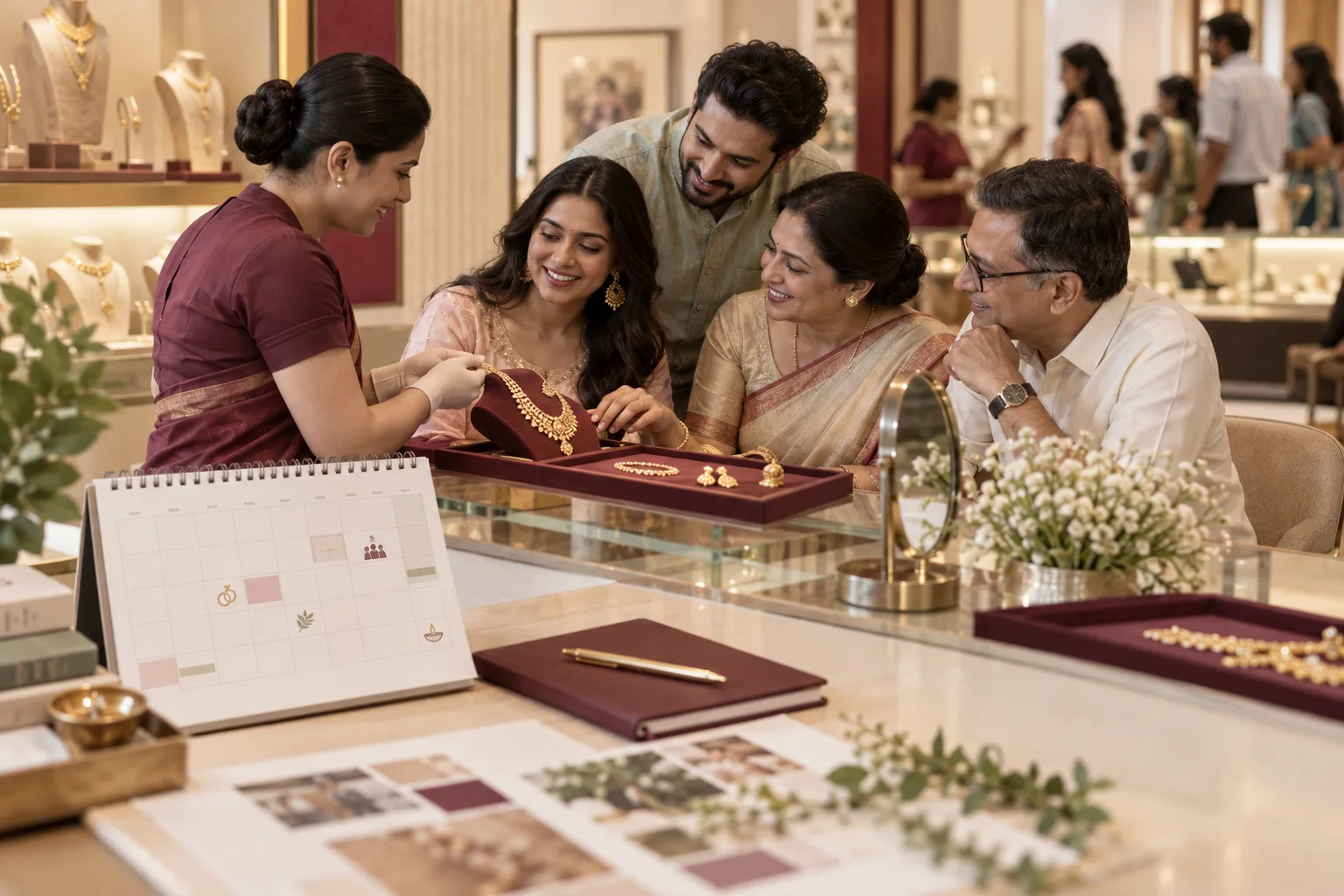 6 min read · 6 Feb 2025How to increase jewellery store footfallJewellery footfall follows a calendar you already own. Plan against the buying seasons and the wedding dates, and sell to the family that decides together.
 8 min read · 21 Sept 2026Tamil advertising creative: what actually changesTamil is written one way and spoken another, and its script cannot tell b from p. What that means for your line, voice artist and brand spelling.
 8 min read · 21 Sept 2026Radio advertising in BengaluruWho listens to radio in Bangalore, and where: the evening traffic crawl, the auto driver's station, shop counters with FM on, and reach past the city.
More for jewellery retailers
Related work to consider.
Closest to this: paid and media
- Cinema advertising for jewellery retailers
- Google Ads for jewellery retailers
- Newspaper advertising for jewellery retailers
- Outdoor advertising for jewellery retailers
- Radio advertising for jewellery retailers
- Billboard advertising for jewellery stores
- Facebook and Instagram ad copywriting for jewellery retailers
- Retargeting ad copywriting for jewellery retailers
Also for jewellery retailers
Or start from the overview: sales and marketing for jewellery retailers.
Your next practical step
Tell us what you are trying to grow, and we will read it before we call.
Eight short steps, mostly taps. Skip anything you would rather answer on the call.