CRM, lead flow and sales techniques · Sales reporting and dashboards
Write down where every enquiry came from, on the day it arrives.
Lead source tracking means recording, against each enquiry, the channel that produced it. It lets an owner compare channels by enquiries, quotes and orders instead of by feeling. This page covers the source field, campaign tags for phone, WhatsApp and marketplace leads, and the source log you review each month.
Scope, fee, reporting and term are agreed in writing after we have read your brief and spoken to you.
In one paragraph
Lead source tracking means recording, against each enquiry, the channel that produced it. It lets an owner compare channels by enquiries, quotes and orders instead of by feeling. This page covers the source field, campaign tags for phone, WhatsApp and marketplace leads, and the source log you review each month.
A tile dealer in Hubballi spends money on a Google campaign, a hoarding on the Gokul Road flyover, a Facebook page and IndiaMART. The enquiry register has a column called Source. It reads "Other" down the whole page, because whoever picked up the phone never asked and the register had no list to pick from. Ask which spend to cut and nobody can answer.
The fix is small and dull. One field, filled in at the moment of the first contact, chosen from a short fixed list. With it you can see which channel brings enquiries, which become quotes and which become orders. Those are three answers, and they point at different channels.
The owner decides the list and the front-desk person or the rep fills it in. Marketing, or the agency running your ads, pulls the numbers. If you have no CRM, this lives in a shared sheet with a drop-down. If you have one, make it a required field on the lead form. Not a note.
This sits next to the dashboard pages in this section. A dashboard shows what the source field records, so get the field right first.
Where this sits
Topic 9 of 13 in crm, lead flow and sales techniques: sales reporting and dashboards. Reports and dashboards that lead to action.
- The topic before
- CRM setup and data
- The topic after
- Frictionless selling
If you want this done for you
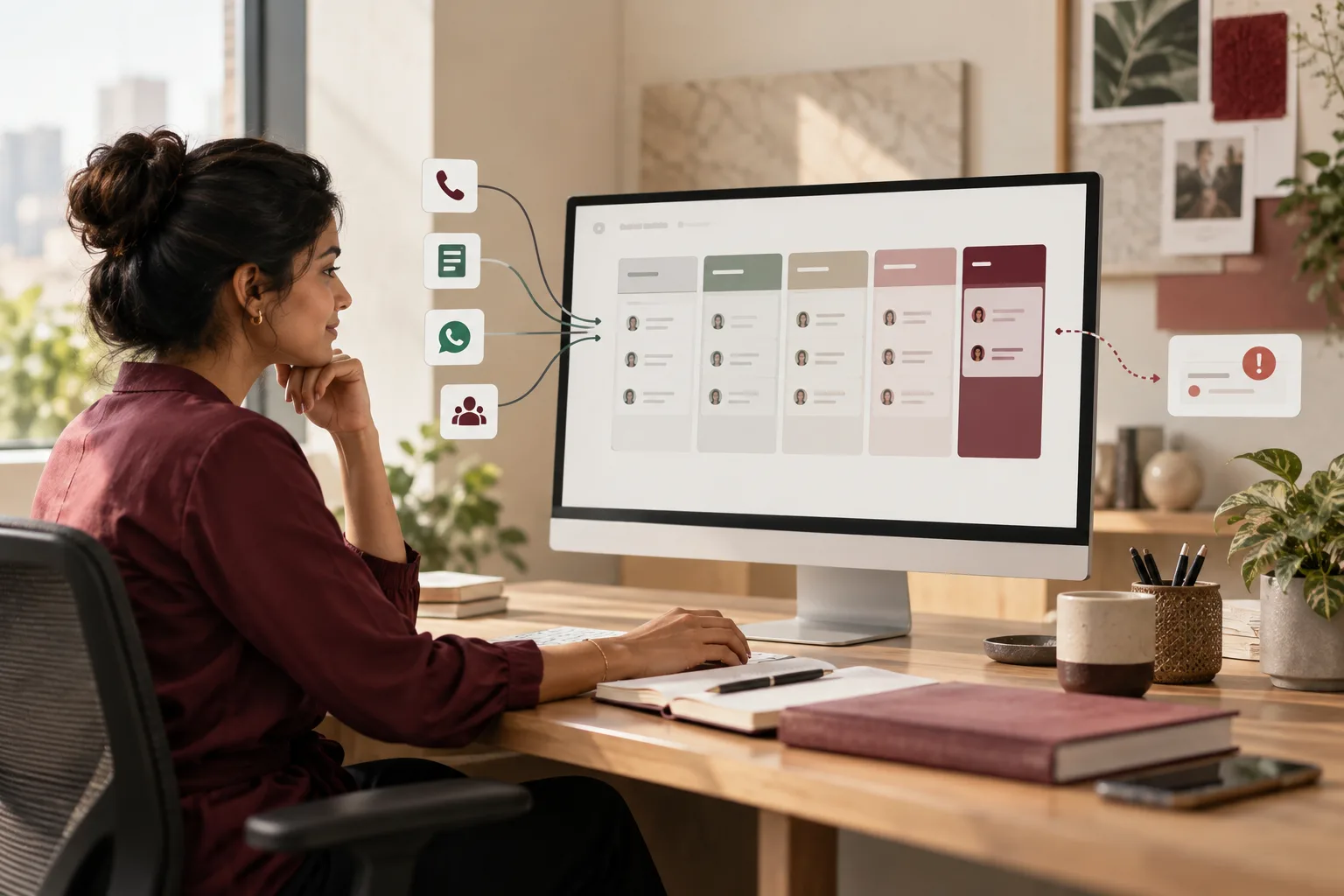
See every enquiry in one place, whether it came by call, form or walk-in.
The work
What this is actually like.
“Phone and WhatsApp leads arrive with no tag”
A website form can carry a source automatically. A call to the number printed on the hoarding cannot. Give each channel its own number or its own opening line, such as a different WhatsApp message pre-filled on each advertisement, so the first message already says where the person came from.
“The customer's answer is not the whole truth”
Someone says they found you on Google, when a cousin gave them the name and they searched to confirm. Record two fields: the channel that first reached them and the one they last used. Where the two differ, the referral deserves the credit you were about to give the search ad.
“Count orders, not just enquiries”
A marketplace can send forty enquiries and no purchase, while a single dealer referral brings the order you wanted. If your source log stops at enquiries it rewards the noisiest channel. Carry the source through to the quote and the sale, so each row of the log ends in rupees or in nothing.
“Too many source options kills the habit”
A drop-down with fourteen choices gets "Other" ticked every time. Start with six or seven your front desk can pick without thinking, and split a channel only before a spending decision.
What we do
What you end up with.
The documents this topic produces, what each one is for, and how you know it is finished.
The source list
A short fixed list agreed by the owner: walk-in, referral, phone from advertisement, WhatsApp, website form, marketplace, repeat customer. One line each saying what counts. The rule for a lead that fits two is written down once.
Result: Finished when two staff members given the same five test enquiries tag them identically.
The source field on the lead form
A required drop-down on the CRM form or the first column of the enquiry sheet, plus a second column for campaign name where an advertisement or festival offer produced the lead. Filled in by whoever takes the first contact.
Result: Finished when you cannot save a new enquiry without choosing a source.
Channel tags for offline spend
A separate phone number, a pre-filled WhatsApp message or a coupon word for each hoarding, handbill run and newspaper insert. A table lists the tag, the spend, the dates and the person who set it up.
Result: Finished when you can name the spend behind every tag in the table.
The source log
One row per channel per month: spend, enquiries, quotes sent, orders won, value won and cost per order. Filled from the CRM or the sheet on the first working day of the month by the marketing lead or agency.
Result: Finished when the owner can point at one channel and say increase it, hold it or stop it.
Why us
Why owners pick GullySales over an agency.
Marketing and sales, as one job
Most agencies stop at the enquiry. We also fix what happens after it: the reply, the follow-up, the quote and the CRM.
The person on the first call does the work
No account managers in between. You are never handed to someone you have not met.
A baseline before anything starts
Your numbers are written down on day one, so every later report compares against something honest.
The fee in writing, split three ways
Our time, your media spend and production on separate lines. You always see what goes to us.
No guarantees we cannot keep
The term is agreed in writing and never a default twelve months. We never promise a ranking or a lead count, because nobody controls those.
One office, and we say so
Nagarbhavi, Bengaluru. We work across India by call and WhatsApp and travel when a session needs to be in person.
#257, 3rd floor, Sri Nanjundeshwara Complex, Nagarbhavi 8th Block, Outer Ring Road. How we work.
Your brief
Tell us what you need, and we will read it before we call.
Eight short steps about your business, what you want and who decides. Most questions are a tap, and you can skip any you would rather answer on the call.
FAQ
Questions owners ask before they call.
Not here? More answers, or ask on WhatsApp.
We have no CRM. Can we do this in Excel?
Do we ask the customer where they heard about us?
What do we do with leads that come from our own sales team's contacts?
When is source tracking not worth setting up?
How much does it cost?
How long is the contract?
How soon will we see results?
Who will actually do the work?
What do you need from us?
What if we are not happy with the work?
Where to go next
The work that carries this topic further.
Services
The rest of sales reporting and dashboards
Or read all of crm, lead flow and sales techniques.
Your next practical step
Tell us what you are trying to grow, and we will read it before we call.
Eight short steps, mostly taps. Skip anything you would rather answer on the call.