Cafes and coffee shops · Community building
Give your regulars a group worth staying in, not a list to be sold to.
Community marketing for a cafe brings the people who already share a table, a hobby or a work routine into one group where they talk to each other as well as to you. GullySales plans the group's purpose, invites the first members with your approval, and sets up moderation and a private route to a booking.
Scope, fee, reporting and term are agreed in writing after we have read your brief and spoken to you.

What community building means
Community building is creating a group, such as a WhatsApp group or a customer forum, where your customers interact with each other and your business. This builds loyalty that outlasts a single purchase. GullySales sets up and moderates this space so it stays useful rather than going quiet.
Also for cafes and coffee shops
- Content marketing for cafes and coffee shops
- Influencer marketing for cafes and coffee shops
- Social media for cafes and coffee shops
- Video marketing for cafes and coffee shops
- Instagram influencer marketing for cafes and coffee shops
- Short-form video and reels production for cafes and coffee shops
- Branding for cafes and coffee shops
- Buyer journey for cafes and coffee shops
Sales and marketing for cafes and coffee shops, the overview.
Last updated 14 Nov 2026. Rules for this trade differ by state and professional body, and they change. We describe restrictions in general terms, so check the current position with your own council or adviser before you publish anything.
For cafes and coffee shops
Where it usually goes wrong, and what we would do.
“Regulars already know each other”
In a neighbourhood cafe, the laptop crowd, the early walkers and the Saturday brunch table nod at each other without ever being introduced. That quiet familiarity is the raw material of a community, and it sits unused. A group gives it a place to live between visits. The work is to find which of those clusters shares a real interest, and to start with the one where the owner can already name three people.
“A group dies without a reason to open it”
Cafe groups fill up on the first day and go silent by the second week, because nobody decided what members would get by staying. Forwarded greetings and menu photographs are not a reason. A group for people who work from a cafe, or one built around a reading hour or a tasting evening, gives a member something to say. We settle that reason in writing before a single invitation goes out.
“The counter team cannot also be moderators”
The person making coffee at the peak hour cannot answer a question in the group, so replies arrive late and the group feels abandoned. Somebody has to own moderation, with agreed hours of coverage and a route for questions that need the owner. This is a staffing decision as much as a marketing one, and it has to be made before launch rather than discovered during the first complaint.
“Members join to belong, not to be pitched”
A regular who is added to a group without being asked, then receives offers, will mute it or leave. Joining has to be a choice the person made, and the rules have to say how offers appear. A booking question for a birthday or an office order should move to a private conversation, so the group stays a place to talk and the enquiry still reaches a salesperson.
What we do
What we deliver for cafes and coffee shops.
The work available for this need. We agree the deliverables and responsibilities for your engagement in writing.
Community purpose and platform brief
A written statement of who the group is for, what they share and why a regular would open it on a quiet weekday. It also names the platform, chosen for where your customers already spend time. The owner approves this before any contact is invited, so recruitment is never done on a vague idea.
Result: You can state in one sentence why someone would join and stay.
Member charter and group setup
The rules a member sees on joining, covering offers, unrelated posts, photographs of other customers and what happens after a warning. It also lists the joining questions and who holds administrator access. The owner reviews the setup as a member would, so privacy settings and visibility are known before invitations are sent.
Result: You have seen the group from a new member's side before it opens.
Founding member invitation plan
A shortlist of regulars and neighbours drawn from contacts you approve, with personal invitation wording for each cluster. The invitation explains the purpose and leaves the decision with the person who receives it. Nobody is added without asking, and each contact on the list has your approval beside the name.
Result: Every invited person appears on a list you approved.
Conversation and meet-up calendar
A plan of questions, introductions and occasions linked to the members' shared interest, such as a reading hour, a tasting evening or a work-from-cafe morning. Your barista or roaster is marked where first-hand knowledge is needed. Event details, space limits and any costs are agreed with you before they are announced.
Result: You can see the next set of prompts and who answers each one.
Moderation and escalation guide
A named moderator, the agreed coverage, and the steps for a complaint, an unanswered question or a post that breaks the charter. It states which decisions return to the owner. The guide stops a late reply to a wrong-order complaint from becoming a public argument in front of every member.
Result: Each type of problem has a named person who handles it.
Booking and enquiry handover record
A shared record for members who ask about a birthday booking, a group table or an office order. It holds the member's request, the preferred contact route and the assigned person. Your team records what became of each enquiry, so a request made in the group is never lost between a chat and a diary.
Result: You can trace any booking enquiry back to the group it came from.
How the result is measured
- Active members
- Engagement rate
- Referrals or repeat business from the community
Recorded as a baseline before work starts, so every later report has an honest comparison.
Who it is for
This is written for these cafes and coffee shops.
- Independent single-outlet cafes
- Specialty coffee roasters with a cafe
- Cafes inside co-working spaces
- Bakery cafes
- Cafe chains opening new outlets
- Cloud kitchen and delivery-only cafes
- Cafes attached to bookstores or art spaces
- Late-night and student-area cafes
Before you decide
Agree the work. Know how to judge it.
Community marketing for cafes and coffee shops: use these checks to prepare, choose the scope, and review what changes.
Bring the right evidence
Review the posts that produced useful conversations, not only the ones with the most views. Gather buyer questions and decide which team member can contribute credible material.
Make the scope clear
Choose the audience and channel before setting a posting volume. Agree who supplies material, approves posts, and handles messages, including complaints or questions the agency cannot answer.
Check the work in use
Follow a post through to the profile, website, and response. A useful report explains the quality of conversations and enquiries, alongside reach and engagement.
Know when to change course
If publishing takes time away from unanswered buyer messages, fix the response routine first. Do not expand to another channel without a clear reason for being there.
These are discussion points, not a fixed package. GullySales confirms the deliverables, responsibilities, fee, and term in writing after reading your brief and speaking with you.
Before we start
What to have ready before the work starts.
The records, access and decisions this work needs from cafes and coffee shops. Anything missing is noted in the written scope, with who will supply it.
- A list of regulars you may invite
- Give us the names you are comfortable inviting, from people you already speak to. We cannot invent a membership, and a group that opens empty gives a newcomer nothing to answer. Without this list, invitations fall back on strangers, which damages the trust the group depends on.
- Access to any existing group
- If you run a group on a messaging app or a social page, give us read access or an export of the messages. We study what members actually talked about before deciding to reset it. When this is missing, we may repeat a topic that already failed.
- A person who can moderate
- Name the individual who will read the group and reply, with the hours they can cover. The counter team during a rush cannot do this reliably. Without a named moderator, replies arrive late, and members drift away from a group that looks unattended.
- Your barista's or roaster's knowledge
- Someone on your side needs to answer questions about beans, brewing and the menu from first-hand knowledge. We draft prompts around what they know. When this is missing, answers become guesses, and a wrong claim about an ingredient or allergen can reach every member at once.
- Rules for offers and meet-ups
- Decide how offers will appear in the group, and whether you will host any meet-up in the cafe, with its space and costs. We write these into the charter. When it is missing, offers drift into every thread and the group turns into the second advertising channel members were trying to avoid.
How it works
How the community building work runs
The work itself, in order. How an engagement starts, from your brief to a written scope, is set out on our method page.
- 1
Find the group that already exists
We start by asking who sits in your cafe on a quiet weekday, and who knows whom. We also review any group you already run, on a messaging app or a social page, and read what it has become. From this we decide whether to reset an old group or begin a new one. You approve the audience and the reason to belong before anything is built.
- 2
Settle the platform and who owns it
We compare the places your customers already use and choose the one that needs least effort to join. The owner holds administrator access, and a named moderator is agreed. We also decide who answers questions that need a barista or roaster, so product answers are never improvised by a moderator.
- 3
Write the charter and joining questions
The charter covers offers, off-topic posts, photographs of other customers and removal after warnings. The joining questions ask what the person wants from the group, which tells us who has arrived. You read the setup from a new member's side, and we explain what other members can see about them under the platform's settings.
- 4
Invite the first members by name
From the contacts you approve, we send personal invitations that explain the purpose and leave the choice with the person. We begin with a small number of people who already know each other from the cafe, because a group that opens with familiar faces gives a newcomer something to answer. Nobody is added without being asked.
- 5
Open conversations the counter can feed
Agreed prompts start the first discussions, and the owner or barista adds the first-hand answers that make a post worth reading. Where a meet-up is planned at the cafe, space and any cost are confirmed with you first. Booking requests are moved to a private route and recorded, so the group stays a conversation.
- 6
Read the group against the starting record
Before the work began we noted who was in any existing group, how many of them had posted, and how booking enquiries reached you. We compare those records with the group now, separating members who started a conversation from members who only joined. You agree what to change, including reducing activity if the group is not earning its place.
Where this fits
Three pieces of sales work, in this order.
This work sits inside sales process design, at stage 0, foundation. The audit comes before it, and sales management keeps it running.
Step 1
Sales audit
Find where deals are being lost and what to fix first.
Start here if you cannot say where orders are lost.
Step 2 · you are here
Sales process design
One written way to sell, from first enquiry to repeat order.
Start here if every salesperson sells differently.
Step 3
Sales management
A target, a review routine and someone who owns the number.
Start here if the team has targets and no routine.
FAQ
Questions owners ask before they call.
Not here? More answers, or ask on WhatsApp.
How do we start a community around a cafe?
Can you revive our quiet group on a messaging app?
Will you moderate it or must our staff?
Is this the same as social media posting?
Can we message every member with the menu offer?
What do you need before quoting?
How much does it cost?
How long is the contract?
How soon will we see results?
Who will actually do the work?
From the blog
Further reading for cafes and coffee shops.
 7 min read · 21 Sept 2026How to design metro and transit advertisingA commuter stands still in front of a platform panel for four minutes and passes the same one twice a day for a month. Design for the sixth viewing.
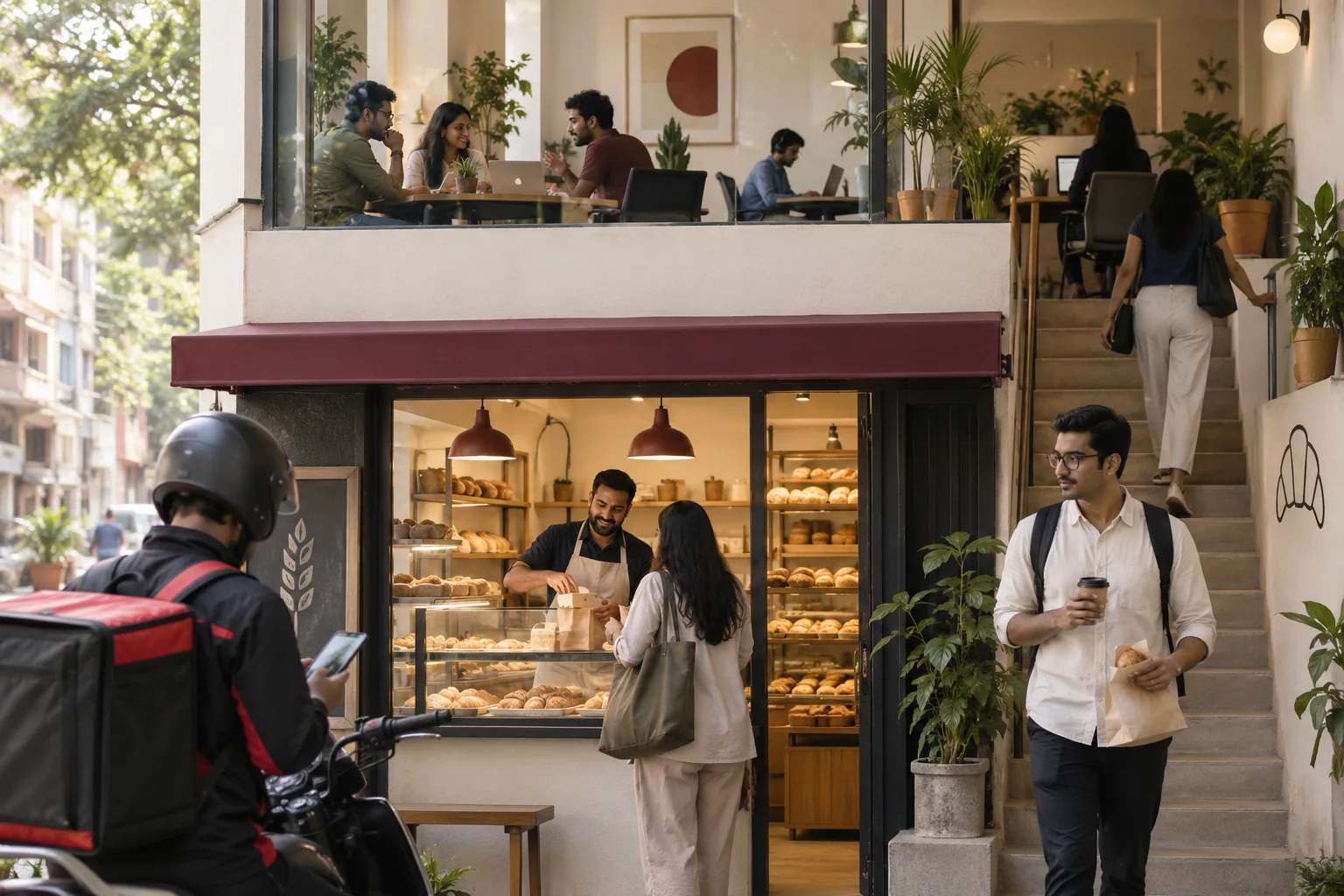 7 min read · 21 Sept 2026How to advertise to startup employeesThere is no tech park to buy. A forty person company sits above a bakery, so the audience is the neighbourhood, the delivery app and the coworking floor.
 7 min read · 21 Sept 2026How to advertise to metro commutersA commuter is a mode, not a person. The journey has four still moments, each needing different creative, so one design across a station fails.
More for cafes and coffee shops
Related work to consider.
Closest to this: content and social
Also for cafes and coffee shops
Or start from the overview: sales and marketing for cafes and coffee shops.
Your next practical step
Tell us what you are trying to grow, and we will read it before we call.
Eight short steps, mostly taps. Skip anything you would rather answer on the call.