Retailers · Local SEO
Win the near-me search that happens while a shopper is already out.
Local SEO for a shop is the near-me result that decides which of the stores on a road somebody walks into. GullySales completes the Business Profile with the categories, photographs and hours a shopper checks, keeps festival timings correct and works the reviews sitting beside them.
Scope, fee, reporting and term are agreed in writing after we have read your brief and spoken to you.
What local SEO means
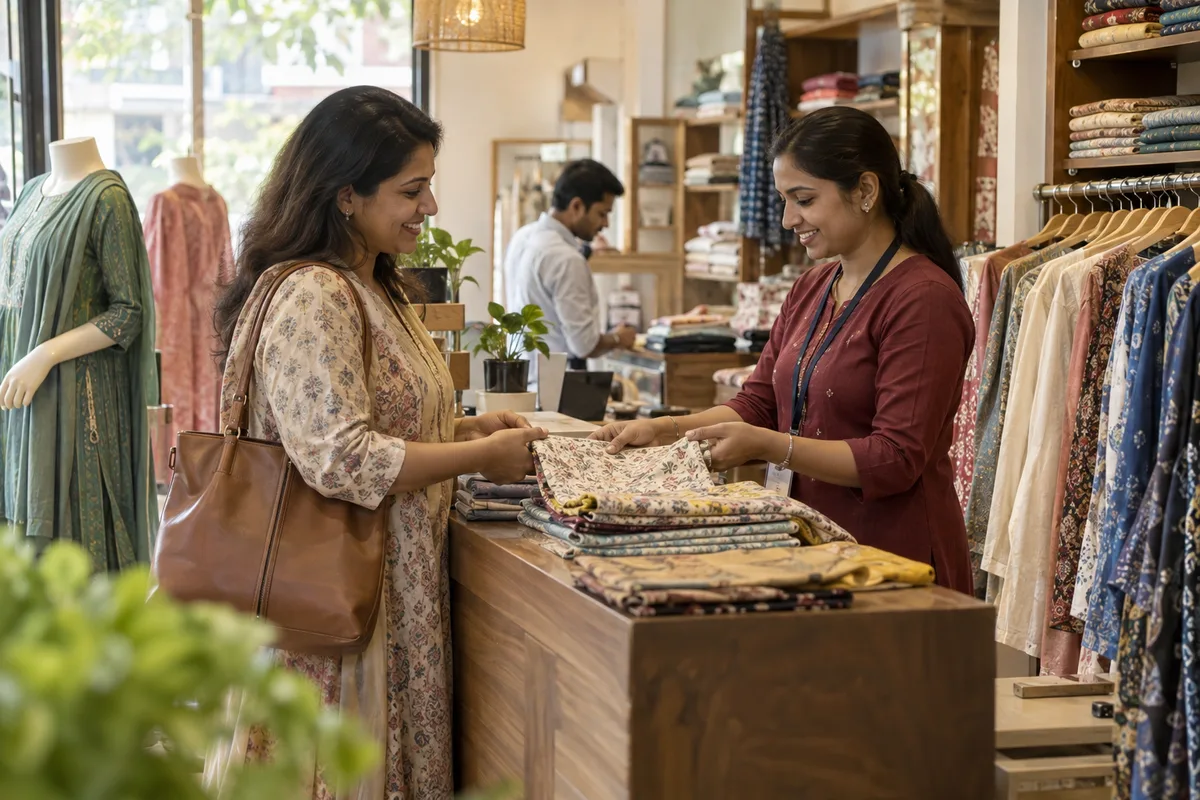
Local SEO is the work of making your business show up for searches that name your town or locality, such as a service plus an area name. GullySales sets up locality pages, local citations and map listings so nearby customers find you before a competitor across town.
Last updated 5 Oct 2026.
For retailers
Where it usually goes wrong, and what we would do.
“The search happens on the road, not at home”
Somebody already out with an hour to spare is choosing between two shops on a phone. Whoever looks open, stocked and well rated gets them.
“The shopfront photograph is how they recognise you”
A shopper walking down the road matches the photograph to the board. An interior shot with no shopfront makes them walk straight past.
“Festival hours are the point of the listing”
The evenings before Diwali and Rakhi are when a shop earns, and they are also when the timings on the listing are most often wrong.
“A shop in a mall needs a floor and a landmark”
Level two, near the escalator, past the food court. Without that, people give up inside a building they do not know.
What we do
What we deliver for retailers.
Every deliverable, what it covers for you, and the result it is there to produce. Nothing here is an extra.
A complete profile with the right categories
Primary and secondary categories, the brands held, products listed, and services such as alterations, exchange or home delivery.
Result: The shop appears for what it actually sells.
Photographs of the shopfront, shelves and counter
The board seen from the road, the inside as it looks today, the parking and the billing counter, refreshed whenever the store changes.
Result: A shopper recognises the place and walks in.
Hours, festival timings and the weekly off
Regular hours, extended festive evenings, holidays and any early closing entered before the day rather than after it.
Result: Nobody arrives to find the shutter down.
Posts when stock and offers change
Short posts for new arrivals, sale dates and festival timings, put up in the week they matter and not afterwards.
Result: The listing shows a shop that is open and trading.
Directions that work inside a mall or market
Floor, landmark, nearest entrance and parking written into the profile, with the map pin checked on the ground.
Result: Shoppers find the door without ringing you.
Visibility and actions reported
How many searches showed the shop, and the calls, direction requests and website taps that followed, against the figures taken before work starts.
Result: You can see whether the listing is producing visits.
How the result is measured
- Map pack ranking
- Local search visibility
- Enquiries by locality
Recorded as a baseline before work starts, so every later report has an honest comparison.
What Google weighs here
How a shopper who is already out finds a store nearby, and what to fix first.
- Primary category
- Choose the most specific category for your biggest line, such as Clothing store, Electronics store or Jewellery shop. Add up to a few secondary categories for lines you stock in depth, not everything on the shelf.
- Pin on the shop door
- Check the pin against your shopfront on the satellite view. In a market or mall, add the floor, the shop number and the nearest landmark, and a clear photograph of the entrance board.
- Products on the profile
- Add your best-selling products with photographs, names and a starting price only where it is stable. A shopper searching for a thing then sees it before walking in. Update when stock goes.
- Special hours
- Set holiday and festival hours before each festival, and the day you are shut. A wrong closing time shown on a Diwali evening costs sales and brings a review that outlasts the festival.
- Mall and market directories
- Check the mall's own store directory, Justdial and Sulekha for the same name, floor and phone. A mall listing with last year's shop number sends shoppers to the wrong floor.
Who it is for
This is written for these retailers.
- Apparel and footwear stores
- Electronics and appliance retailers
- Grocery and kirana stores
- Home decor and furnishing stores
- Jewellery and gifting retailers
- Multi-brand outlet stores
How it works
From your first message to the first report.
No open-ended retainer. Every step gives you something in writing.
First
Your brief
You tell us what you need in a few short steps: your business, what you want, where enquiries come from and how they are handled.
After the brief
A conversation and a written scope
We read it, then talk with whoever handles your enquiries. If you want our help, the scope, the fee and the reporting come in writing, and nothing starts before you have read them.
Before work starts
Baseline recorded
The numbers this work is meant to move, such as enquiries, quotations, orders, visits or renewals, written down so every later report has an honest comparison.
After the baseline
The first fix goes live
The fix we agreed to start with is put in place and measured against the baseline, whether that is a reply, a follow-up, a page, a listing or the handover between marketing and sales.
As agreed
Report against the baseline
What moved, what did not, and what changes next, in plain words. How often you get it is set in writing before work starts.
At renewal
Renew on the numbers
The term ends and you decide whether to continue from the results. The length is agreed in writing before anything starts.
How the local SEO work runs
- 1
Audit every listing
We check the Google Business Profile and directory listings for every branch against what should actually be shown.
- 2
Complete and correct
Profiles are filled in fully and inconsistent details are corrected across every directory found.
- 3
Build location pages
Each branch gets a page written for its own area, not a copy of the head office page with the address changed.
- 4
Set up review handling
A simple process for requesting and responding to reviews is put in place with whoever is closest to the customer.
- 5
Report and adjust
Map actions and enquiries per branch are reported, and branches falling behind are prioritised the next month.
Proof
What happened when owners fixed this.
Real clients, the work we did, and the result as it was recorded. Where no number was recorded, none is claimed.
Bon Millette
- Situation
- A new food brand has to look trustworthy before anyone will try it, and Bon Millette had nothing online for a first-time buyer to weigh up.
- What we did
- A site that matches the food
- The story in a trust-building order
- Product sections with full disclosure
- A short path from reading to buying
- Result
- No numbers were recorded for this engagement. The work is described in full in the case study.
Also worked with
Chord Road Hospital · Curtain Label · Difesa Security Services · Felicity Inn · Hands On CSR · Implevista · Kambar Group · Kalessi · Kerur Pain Clinic · LL Trust · Lucky Deals · Natural Gases · NavaShakthi Souhardha · NewCom Logistics · Proton Technical Services · SB Engineering · Shakthi Foundation · Shakthi Group · Urbanest · Insyde Studio · Venkateshwara Laser Tech · Vivara Studios
Why us
Why owners pick GullySales over an agency.
Marketing and sales, as one job
Most agencies stop at the enquiry. We also fix what happens after it: the reply, the follow-up, the quote and the CRM.
The person on the first call does the work
No account managers in between. You are never handed to someone you have not met.
A baseline before anything starts
Your numbers are written down on day one, so every later report compares against something honest.
The fee in writing, split three ways
Our time, your media spend and production on separate lines. You always see what goes to us.
No guarantees we cannot keep
The term is agreed in writing and never a default twelve months. We never promise a ranking or a lead count, because nobody controls those.
One office, and we say so
Nagarbhavi, Bengaluru. We work across India by call and WhatsApp and travel when a session needs to be in person.
#257, 3rd floor, Sri Nanjundeshwara Complex, Nagarbhavi 8th Block, Outer Ring Road. How we work.
Your brief
Tell us what you need, and we will read it before we call.
Eight short steps about your business, what you want and who decides. Most questions are a tap, and you can skip any you would rather answer on the call.
FAQ
Questions owners ask before they call.
Not here? More answers, or ask on WhatsApp.
Our pin is in the wrong place on the map.
We have two branches. Do they need separate listings?
Can we show products on Maps if we do not sell online?
Somebody reported our shop as closed. How do we fix it?
How much does it cost?
How long is the contract?
How soon will we see results?
Who will actually do the work?
What do you need from us?
What if we are not happy with the work?
From the blog
Further reading for retailers.
 7 min read · 21 Sept 2026Local audience targeting strategyThree different people are local to you: the one who lives near you, the one who works near you, and the one searching near you. The settings that reach each are different.
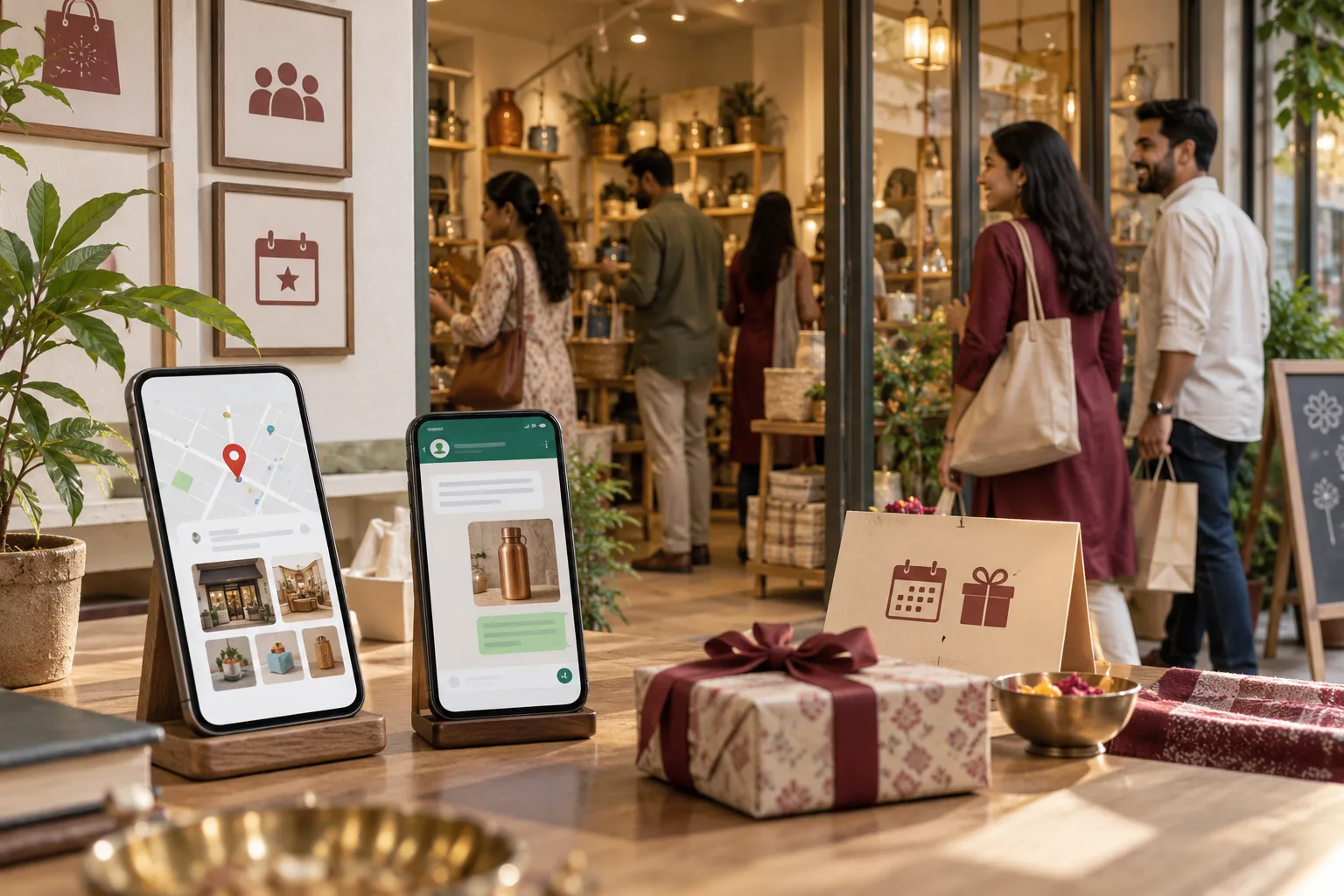 6 min read · 22 May 2026How to increase footfall in a retail storeBe found on Maps for what you stock, give past customers a reason to come back on WhatsApp, and run promotions tied to dates people already shop for.
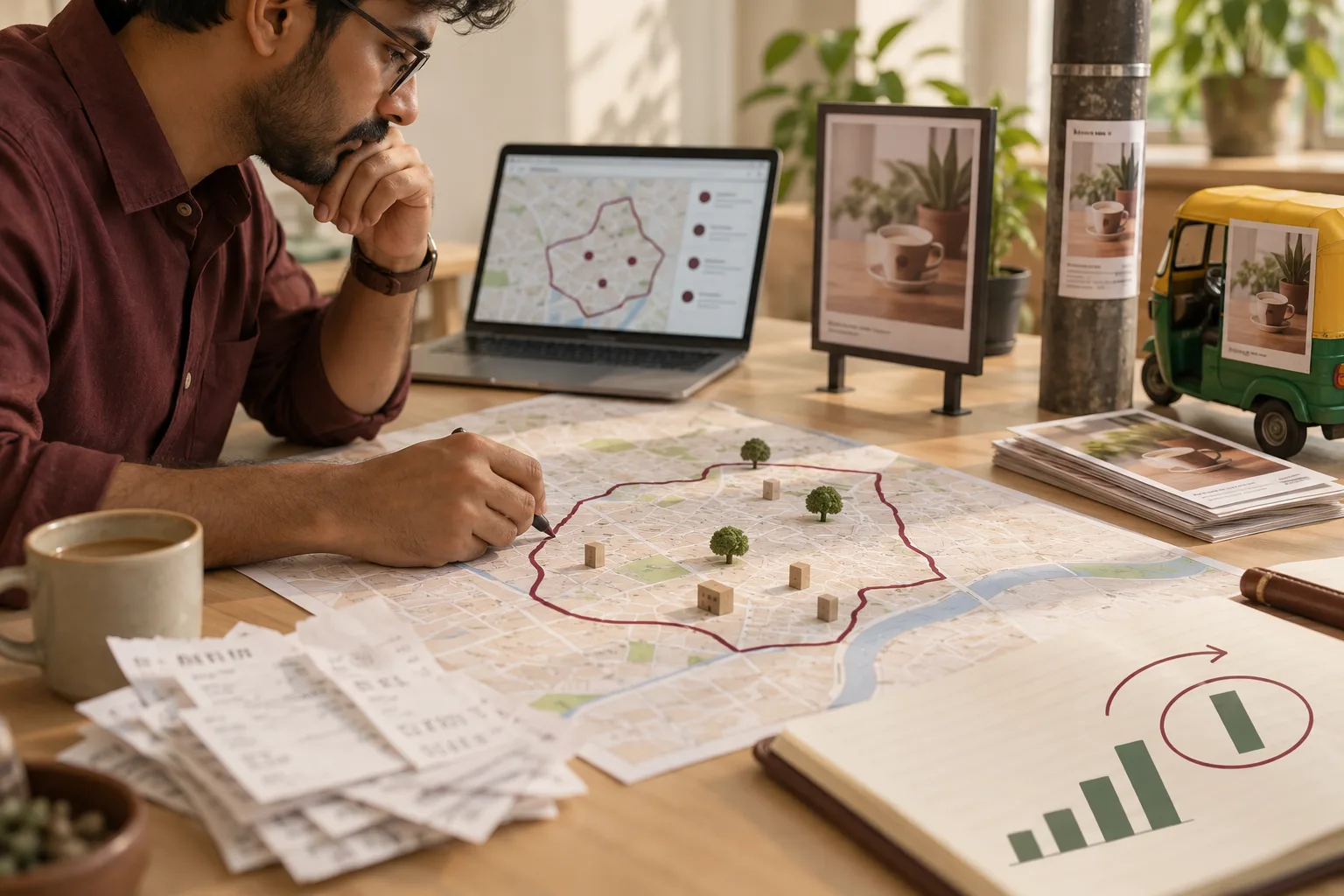 6 min read · 19 Mar 2026How to plan a hyperlocal advertising campaignDraw the catchment from your own bills first. Then buy only the media that stops at the same boundary, and measure it with a number nobody else uses.
More for retailers
Everything else we would do for you.
Closest to this: search and visibility
Also for retailers
Or start from the overview: sales and marketing for retailers.
Your next practical step
Tell us what you are trying to grow, and we will read it before we call.
Eight short steps, mostly taps. Skip anything you would rather answer on the call.