Hospitals · Outdoor advertising
Buy the hoarding on the road families already take to reach you.
Outdoor advertising for a hospital is the hoarding, pole kiosk or bus shelter on the roads families already drive to reach you, plus the signs that get them from the main gate to the right block. GullySales picks sites by the routes your own patients travel and keeps one department on each panel.
Scope, fee, reporting and term are agreed in writing after we have read your brief and spoken to you.

What outdoor advertising means
Outdoor advertising is the hoarding, billboard, bus shelter or digital screen on a road your buyers already use. GullySales picks the sites from where your customers actually come from, coordinates the booking with the media owner, and gives the campaign a traceable route so it is not judged on guesswork.
Last updated 5 Oct 2026. Rules for this trade differ by state and professional body, and they change. We describe restrictions in general terms, so check the current position with your own council or adviser before you publish anything.
For hospitals
Where it usually goes wrong, and what we would do.
“The road decides the site, not the crowd”
A family in a hurry takes the shortest route to a hospital, so the panel worth paying for faces the traffic coming towards your gate. The same structure on the far carriageway is read by people driving away from you.
“A hoarding is the wrong place for a date”
Printing and mounting take days and the cycle runs for a month or more. A camp on the 14th belongs on air and on posters, while the board carries the department and the way in, which is still true in week nine.
“The last kilometre is the campaign nobody buys”
Families circle a hospital campus looking for which gate takes them to casualty and which to the OPD block. A directional board at the junction and clear gate signage do more for a first visit than a landmark site across town.
“One department to a panel”
Cardiology, maternity and dialysis crowded onto one board give a driver nothing to hold on to. A site beside a residential layout can carry maternity while the one on the commuter road carries the joint replacement clinic.
What we do
What we deliver for hospitals.
Every deliverable, what it covers for you, and the result it is there to produce. Nothing here is an extra.
Site shortlist drawn from your own patient addresses
The localities and pin codes in last year's OPD register, read against the roads that feed them, so the list starts from where patients already come from rather than from the media owner's deck.
Result: Every site on the list sits on a road your patients use.
Wayfinding checked from the junction to the ward block
What a driver sees at the turning, at the gate and inside the campus, including whether the casualty entrance is named and whether the boards are lit after dark.
Result: A family arriving at night finds the right entrance without a phone call.
Panel artwork for one department, read at speed
A single department, type sized for a moving car, and the response line set inside the safe area so the frame does not swallow it.
Result: A driver takes away one thing, and it is legible.
Claim wording cleared inside the hospital first
Anything the panel says about a doctor, a procedure or a result goes past your medical director and your own adviser, because flex on a structure cannot be edited for the rest of the cycle.
Result: Nothing stays on the road that a doctor has to defend.
An appointment line you will still answer in month three
One number printed on the boards and nowhere else, ringing the appointment desk rather than casualty, and staffed for the whole display period instead of the first fortnight.
Result: Calls from the boards are counted and the emergency line stays clear.
Dated photographs at mounting and mid-cycle
Pictures taken standing where a driver sits, once when the panel goes up and again during the cycle, including after dark for an illuminated site.
Result: You hear about a torn or unlit panel while there is still time to fix it.
Catchment reading in the report
Calls to the printed line, and registrations from the pin codes those sites sit in, compared with the weeks before the cycle and against the baseline taken at the start.
Result: You get a direction on the spend, and we say where it is only a direction.
How the result is measured
- Sites booked
- Proof of display received
- Enquiries quoting the campaign route
Recorded as a baseline before work starts, so every later report has an honest comparison.
How it is bought, and approved
A hospital buys outdoor panel by panel, and its own management and the civic body clear it first.
- Booked per panel and department
- Book a panel for one department. Ask the media owner for the exact face and size, and note who sees it from which direction.
- Management sign-off on wording
- Doctor names, department claims and words like best or only go to your administrator and medical head before printing. Hospital advertising rules differ by state and body and change, so check with your own council.
- Licence for each structure
- Each hoarding needs the civic body's licence and the owner's consent. Ask to see the licence, because a panel without one can be removed mid-cycle.
- Junction and traffic view
- Boards that block a junction view can be refused. Ask the local body and the media owner whether the face has been cleared by traffic authorities.
- Casualty on your own signage
- The casualty entrance and ambulance line belong on gate and campus signage that you control, not on a hoarding for appointments.
- An appointment line and a source
- Print an appointment line used on the boards only, have the helpdesk ask 'where did you see us', and log the answer by department.
Who it is for
This is written for these hospitals.
- Multi-speciality hospitals
- Single-speciality hospitals, maternity, orthopaedic or eye
- Nursing homes
- Day-care surgery centres
- Corporate hospital chains with several branches
- Diagnostic-centre-led hospitals
- Hospitals attached to medical colleges
- Government-empanelled private hospitals
Not for
It is not the right fit if.
- The panel would sit on a road your patients do not take to reach you, however busy that road is.
- You want the hoarding to carry a camp date or a doctor's photograph, which the wording rules may not permit.
- The hospital's own gate is hard to find from the main road, so a board would draw people to a place they cannot enter.
How it works
How the outdoor advertising work runs
The work itself, in order. How an engagement starts, from your brief to a written scope, is set out on our method page.
- 1
Draw the catchment
We agree the roads, junctions and neighbourhoods your buyer moves through. Owners first name a wider area than their buyers travel, and a clinic in Nagarbhavi does not need the whole of west Bengaluru.
- 2
Survey what is available
We work through the sites on offer inside that catchment and go and stand in front of the ones worth looking at, at the hour your buyer passes. A site that reads well at noon can be dark and hidden by a tree at seven.
- 3
Compare and book
Sites are compared on facing, visibility, illumination, paperwork and cycle length, then booked through the media owner or their agency at a negotiated rate. The booking is written down: site address, size, lit or unlit, start date and cycle.
- 4
Print to specification
Artwork is made to the exact panel size and delivered ahead of mounting day, with a proof you approve before printing.
- 5
Monitor the cycle
We collect mounting and mid-cycle photographs, and take up anything late, torn or unlit with the media owner while the cycle is still running.
Proof
What happened when owners fixed this.
Real clients, the work we did, and the result as it was recorded. Where no number was recorded, none is claimed.
Chord Road Hospital
- Situation
- Patients who knew the hospital trusted it. Patients who searched for a department or a treatment in the area did not find it.
- What we did
- Website rebuilt around patient needs
- Search visibility
- Social media on a schedule
- Review management
- Result
- Organic traffic increased 60% within six months
- Online appointment bookings increased 40%
- Social following grew 45%, and engagement on it rose 70%
Nanda Arthritis and Rheumatology Center
- Situation
- There was no website, so a patient looking for a rheumatologist had no way to learn about the centre. Enquiries were few, and the ones that arrived came by word of mouth.
- What we did
- A website for patients
- Search work
- Google Business and reviews
- Lead capture and advertising
- Result
- No numbers were recorded for this engagement. The work is described in full in the case study.
Also worked with
Curtain Label · Difesa Security Services · Felicity Inn · Hands On CSR · Implevista · Kambar Group · Kalessi · Kerur Pain Clinic · LL Trust · Lucky Deals · Natural Gases · NavaShakthi Souhardha · NewCom Logistics · Proton Technical Services · SB Engineering · Shakthi Foundation · Shakthi Group · Urbanest · Insyde Studio · Venkateshwara Laser Tech · Vivara Studios
Where this fits
Three pieces of sales work, in this order.
This work sits inside sales process design, at stage 1, prospecting and lead generation. The audit comes before it, and sales management keeps it running.
Step 1
Sales audit
Find where deals are being lost and what to fix first.
Start here if you cannot say where orders are lost.
Step 2 · you are here
Sales process design
One written way to sell, from first enquiry to repeat order.
Start here if every salesperson sells differently.
Step 3
Sales management
A target, a review routine and someone who owns the number.
Start here if the team has targets and no routine.
FAQ
Questions owners ask before they call.
Not here? More answers, or ask on WhatsApp.
Should the hoarding carry our camp date?
How do we know the boards brought any patients in?
Can the hoarding show our doctors' photographs?
Who pays when a panel is removed by the civic body or damaged?
How much does it cost?
How long is the contract?
How soon will we see results?
Who will actually do the work?
What do you need from us?
What if we are not happy with the work?
From the blog
Further reading for hospitals.
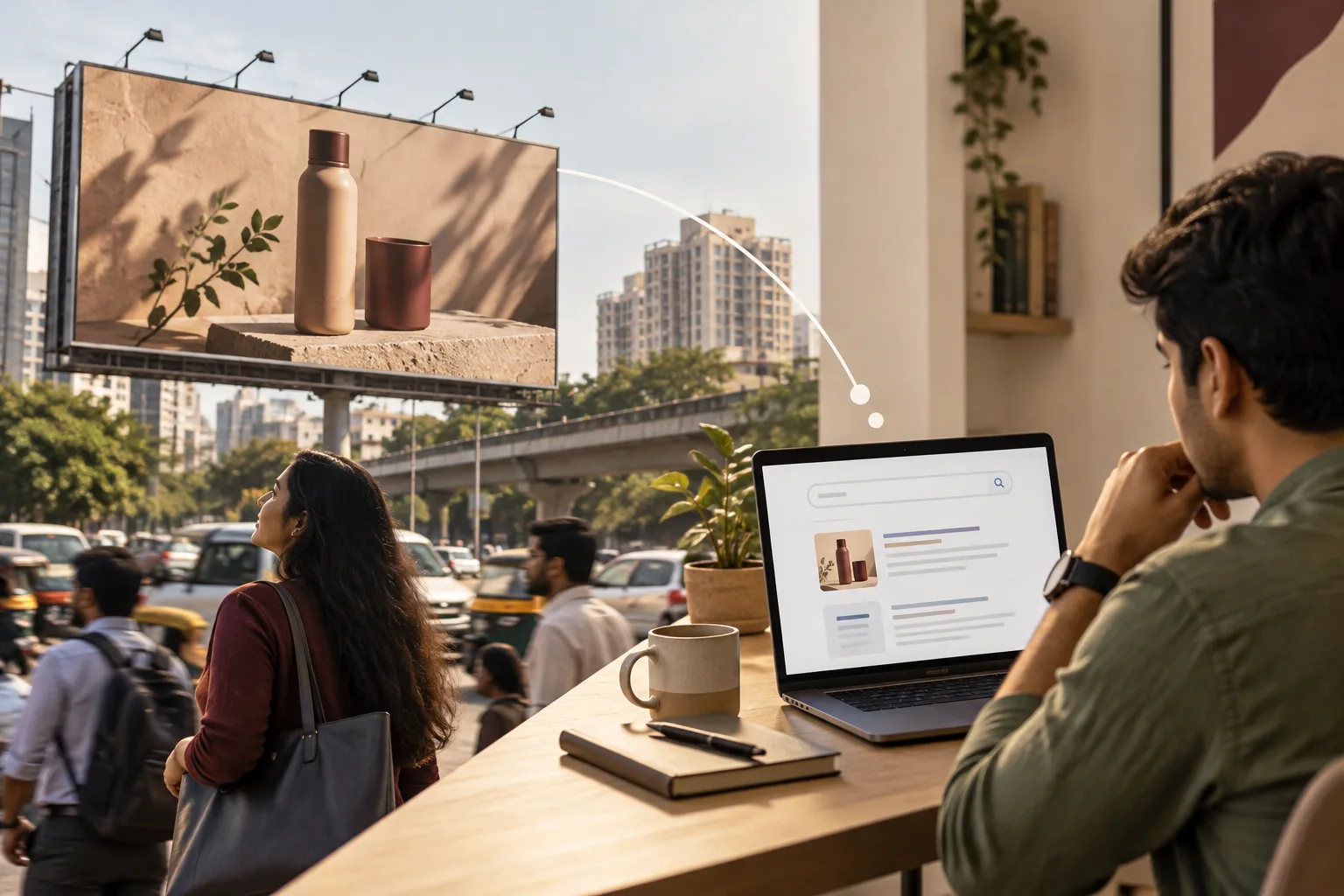 6 min read · 21 Sept 2026Google Ads vs outdoor advertising: capture demand or create it?Google Ads collects the demand that already exists. A hoarding creates the demand Google later collects, and then search takes the credit for it.
 8 min read · 21 Sept 2026Airport advertising in BengaluruKempegowda International is forty kilometres of media in three parts: the Bellary Road drive, the forecourt, and a terminal sold by the airport's own concessionaire on its own rules.
 7 min read · 9 Jun 2026How to measure offline advertisingA hoarding does not report. If you want a spot, a site or a cinema slide traced to an enquiry, the route has to be built before the campaign runs.
More for hospitals
Everything else we would do for you.
Closest to this: paid and media
Also for hospitals
Or start from the overview: sales and marketing for hospitals.
Your next practical step
Tell us what you are trying to grow, and we will read it before we call.
Eight short steps, mostly taps. Skip anything you would rather answer on the call.