Real estate developers and brokers · Hyperlocal advertising
Advertise to the streets your buyers already drive, not to the whole city.
Hyperlocal advertising buys media inside the few neighbourhoods from which a family will realistically travel to your sales office or site. GullySales maps that catchment from your own enquiry and visit records, plans digital targeting and nearby placements together, and gives the sales office one way to log every response.
Scope, fee, reporting and term are agreed in writing after we have read your brief and spoken to you.

What hyperlocal advertising means
Hyperlocal advertising buys media within the area your shop, branch, or service location can realistically serve, rather than across an entire city. GullySales maps that catchment using your customer records and local access routes, then plans digital targeting and nearby physical placements with a response route your sales team can track.
Also for real estate developers and brokers
- Cinema advertising for real estate developers and brokers
- Newspaper advertising for real estate developers and brokers
- Outdoor advertising for real estate developers and brokers
- Radio advertising for real estate developers and brokers
- PPC ads for real estate developers and brokers
- Billboard advertising for real estate developers and brokers
- Door-to-door promotional campaigns for real estate developers and brokers
- Facebook and Instagram ad copywriting for real estate developers and brokers
Sales and marketing for real estate developers and brokers, the overview.
Last updated 14 Nov 2026. Rules for this trade differ by state and professional body, and they change. We describe restrictions in general terms, so check the current position with your own council or adviser before you publish anything.
For real estate developers and brokers
Where it usually goes wrong, and what we would do.
“A kilometre on the map is not a kilometre of travel”
A railway line, a flyover, a school-hour jam or an unlit service road can make a neighbouring pin code further from your site than a locality across the ring road. Buyers judge distance by the commute they already make, not by the radius on a map. The catchment has to follow the roads the family takes to work and school, and your own visit records show it.
“Apartment societies are closed audiences”
A resident buying a larger home in the same area is a strong prospect, and the lift lobby and notice board of a nearby society reach that family directly. But these placements need the association's written permission, and a panel put up without it is removed. The plan lists named societies with the permission in hand, not an unspecified promise of neighbourhood coverage.
“Digital radius settings reach the wrong people”
A radius around the sales office will include a commercial street, a hospital campus and a village on the far bank of a river. Search and social campaigns set to location only will spend on people who pass through and never live nearby. Pin-code lists, exclusions and the actual approach roads give the targeting a shape closer to where buyers live.
“The site is far from where buyers live”
A project on the edge of a growing area draws families from older neighbourhoods several kilometres away, who want to move up. Advertising only around the site misses them, while advertising across the city reaches families who will never make the trip. The catchment is therefore two shapes: the families near the site, and the neighbourhoods that feed it.
What we do
What we deliver for real estate developers and brokers.
The work available for this need. We agree the deliverables and responsibilities for your engagement in writing.
Catchment map of feeder neighbourhoods
A map of the pin codes, societies and approach roads from which your visits and bookings have come, with barriers marked and the families near the site shown separately. You review the proposed boundary against where you can host a visit and where earlier buyers actually lived.
Result: Every neighbourhood on the map is tied to a recorded enquiry or a reason for inclusion.
Local media shortlist
A comparison of nearby digital and physical options with quoted costs and availability: society panels, hoardings on the approach road, lift branding, local print inserts and search settings. You see why each placement is recommended and which options were left out.
Result: Each recommended placement has a quoted cost and a reason against the catchment.
Digital location settings
Pin-code or radius targeting for the agreed search and social campaigns, with exclusions for areas that fall in the radius but not in the catchment. The advertisement, the map pin and the sales office address are checked so all three name the same place.
Result: A test search from inside and outside the catchment shows the advertisement only where agreed.
Placement and permission file
A named list of the society panels, boards and other sites proposed, with the written permission from each association or owner where required. You approve actual locations, and the file records who gave consent so a removed panel does not become a surprise.
Result: Every physical placement has a permission on file before it is printed.
Local artwork and message
Advertisements adapted to each placement: the road name and landmark for a hoarding, the walking distance for a society panel, the visit day for a search advertisement. Renders carry an artist-impression line, and the registration detail your adviser requires appears where the rules ask.
Result: Each advertisement names its locality and carries the details your adviser approved.
Response tracking sheet
A sheet or register field recording which placement or digital area each enquiry came from, with a distinct number, QR code or question for the sales executive to ask. Responses can then be read against the catchment, not simply counted.
Result: Every enquiry in the register shows the neighbourhood or placement it came from.
How the result is measured
- Spend and placement delivery by catchment, separate from buyer response
- Clicks and QR scans, treated as activity rather than qualified enquiries
- Enquiries by pin code and share arriving from outside the catchment
Recorded as a baseline before work starts, so every later report has an honest comparison.
Who it is for
This is written for these real estate developers and brokers.
- Residential apartment developers
- Villa and plotted development builders
- Commercial and office space developers
- Independent brokers and channel partner networks
- Redevelopment and rehabilitation projects
- Plot and land aggregators
- NRI-focused residential projects
- Affordable and mid-income housing developers
- Luxury and premium residential developers
Before you decide
Agree the work. Know how to judge it.
Hyperlocal advertising for real estate developers and brokers: use these checks to prepare, choose the scope, and review what changes.
Bring the right evidence
State the buyer group, catchment, and dates that matter to the offer. Ask for the proposed inventory and available evidence about its audience, with the source and date shown.
Make the scope clear
Agree the exact placements, formats, booking period, and proof of delivery. Separate media charges from design, production, permissions, and installation where these apply.
Check the work in use
Compare delivery evidence with the agreed booking and record enquiries through a distinct response route where practical. Treat audience estimates separately from measured responses.
Know when to change course
Do not buy a placement only because it is discounted. If the location or audience does not fit the buyer, revisit the plan before committing production costs.
These are discussion points, not a fixed package. GullySales confirms the deliverables, responsibilities, fee, and term in writing after reading your brief and speaking with you.
Before we start
What to have ready before the work starts.
The records, access and decisions this work needs from real estate developers and brokers. Anything missing is noted in the written scope, with who will supply it.
- Addresses of visitors and buyers
- The site-visit register and booking list with locality, pin code or society tell us where buyers actually live. Without them the catchment is drawn from a radius, which is the mistake this work is meant to avoid. Share only what your privacy practice allows.
- A list of nearby societies and contacts
- Names of the societies, associations and landlords near the site, with a contact for each, let us request permission for panels and boards. Without a named contact, a placement stays on the list and never goes up, or goes up unapproved and is taken down.
- Sales office address and visit routine
- The advertisement sends a family to a place. Confirm the address, the opening days, the parking and the person who greets visitors. If the map pin leads to the wrong gate, the money spent on the advertisement is wasted at the last step.
- Registration and approval details
- Keep the project's registration and sanctioned plan details ready. Local advertisements are read by neighbours and by the regulator, and a panel missing the required detail can be removed. Your own legal adviser confirms the wording for your state.
- A person who logs every response
- Name the person who writes each enquiry's source into the register. A catchment plan cannot be read if responses are logged as general enquiries, and the next spend decision will fall back to guesswork about which neighbourhood worked.
How it works
How the hyperlocal advertising work runs
The work itself, in order. How an engagement starts, from your brief to a written scope, is set out on our method page.
- 1
Mark the homes of past visitors and buyers
Send the site-visit register and booking records with addresses or localities. We plot where earlier visitors lived and where bookings came from, and we mark the roads and barriers that shape the commute, so the first catchment rests on your own record.
- 2
Approve the boundary and the feeder areas
We propose the catchment, the feeder neighbourhoods and the exclusions. Your sales head confirms them against local knowledge and against where an executive can reach the site for a visit, and removes any area the project cannot serve.
- 3
Choose placements and set the spend
We compare societies, hoardings, lift panels, local inserts and digital settings against the catchment. You approve the selected media and quoted costs before any booking, and the plan states which placements were considered and left out.
- 4
Collect permissions and clear the artwork
Association or owner permissions are gathered for each physical site. Your legal adviser reads the advertisement for registration details, artist impressions and amenity wording, because advertising rules differ by state and the adviser decides what the artwork may say.
- 5
Brief the sales office and go live
The sales head receives the placement list, the numbers or QR codes used, and the source field for the register. Phone numbers and map pins are tested before a panel is printed or a campaign begins.
- 6
Read responses by neighbourhood
Enquiries and visits are compared with the baseline and sorted by area. You decide where to repeat, widen or remove a placement. We do not promise enquiries from any neighbourhood, and the register shows which areas produced visits, not only calls.
Where this fits
Three pieces of sales work, in this order.
This work sits inside sales process design, at stage 1, prospecting and lead generation. The audit comes before it, and sales management keeps it running.
Step 1
Sales audit
Find where deals are being lost and what to fix first.
Start here if you cannot say where orders are lost.
Step 2 · you are here
Sales process design
One written way to sell, from first enquiry to repeat order.
Start here if every salesperson sells differently.
Step 3
Sales management
A target, a review routine and someone who owns the number.
Start here if the team has targets and no routine.
FAQ
Questions owners ask before they call.
Not here? More answers, or ask on WhatsApp.
How small is a hyperlocal catchment for a housing project?
Do society panels need permission?
Can we use hoardings and digital together?
Will you promise enquiries from the area?
What if our buyers come from across the city?
Who approves the advertisement wording?
How much does it cost?
How long is the contract?
How soon will we see results?
Who will actually do the work?
From the blog
Further reading for real estate developers and brokers.
 8 min read · 21 Sept 2026Radio advertising in BengaluruWho listens to radio in Bangalore, and where: the evening traffic crawl, the auto driver's station, shop counters with FM on, and reach past the city.
 8 min read · 21 Sept 2026Metro advertising in BengaluruNamma Metro sells three audiences under one name: people in the station, people in the train and drivers under the viaduct. Which to buy, and why.
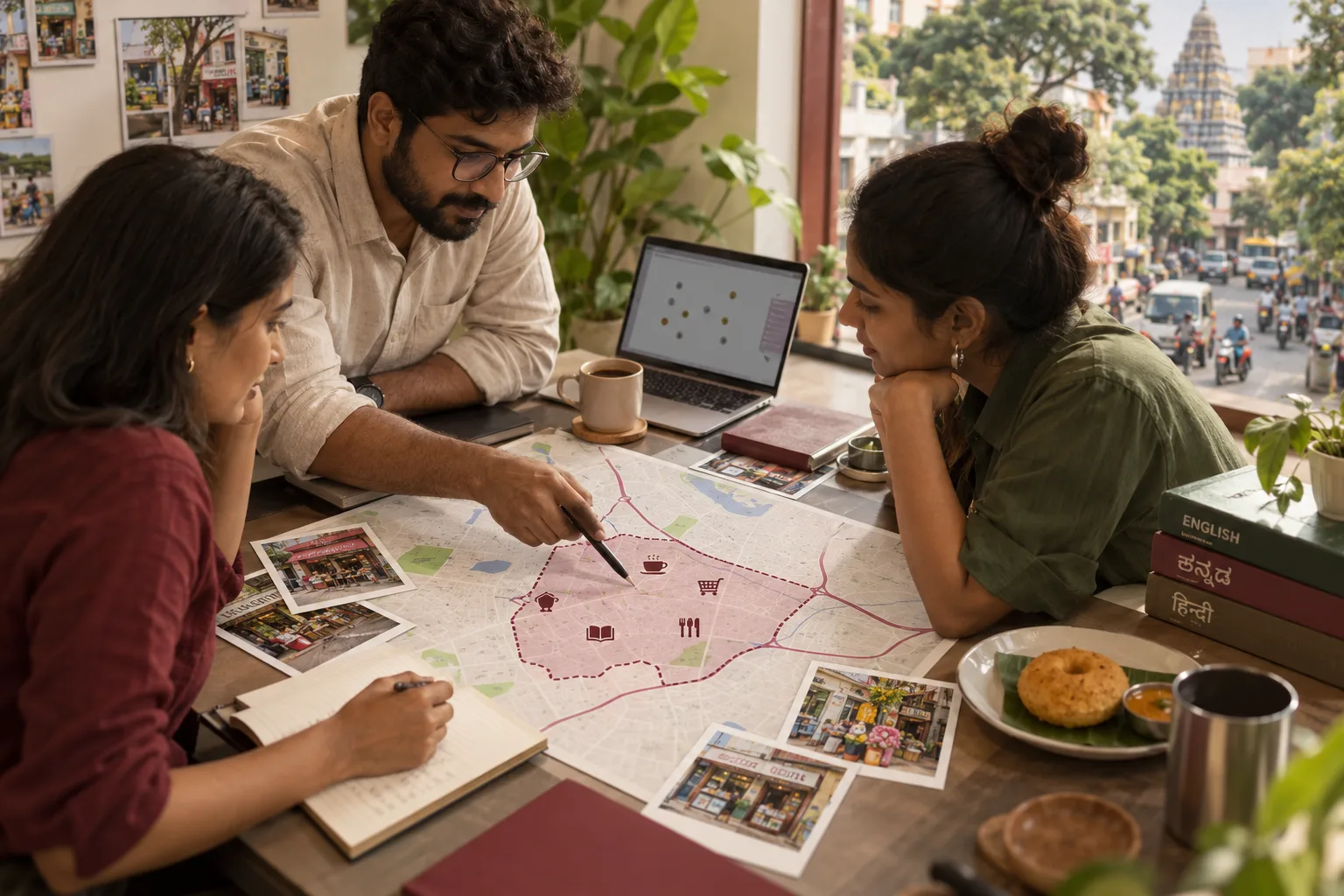 9 min read · 21 Sept 2026Hyperlocal advertising in BengaluruA Bangalore catchment is measured in minutes and bounded by roads people will not cross. See what media sits inside it and which language it reads in.
More for real estate developers and brokers
Related work to consider.
Closest to this: paid and media
- Cinema advertising for real estate developers and brokers
- Newspaper advertising for real estate developers and brokers
- Outdoor advertising for real estate developers and brokers
- Radio advertising for real estate developers and brokers
- PPC ads for real estate developers and brokers
- Billboard advertising for real estate developers and brokers
- Door-to-door promotional campaigns for real estate developers and brokers
- Facebook and Instagram ad copywriting for real estate developers and brokers
Also for real estate developers and brokers
- SEO for real estate developers and brokers
- Lead generation for real estate developers and brokers
- Digital marketing for real estate developers and brokers
- Reputation management for real estate developers and brokers
- Local SEO for real estate developers and brokers
- Branding and identity for real estate developers and brokers
Or start from the overview: sales and marketing for real estate developers and brokers.
Your next practical step
Tell us what you are trying to grow, and we will read it before we call.
Eight short steps, mostly taps. Skip anything you would rather answer on the call.