Used car dealers · Social media
Post the car as it stands in the yard, with the scratch in the picture.
Social media marketing for a used car dealer means showing real cars, real handovers and the people who run the lot, so that a buyer trusts the dealer before his first message. The posts are cars on your lot, not stock images. GullySales plans what goes up around the stock and sends every comment and message to someone who answers.
Scope, fee, reporting and term are agreed in writing after we have read your brief and spoken to you.

What social media means
Social media is the ongoing posting your business does on platforms such as Instagram, Facebook and LinkedIn to stay visible to customers and prospects between purchases. GullySales plans a posting calendar, writes captions and designs the images so the page looks active and answers what a visitor would ask.
Last updated 6 Oct 2026.
For used car dealers
Where it usually goes wrong, and what we would do.
“A new arrival is a post, and nobody posts it”
A car that reaches the lot on Tuesday and is posted on Saturday has already been seen on the portals. The staff who park it have a phone, and a routine can turn that into the post.
“A bright photograph hides what the buyer finds on arrival”
A filtered picture of a car with a dented door brings an angry visit and a public comment. A plain photograph of the dent, posted with the car, is believed.
“A comment asking the price gets a reply that says message me”
The buyer asking what it costs wants a figure. Sending him to a private message costs the post its best reader. Put the price in the post and keep messages for arranging the visit.
What we do
What we deliver for used car dealers.
Every deliverable, what it covers for you, and the result it is there to produce. Nothing here is an extra.
A post for each car the day it arrives
A short routine for whoever parks the car: four plain photographs, the price, kilometres and owner number, posted from the stock list.
Result: The page shows cars that are really on the lot.
A plain-photograph standard
A written rule on angles, light and what must be shown, including flaws, so every car is photographed the same way by anyone on the lot.
Result: Buyers arrive expecting what they find.
Facebook Marketplace and Instagram run from one stock list
Listings and posts made from the same record, so the price and details match across platforms and a sold car comes down everywhere.
Result: A buyer never sees two prices for one car.
Delivery posts taken with permission
A short consent line asked at the handover and kept, and a rule on what stays out of the picture, such as the plate and the papers.
Result: Happy buyers appear on your page by choice.
A routine for comments and messages
A named person who reads every comment and message during opening hours and answers with price, kilometres and the day the car can be seen.
Result: A buyer who asks on a post gets an answer from a person.
A report from post to enquiry
Messages and calls that name a post, entered in the register and compared with the baseline taken before the work began.
Result: You see which kind of post brings a visit.
How the result is measured
- Posts published
- Engagement rate
- Enquiries from social profiles
Recorded as a baseline before work starts, so every later report has an honest comparison.
Platform for this buyer
Where used car buyers look, and what a dealer can post on each.
- Facebook Marketplace and the dealer page
- Post each car with price, kilometres, owner number and area. The action wanted is a message or a call to see the car, so answer from the stock list and take a sold car down.
- Instagram reels of a walk-around
- Film one car outside and in, showing the dent and the odometer, with the price in the caption. The action wanted is a visit, so give the day the lot is open and a landmark.
- WhatsApp status for past buyers and enquirers
- Post new arrivals and sold cars to people who already know you. The action wanted is a reply asking for the details. Post only cars that are on the lot.
- YouTube walk-arounds in the local language
- A longer video of one popular model, talking through condition and paperwork in the language your buyers speak. The action wanted is a call, so link the car's page in the description.
- What not to post
- Do not post filtered photographs, a car that has sold, or a customer's plate and papers. Do not call a car accident-free or claim genuine kilometres unless you hold proof you can show.
Who it is for
This is written for these used car dealers.
- Independent used car dealers
- Multi-brand pre-owned showrooms
- Dealers specialising in one segment
- Franchise pre-owned outlets
- Online-first used car sellers
- Dealers who also broker and consign
How it works
From your first message to the first report.
No open-ended retainer. Every step gives you something in writing.
First
Your brief
You tell us what you need in a few short steps: your business, what you want, where enquiries come from and how they are handled.
After the brief
A conversation and a written scope
We read it, then talk with whoever handles your enquiries. If you want our help, the scope, the fee and the reporting come in writing, and nothing starts before you have read them.
Before work starts
Baseline recorded
The numbers this work is meant to move, such as enquiries, quotations, orders, visits or renewals, written down so every later report has an honest comparison.
After the baseline
The first fix goes live
The fix we agreed to start with is put in place and measured against the baseline, whether that is a reply, a follow-up, a page, a listing or the handover between marketing and sales.
As agreed
Report against the baseline
What moved, what did not, and what changes next, in plain words. How often you get it is set in writing before work starts.
At renewal
Renew on the numbers
The term ends and you decide whether to continue from the results. The length is agreed in writing before anything starts.
How the social media work runs
- 1
Understand your audience and platforms
We identify which platforms your specific buyers actually use and what kind of content they respond to.
- 2
Audit current presence
We review existing pages, past content performance and any gaps in consistency.
- 3
Build the content calendar
A plan is created, balancing genuine value with occasional direct offers.
- 4
Implement and post
Content is created and published consistently on the agreed schedule.
- 5
Measure and optimise
We track enquiries alongside engagement and adjust the content mix based on what actually performs.
Why us
Why owners pick GullySales over an agency.
Marketing and sales, as one job
Most agencies stop at the enquiry. We also fix what happens after it: the reply, the follow-up, the quote and the CRM.
The person on the first call does the work
No account managers in between. You are never handed to someone you have not met.
A baseline before anything starts
Your numbers are written down on day one, so every later report compares against something honest.
The fee in writing, split three ways
Our time, your media spend and production on separate lines. You always see what goes to us.
No guarantees we cannot keep
The term is agreed in writing and never a default twelve months. We never promise a ranking or a lead count, because nobody controls those.
One office, and we say so
Nagarbhavi, Bengaluru. We work across India by call and WhatsApp and travel when a session needs to be in person.
#257, 3rd floor, Sri Nanjundeshwara Complex, Nagarbhavi 8th Block, Outer Ring Road. How we work.
Your brief
Tell us what you need, and we will read it before we call.
Eight short steps about your business, what you want and who decides. Most questions are a tap, and you can skip any you would rather answer on the call.
FAQ
Questions owners ask before they call.
Not here? More answers, or ask on WhatsApp.
Who should be on camera, the owner or the sales staff?
How do we answer comments asking the price?
Should we post festival greetings?
Can we post a customer with his new car?
How long is the contract?
How soon will we see results?
Who will actually do the work?
What do you need from us?
What if we are not happy with the work?
From the blog
Further reading for used car dealers.
 5 min read · 6 Oct 2026How used car dealers move ageing stockA used car that has sat for two months is costing you every day. Find out why it is not selling, fix that cause before you cut the price, and put it in front of buyers who already asked.
 6 min read · 6 Oct 2026How buyers choose a showroom, workshop or parts counterCar, bike, repair and parts buyers send one enquiry to several sellers and pick the first clear answer. This post lists what each buyer checks, and where a dealer or workshop quietly loses them.
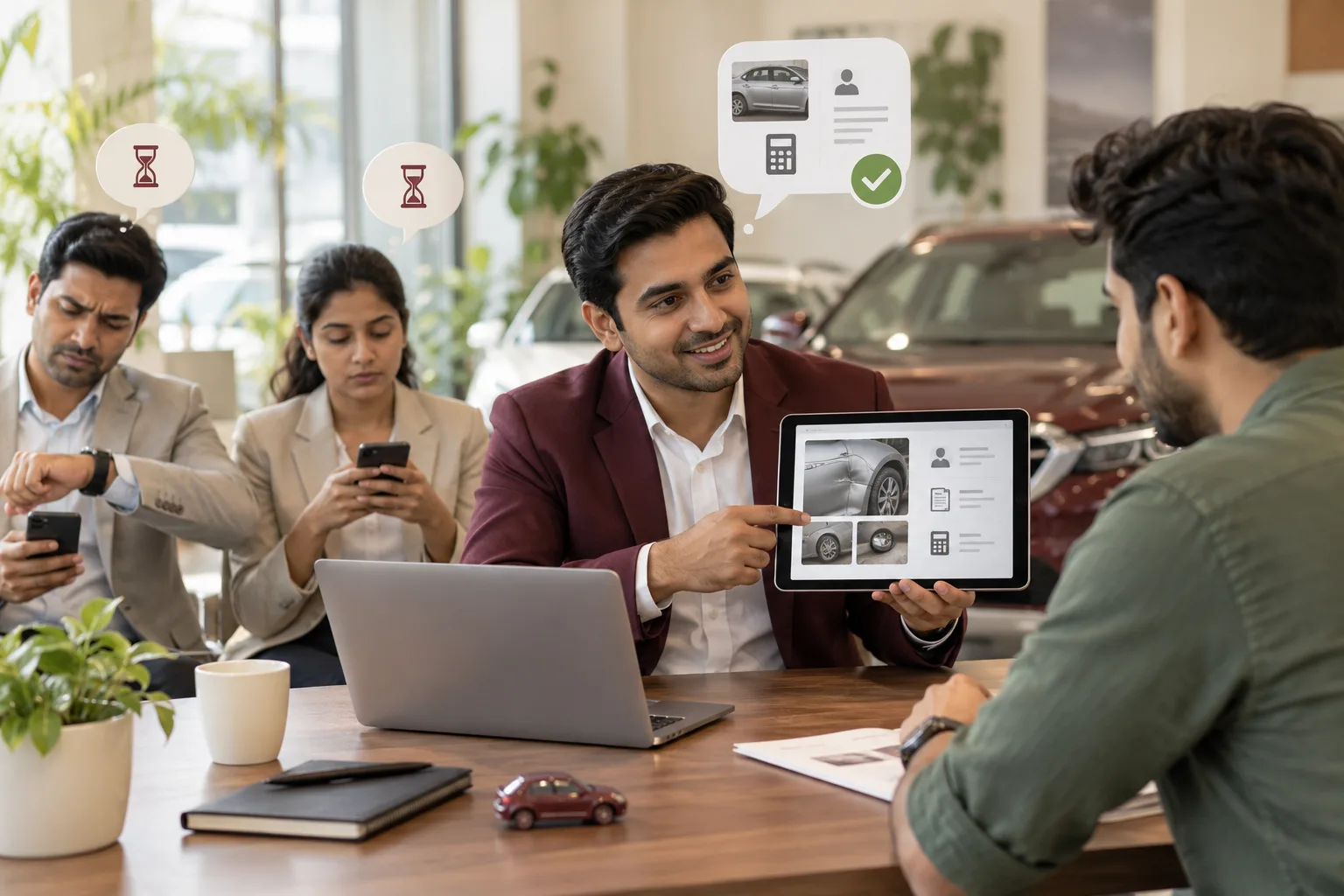 7 min read · 19 Feb 2026How used car dealers should answer portal enquiriesThe same portal enquiry went to three dealers. The one who replies first with photographs of the flaws, the ownership details and an EMI figure gets the test drive.
More for used car dealers
Everything else we would do for you.
Closest to this: content and social
Also for used car dealers
Or start from the overview: sales and marketing for used car dealers.
Your next practical step
Tell us what you are trying to grow, and we will read it before we call.
Eight short steps, mostly taps. Skip anything you would rather answer on the call.