Real estate developers and brokers · Metro advertising
A metro station should be chosen for the commuters who could live near your project.
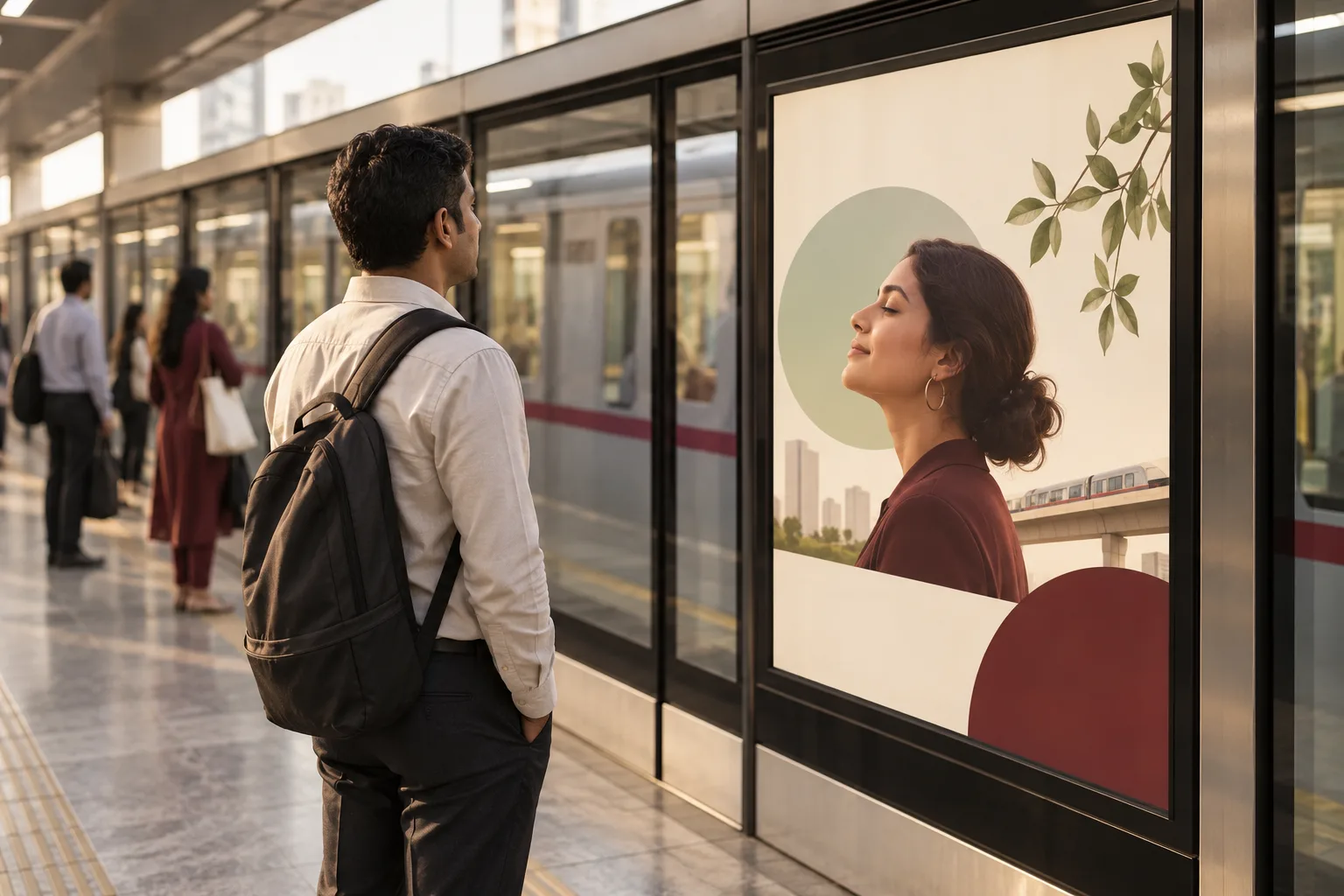
Metro advertising for a developer or broker buys space in stations or trains, such as pillar wraps, platform panels and screens near the gates, aimed at commuters who could visit a project. GullySales selects stations along your buyers' journeys, checks availability with the appointed agency, coordinates booking and approvals, and puts a response route on the advertisement.
Scope, fee, reporting and term are agreed in writing after we have read your brief and spoken to you.

What metro advertising means
Metro advertising buys space in metro stations or trains, including pillar wraps, platform panels, and screens near the gates. GullySales selects stations around your buyers' journeys, checks availability with the appointed advertising agency, coordinates booking and artwork approval, and puts a response route on the advertisement so your team can record enquiries.
Also for real estate developers and brokers
- Cinema advertising for real estate developers and brokers
- Newspaper advertising for real estate developers and brokers
- Outdoor advertising for real estate developers and brokers
- Radio advertising for real estate developers and brokers
- PPC ads for real estate developers and brokers
- Billboard advertising for real estate developers and brokers
- Door-to-door promotional campaigns for real estate developers and brokers
- Facebook and Instagram ad copywriting for real estate developers and brokers
Sales and marketing for real estate developers and brokers, the overview.
Last updated 14 Nov 2026. Rules for this trade differ by state and professional body, and they change. We describe restrictions in general terms, so check the current position with your own council or adviser before you publish anything.
For real estate developers and brokers
Where it usually goes wrong, and what we would do.
“A commuter reads in seconds, not minutes”
A person passing through a station is walking, checking a phone or waiting for a train, and gives an advertisement a few seconds. A project advertisement with a render, six lines of text and a registration block cannot be read at that pace. The message has to be the locality, the configuration and one way to respond. What goes on the panel and what stays for the brochure is a decision to make before the artwork is drawn.
“The right station is on the buyer's route, not the project's”
A project near a station does not mean the station's commuters are your buyers. The better question is where your buyer lives, works and changes trains. A project in a suburb may reach its buyers at the interchange near their offices instead of at the nearest stop. We start from a described buyer and the stations that buyer uses, and compare exits, platforms and gates, not just station names.
“Rights sit with an appointed agency and approvals are strict”
Metro space is controlled by the transit authority and sold through an appointed advertising agency, with rules on size, content, lighting and installation. Property advertisements also carry the local regulator's expectations about registration details and claims, which your own adviser decides. A panel printed before the agency approves the artwork can be rejected, and printed vinyl cannot be reused for another project.
“Response from a panel is hard to trace”
A commuter sees the panel on Monday, thinks about it on the train and calls on Thursday, perhaps through a portal. Attribution is difficult and an owner who demands exact figures will be disappointed. A distinct number, a short link and a code on the panel, entered in your register with the station name, gives a usable record. It shows what responded, not everything the panel influenced.
What we do
What we deliver for real estate developers and brokers.
The work available for this need. We agree the deliverables and responsibilities for your engagement in writing.
Station and exit shortlist
A list of stations and exits on the routes your buyer takes, with the reason for each: nearness to office clusters, interchanges, or the line towards your locality. Stations are ranked by fit with your buyer. A busy station with the wrong commuters is marked as a poor choice, so you pay for the right passers-by.
Result: You can see which stations fit your buyer and why the others were set aside.
Placement and format comparison
A comparison of the formats open to you, such as pillar wraps, platform panels, gate-side screens, escalator branding or in-train panels, by sightline, dwell time and the message each can hold. It names what each format can and cannot carry for a project. A gate-side screen suits a short invitation; a platform panel suits a locality and configuration line.
Result: You choose a format knowing what it can carry and where people stand when they read it.
Appointed agency and rights check
A written confirmation from the appointed agency of which sites are open, on which dates, with which restrictions on content. We confirm that the agency holds the rights and ask for the offer in writing. We hold no inventory and no exclusive rate; the booking is between you and the agency.
Result: The offer on paper names the agency, the site and the dates, and you have signed it.
Booking and production schedule
A schedule that sets printing, delivery and installation against the booked dates, with who is responsible for each step. Printing is paid to a third party, so the schedule also records the sizes the agency requires. A missed print date wastes the booked space, so the schedule is checked backwards from the first day.
Result: Each production step has a named person and a place on the calendar.
Artwork and approval pack
The artwork for each panel, built for a quick read, with the registration details your adviser has cleared, and the agency's and authority's written approval. The pack also holds the text your adviser rejected. Printing starts only after approval is on file.
Result: Written approval is on file for every panel before printing starts.
Response route and campaign record
A phone number, short link and code used only for the metro campaign, with a register that notes each enquiry's station and panel. The record includes installation photographs and the dates the panels were up. It gives your sales manager a clear view of what the metro produced beside other sources.
Result: Your register separates metro enquiries from portal and broker enquiries.
How the result is measured
- Booked positions and creative verified through dated photographs
- Display days delivered against display days purchased
- Campaign calls and scans, reported as responses rather than sales
Recorded as a baseline before work starts, so every later report has an honest comparison.
Who it is for
This is written for these real estate developers and brokers.
- Residential apartment developers
- Villa and plotted development builders
- Commercial and office space developers
- Independent brokers and channel partner networks
- Redevelopment and rehabilitation projects
- Plot and land aggregators
- NRI-focused residential projects
- Affordable and mid-income housing developers
- Luxury and premium residential developers
Before you decide
Agree the work. Know how to judge it.
Metro advertising for real estate developers and brokers: use these checks to prepare, choose the scope, and review what changes.
Bring the right evidence
State the buyer group, catchment, and dates that matter to the offer. Ask for the proposed inventory and available evidence about its audience, with the source and date shown.
Make the scope clear
Agree the exact placements, formats, booking period, and proof of delivery. Separate media charges from design, production, permissions, and installation where these apply.
Check the work in use
Compare delivery evidence with the agreed booking and record enquiries through a distinct response route where practical. Treat audience estimates separately from measured responses.
Know when to change course
Do not buy a placement only because it is discounted. If the location or audience does not fit the buyer, revisit the plan before committing production costs.
These are discussion points, not a fixed package. GullySales confirms the deliverables, responsibilities, fee, and term in writing after reading your brief and speaking with you.
Before we start
What to have ready before the work starts.
The records, access and decisions this work needs from real estate developers and brokers. Anything missing is noted in the written scope, with who will supply it.
- A named buyer and their journey
- A description of the household you want, where they live and work and how they travel. A rough sketch from your sales team is enough. Without it, the shortlist becomes a list of busy stations with no link to your buyer.
- Space and production ceiling
- A range for what you can spend on space, printing and installation, which are paid to third parties. The range lets us compare options within limits. Without it, the shortlist may include sites you cannot afford and time is lost.
- Registration and approval details
- The project's registration number and other details your adviser requires on advertising. They go on the panel and are checked by the agency. If they are missing or wrong, the panel is rejected or printed again.
- Artwork files and brand rules
- Logos, project images and any brand rules, in print-ready form. The artwork must be drawn to the agency's sizes and read at walking pace. Without files, the creative waits and printing slips past the first booked date.
- A person to answer the response route
- The sales executive or team who answers the number and calls back each enquiry. Without one, the first commuters to respond meet voicemail and the campaign cannot be read fairly.
How it works
How the metro advertising work runs
The work itself, in order. How an engagement starts, from your brief to a written scope, is set out on our method page.
- 1
Describe the buyer and the journey
We begin with the household you want to reach and the route they take: where they live, where they work and which stations they use. You tell us what a commuter should do after reading the panel. The figures recorded at this stage, such as enquiries per source and site visits in the current phase, are the starting point for reading the campaign later.
- 2
Check availability and choose stations
With the journey described, we ask the appointed agency which sites are open on your routes and compare them by sightline, dwell time and the commuter's mood at that point. We visit or ask for photographs where possible. You receive a shortlist with a recommendation and decide which stations and formats to take before any production begins.
- 3
Authorise the booking
We request the written offer with site, dates and charges, check that the position matches what was shown, and read the restrictions. You approve the booking, sign it and pay the agency directly. Any change of site is confirmed in writing. We keep the offer with the plan so that later questions about what was booked can be answered.
- 4
Prepare creative and clear it
The panel carries the locality, the configuration and one response route, written to be read at walking pace. The registration details and any claim are cleared by your adviser, and the agency and authority approve the artwork. Printing starts only after approval. A rejected panel before printing costs a revision; after printing it costs the vinyl.
- 5
Install and open the response route
We follow printing and delivery against the schedule and ask the agency for installation photographs showing the whole site. The phone number, link and register are tested before the dates open. Your sales manager sets who answers and when the first call is due. Any fault in installation is raised with the agency at once, while the dates are running.
- 6
Read the result against the starting figures
After the dates, we collect the enquiries, site visits and bookings tagged to the metro and set them beside the starting figures. We record what the commuters asked and which stations produced responses. You get a short record and decide whether to book again, change stations or stop. No result is promised.
Where this fits
Three pieces of sales work, in this order.
This work sits inside sales process design, at stage 1, prospecting and lead generation. The audit comes before it, and sales management keeps it running.
Step 1
Sales audit
Find where deals are being lost and what to fix first.
Start here if you cannot say where orders are lost.
Step 2 · you are here
Sales process design
One written way to sell, from first enquiry to repeat order.
Start here if every salesperson sells differently.
Step 3
Sales management
A target, a review routine and someone who owns the number.
Start here if the team has targets and no routine.
FAQ
Questions owners ask before they call.
Not here? More answers, or ask on WhatsApp.
Does metro advertising suit a real estate project?
How much can one panel say?
Who sells the space, and do you get a special rate?
Can you tell me how many commuters saw the panel?
What if the agency rejects the artwork?
When is metro advertising the wrong choice?
How long is the contract?
How soon will we see results?
Who will actually do the work?
What do you need from us?
From the blog
Further reading for real estate developers and brokers.
 8 min read · 21 Sept 2026Metro advertising in BengaluruNamma Metro sells three audiences under one name: people in the station, people in the train and drivers under the viaduct. Which to buy, and why.
 7 min read · 21 Sept 2026How to design metro and transit advertisingA commuter stands still in front of a platform panel for four minutes and passes the same one twice a day for a month. Design for the sixth viewing.
 6 min read · 10 Oct 2026How real estate businesses can qualify leads before site visitsSix questions on WhatsApp or a short call decide whether a buyer gets a site visit, and keep your sales team's weekends for visits that count.
More for real estate developers and brokers
Related work to consider.
Closest to this: paid and media
- Cinema advertising for real estate developers and brokers
- Newspaper advertising for real estate developers and brokers
- Outdoor advertising for real estate developers and brokers
- Radio advertising for real estate developers and brokers
- PPC ads for real estate developers and brokers
- Billboard advertising for real estate developers and brokers
- Door-to-door promotional campaigns for real estate developers and brokers
- Facebook and Instagram ad copywriting for real estate developers and brokers
Also for real estate developers and brokers
- SEO for real estate developers and brokers
- Lead generation for real estate developers and brokers
- Digital marketing for real estate developers and brokers
- Reputation management for real estate developers and brokers
- Local SEO for real estate developers and brokers
- Branding and identity for real estate developers and brokers
Or start from the overview: sales and marketing for real estate developers and brokers.
Your next practical step
Tell us what you are trying to grow, and we will read it before we call.
Eight short steps, mostly taps. Skip anything you would rather answer on the call.