Industries · Manufacturing & Industrial
A packed food sells when the buyer in the middle says yes first.
A namkeen maker, a biscuit factory and a pickle unit each hand a sample to someone who is not the eater. It might be a wholesaler in the next town, a store buyer in a chain, a brand that wants a co-packer or a hotel kitchen. That person tastes, asks about the margin or the shelf life, says they will think, and the sample goes quiet. The owner is back at the plant with no note of who took what.
Scope, fee, reporting and term are agreed in writing after we have read your brief and spoken to you.
In one paragraph
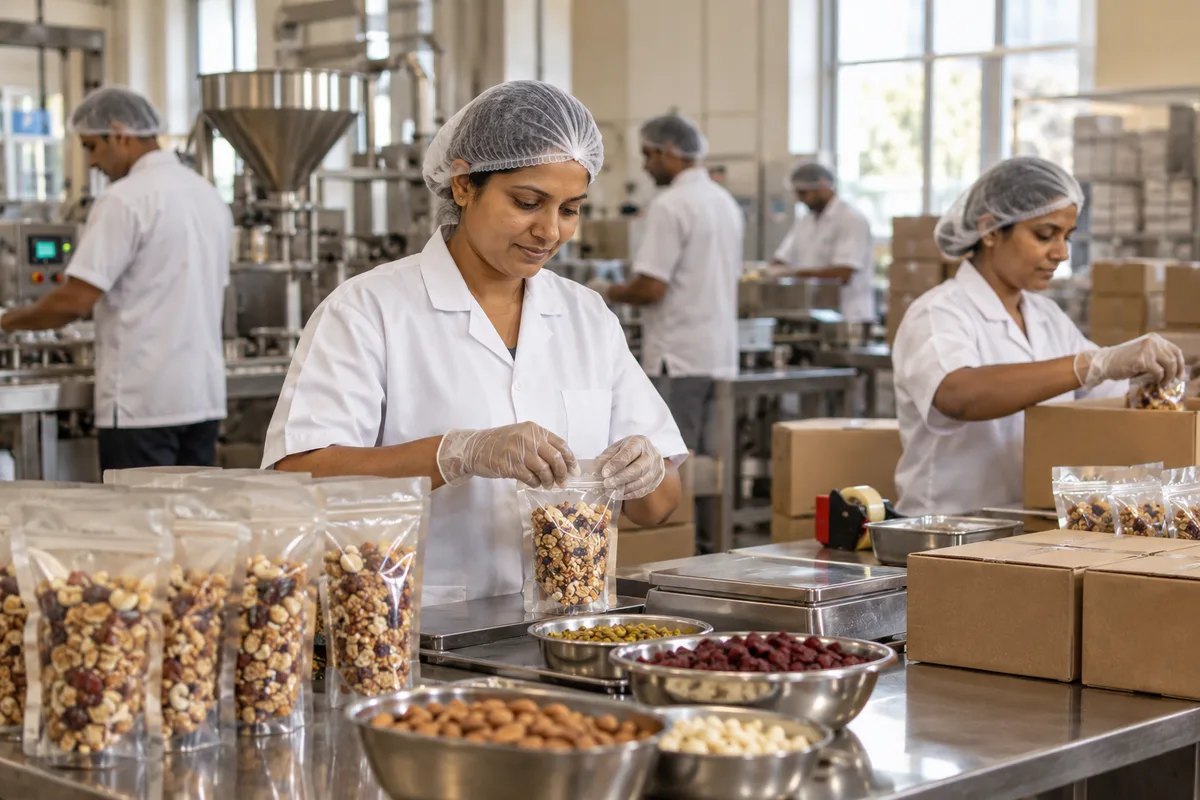
Packaged food, snack and sweet manufacturing is the making of packs, cartons and bulk lots of food that other people stock, resell or cook with. GullySales looks at how wholesalers, distributors, store buyers and bulk buyers find and test you, what your pack and sheet tell them, and who reorders after the first carton.
These trades make different things. Sweets and toffee go through kirana and school-gate shops, frozen and ready-to-eat lines go to cabinets, quick-commerce apps and kitchens, and a food processing company sells pulp, powder or cut produce to other businesses. What they share is a packed product, a middle buyer who decides what gets stocked, and reorders that happen only when somebody asks. Shelf life, licence and label questions come from that buyer before the first order.
Last updated 18 Oct 2026. Rules on what you may advertise differ by trade and change. This page describes them in general terms only, so check the current position with your own adviser or regulator.
11 kinds of business
Each kind of business in packaged foods, snacks & sweets sells a little differently.
Open the page closest to yours for how its buyers choose and what we would fix first.
Food processing companies
The buyer is another business: a brand, an exporter or an institutional kitchen. Sales run on samples, specification sheets and a plant visit, and brokers can hold the buyer relationship, so the sample trail and your own buyer list matter most.
Read the page for food processing companiesPackaged food manufacturers
A branded pack must win the distributor first and the shopper second. The work is a distributor pitch, a retailer kit and a record of what sold off the shelf, not only what left the godown.
Read the page for food product manufacturersSnack manufacturers
Small packs sell through kirana shops, sweet stalls and distributors, so reorders matter more than first orders. Festival and gifting demand arrives in bursts from many senders and is easily lost.
Read the page for snack manufacturersBiscuit manufacturers
Wholesalers and stockists earn more on the bigger brands, and a scheme can load the market and slow the next month's orders. Private label and institutional buyers are a second route for spare plant capacity.
Read the page for biscuit manufacturersBakery product manufacturers
Bread, buns and cakes are fresh and short-lived, so the sale is a delivery route and shops that reorder, with stale returns eating the margin. Hotels and cafes phone in orders at odd hours, and the drivers' memory is the only record.
Read the page for bakery product manufacturersConfectionery manufacturers
Sweets and toffees reach kirana, pan and school-gate shops through wholesalers, and a rival's higher scheme can pull a wholesaler away. Summer melt and a rushed festival assortment are the other worries of the trade.
Read the page for confectionery manufacturersChocolate manufacturers
Corporate gifting buyers send one brief to several makers, bakers stay with the couverture they know, and summer heat melts parcels sent to other cities. Each buyer needs a different pitch.
Read the page for chocolate manufacturersPickle manufacturers
The recipe is loved by family and friends and hardly known beyond them, and mango season sells out in weeks. Shops take a carton and do not reorder, couriers break jars, and gift orders flood in on WhatsApp.
Read the page for pickle manufacturersFrozen food manufacturers
Buyers worry about the cold chain, so being able to show it is part of the pitch. Cloud kitchens order once and drift away, and a distributor hesitates to stock a freezer line that nobody is asking for.
Read the page for frozen food manufacturersReady-to-eat food manufacturers
Shelf-stable meals and mixes go to supermarkets, quick-commerce apps and institutions. A chain can be slow to decide a listing, new online listings carry few reviews, and a store buyer worries about shelf life.
Read the page for ready-to-eat food manufacturersCoffee roasters and tea traders
Cafes and hotels reorder from the roaster whose cup beats their current supply in a side by side tasting, and who can name estate, roast level and delivery without a minimum that blocks them.
Read the page for coffee roasters and tea tradersWhat they share
What usually goes wrong across packaged foods, snacks & sweets.
Whichever of these you run, you will probably recognise most of them.
“The buyer in the middle decides before the shopper does”
A wholesaler, distributor, store buyer or brand owner chooses what we get to sell. If we give that person no reason to stock us over the maker next to us, the product waits in our godown.
“A sample goes out and nothing comes back”
Someone tastes, says it is good and goes silent. We have no note of who got which sample, so the follow-up call never gets made and the trial ends where it began.
“We count what we dispatched, not what sold”
Billing and dispatch are on record. Whether the pack moved off the shelf, was cooked with or came back to us as a reorder is not, so a slow product shows up only when the calls stop.
“Our pack, sheet or listing looks like the one beside it”
A shelf, a catalogue page, a quote on WhatsApp or a specification sheet gets a few seconds of a buyer's attention. If it does not say what is different here, the buyer picks the cheaper one.
“Buyers ask about shelf life, licence and storage and we answer from memory”
FSSAI details, shelf life, ingredients, storage and test results get asked for before a larger order. When we hunt for them each time, the buyer reads a business that is not ready.
“A bigger or cheaper maker is always in the comparison”
Our pack is set against a known brand, a rival's scheme or another processor's rate. Without a clear reason to pay what we ask, the conversation drops to price and a discount.
Where to start
What to fix first in packaged foods, snacks & sweets.
In the order we would look at them. Your own enquiry records may change the order, and we would say so.
- Keep one list of every buyer who got a sample or a first carton, with the date and what happens next, so follow-up does not depend on the owner's memory.
- Ask each buyer what sold or was used after dispatch, and write down which ones stopped and when. The stoppers tell you more than the repeaters.
- Put the licence, shelf life, ingredient and storage details and a one-page product sheet in a single place, ready to send when a buyer asks.
- Give whoever carries your product to a buyer, whether a distributor, a salesman or the owner, a short offer with a reason to stock it and something to leave behind.
- Write the reply to a bulk, private label or export enquiry once, with the questions you need answered, so that it goes out the same day it arrives.
- Make the pack or catalogue say what the product is and where it differs before the price is discussed.
Related services
The work that usually comes up.
Which of these you need is decided after we have read your brief.
- Distributor developmentFix the stocking, credit and coverage gaps that stop a distributor ordering more.
- Route to market and distribution strategyRedesign your distribution network layers before you add another distributor.
- Trade and dealer marketingHelp your dealers sell more without doing all the work of demand generation for them.
- Sampling and product demonstrationFour hundred samples went out on Sunday and nobody wrote down a single name.
- Lead response and follow-upMore enquiries turned into orders, for teams that reply late and follow up once.
- E-commerce and marketplace marketingGet found and chosen on Amazon, Flipkart and IndiaMART, not just your own site.
- Festive and seasonal advertisingBook the Diwali slot in August, because by October there is nothing left.
- Export and international market developmentFind the overseas distributor who can get your product past customs and onto a shelf.
FAQ
Questions about packaged foods, snacks & sweets.
Not here? More answers, or ask on WhatsApp.
How do we get a distributor to push our product and not only stock it?
Should a food maker use schemes to get shops to stock a product?
What do buyers check before they place a larger order?
Do we need an online listing if we sell through trade?
How do we find buyers outside our home towns?
How much does it cost?
How long is the contract?
How soon will we see results?
Who will actually do the work?
What do you need from us?
More in Manufacturing & Industrial
- Machining & Precision Components
- Cutting & Metal Fabrication
- Casting, Forging & Tooling
- Metal Finishing & Surface Treatment
- Machine Tools & Factory Automation
- Industry-Specific Machinery
- Pumps, Drives & Thermal Equipment
- Power Equipment & Panels
- Cables, Electronics & Instrumentation
- Plastics, Rubber & Polymer Manufacturing
- Cement, Concrete & Masonry
- Tiles, Stone & Glass
- Wood, Doors & Windows
- Roofing, Paints & Bath Fittings
- Furniture & Interior Product Manufacturing
- Textile Mills & Fabric
- Garments & Home Textiles
- Footwear, Leather & Accessories
- Dairy & Beverage Manufacturing
- Staples, Oils & Feed
- Industrial Chemicals & Coatings
- Pharma & Personal Care Manufacturing
- Paper & Packaging Materials
Looking for a single trade? See every industry.
Your brief
Tell us what you need, and we will read it before we call.
Eight short steps about your business, what you want and who decides. Most questions are a tap, and you can skip any you would rather answer on the call.
Your next practical step
Tell us what you are trying to grow, and we will read it before we call.
Eight short steps, mostly taps. Skip anything you would rather answer on the call.