Hospitals · Branding
Look like the hospital a family trusts with a diagnosis.
Branding for a hospital covers the name, the signage, the doctor coats and the tone of every enquiry reply. All of it should say the same thing about how the hospital treats a worried family. GullySales sets this once and applies it to the website, WhatsApp replies and every department page.
Scope, fee, reporting and term are agreed in writing after we have read your brief and spoken to you.

What branding means
Branding is what a customer remembers about your business beyond the product, including your name, colours, tone of voice and what you are known for locally. GullySales sets or corrects this once and applies it consistently across your website, signage and adverts so the business looks like one company everywhere.
Last updated 5 Oct 2026. Rules for this trade differ by state and professional body, and they change. We describe restrictions in general terms, so check the current position with your own council or adviser before you publish anything.
For hospitals
Where it usually goes wrong, and what we would do.
“Accreditation marks belong on the identity”
An NABH or state licence mark on the signage reassures a family choosing between two similarly priced hospitals.
“The tone changes by department”
A maternity page reads warm and reassuring, an emergency page reads fast and clear, under the same visual identity.
“Doctor branding sits inside hospital branding”
Patients often choose a doctor before a hospital, so senior doctors need a consistent photograph and department tag across every material.
What we do
What we deliver for hospitals.
Every deliverable, what it covers for you, and the result it is there to produce. Nothing here is an extra.
Accreditation marks placed consistently
NABH or state licence marks added consistently across signage, the website and department pages, wherever the hospital is entitled to show them.
Result: A family comparing two similarly priced hospitals sees the credential first.
A department-specific tone guide
Written guidance on how maternity should read warm and emergency should read fast and clear, all under the same visual identity.
Result: Each department speaks the right way to a worried family without breaking the hospital's look.
A doctor photography and tag standard
A consistent photograph style and department tag applied to every senior doctor across the website, profile and print material.
Result: A patient who chooses a doctor first still recognises the hospital behind them.
A signage and print consistency review
A check of signboards, prescription pads and leaflets against the current identity, with a written fix list in priority order.
Result: A family walking through the hospital sees one consistent name and look.
An identity kit for every touchpoint
Logo, colours and type rules packaged for the website, WhatsApp, the profile and department signage.
Result: The hospital looks the same wherever a family encounters it.
How the result is measured
- Recognition in customer feedback
- Consistency across channels
- Repeat enquiries by name
Recorded as a baseline before work starts, so every later report has an honest comparison.
Positioning in one sentence
Fill this sentence in with the management and the medical team, and every department will describe the hospital in the same way.
- Who it is for, as a family and a need
- Name the family and the need: parents looking for maternity and newborn care, an older couple needing orthopaedic care, a family with an emergency at night. Say which of these the hospital is built for.
- What you treat, in the family's words
- List the departments and services as families name them: maternity, heart care, joint replacement, dialysis, emergency. Use plain words first and the medical term in brackets.
- What a family gets that the nearest hospital does not
- Choose a true, checkable difference: a department that is staffed round the clock, a single point of contact for admission, a tie-up with an insurer or scheme. Do not make any claim about treatment outcomes.
- The proof you can show
- Show approvals and accreditations as issued, doctors' qualifications and registration with their consent, and facilities as photographed today. Advertising rules for hospitals differ by state and council and change, so check yours.
- Words every hospital uses
- Best care, top-class and state-of-the-art are on every hoarding and can read as a claim. Replace them with the department, the equipment and the doctors' registered qualifications.
- The name and tagline test
- The name goes on an ambulance, a wristband and a discharge summary. Check that it matches the registration, is clear in every language the families read, and does not imply a speciality you do not run.
Who it is for
This is written for these hospitals.
- Multi-speciality hospitals
- Single-speciality hospitals, maternity, orthopaedic or eye
- Nursing homes
- Day-care surgery centres
- Corporate hospital chains with several branches
- Diagnostic-centre-led hospitals
- Hospitals attached to medical colleges
- Government-empanelled private hospitals
Not for
It is not the right fit if.
- You want a guaranteed Google ranking or a guaranteed number of leads. Nobody honest can promise either.
- You need enquiries by next week and have nobody to answer them.
- You want posts and reach reported, not enquiries and orders.
How it works
From your first message to the first report.
No open-ended retainer. Every step gives you something in writing.
First
Your brief
You tell us what you need in a few short steps: your business, what you want, where enquiries come from and how they are handled.
After the brief
A conversation and a written scope
We read it, then talk with whoever handles your enquiries. If you want our help, the scope, the fee and the reporting come in writing, and nothing starts before you have read them.
Before work starts
Baseline recorded
Enquiries by source, reply time, conversion and cost per order, written down so every later report has an honest comparison.
After the baseline
The first fix goes live
The fix we agreed to start with is put in place and measured against the baseline, whether that is reply time, a follow-up sequence, the page buyers land on or the handover between marketing and sales.
As agreed
Report against the baseline
What moved, what did not, and what changes next, in plain words. How often you get it is set in writing before work starts.
At renewal
Renew on the numbers
The term ends and you decide whether to continue from the results. The length is agreed in writing before anything starts.
How the branding work runs
- 1
Interview customers and team
We talk to real buyers, won and lost, and to people inside the business who deal with customers daily.
- 2
Review the competitive field
We look at how the nearest competitors present themselves so the position is not accidentally identical.
- 3
Draft the position
A first version of the positioning statement and messaging pillars is written and checked against what customers actually said.
- 4
Test it against real conversations
The draft is tried out in a real sales call or two before it is finalised, since a position that does not survive a real conversation needs rework.
- 5
Hand over the rollout brief
The final position, pillars and not-for list are documented for your team and any agency to apply consistently.
Proof
What happened when owners fixed this.
Real clients, the work we did, and the result as it was recorded. Where no number was recorded, none is claimed.
Chord Road Hospital
- Situation
- Patients who knew the hospital trusted it. Patients who searched for a department or a treatment in the area did not find it.
- What we did
- Website rebuilt around patient needs
- Search visibility
- Social media on a schedule
- Review management
- Result
- Organic traffic increased 60% within six months
- Online appointment bookings increased 40%
- Social following grew 45%, and engagement on it rose 70%
Nanda Arthritis and Rheumatology Center
- Situation
- There was no website, so a patient looking for a rheumatologist had no way to learn about the centre. Enquiries were few, and the ones that arrived came by word of mouth.
- What we did
- A website for patients
- Search work
- Google Business and reviews
- Lead capture and advertising
- Result
- No numbers were recorded for this engagement. The work is described in full in the case study.
Also worked with
Curtain Label · Difesa Security Services · Felicity Inn · Hands On CSR · Implevista · Kambar Group · Kalessi · Kerur Pain Clinic · LL Trust · Lucky Deals · Natural Gases · NavaShakthi Souhardha · NewCom Logistics · Proton Technical Services · SB Engineering · Shakthi Foundation · Shakthi Group · Urbanest · Insyde Studio · Venkateshwara Laser Tech · Vivara Studios
Why us
Why owners pick GullySales over an agency.
Marketing and sales, as one job
Most agencies stop at the enquiry. We also fix what happens after it: the reply, the follow-up, the quote and the CRM.
The person on the first call does the work
No account managers in between. You are never handed to someone you have not met.
A baseline before anything starts
Your numbers are written down on day one, so every later report compares against something honest.
The fee in writing, split three ways
Our time, your media spend and production on separate lines. You always see what goes to us.
No guarantees we cannot keep
The term is agreed in writing and never a default twelve months. We never promise a ranking or a lead count, because nobody controls those.
One office, and we say so
Nagarbhavi, Bengaluru. We work across India by call and WhatsApp and travel when a session needs to be in person.
#257, 3rd floor, Sri Nanjundeshwara Complex, Nagarbhavi 8th Block, Outer Ring Road. How we work.
Your brief
Tell us what you need, and we will read it before we call.
Eight short steps about your business, what you want and who decides. Most questions are a tap, and you can skip any you would rather answer on the call.
FAQ
Questions owners ask before they call.
Not here? More answers, or ask on WhatsApp.
Do we need to rebrand completely?
Should every department look the same?
Can a doctor's name and photograph go on the hospital's hoardings?
Should the maternity wing have a name of its own?
How soon would we see more admissions?
Do we need to advertise?
How much does it cost?
How long is the contract?
Who will actually do the work?
What do you need from us?
From the blog
Further reading for hospitals.
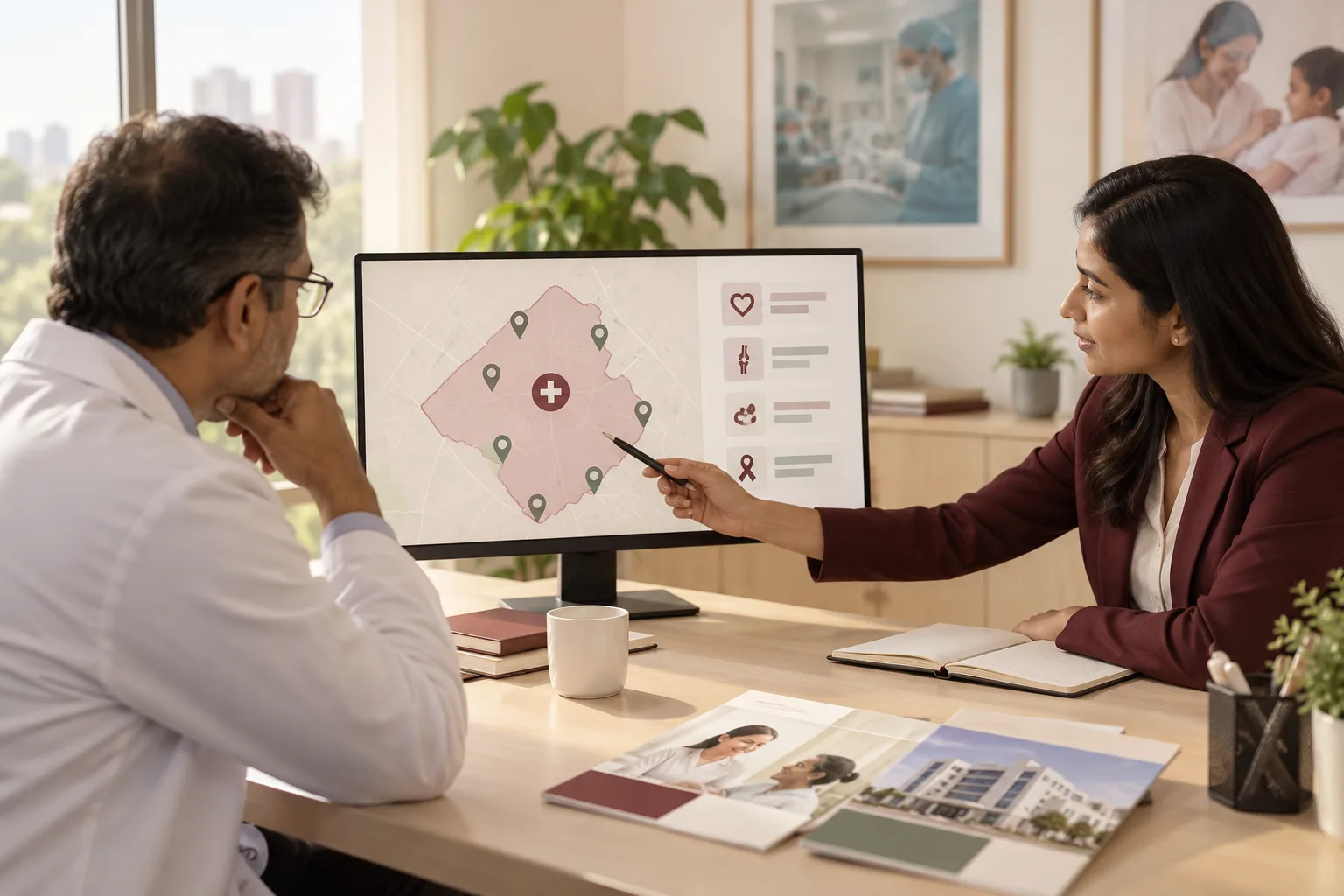 8 min read · 8 Jul 2025How a hospital builds brand awareness with targeted campaignsA hospital does not need city-wide awareness, only to be the first name in its own catchment for the departments it wants to fill.
 6 min read · 17 Jun 2025How to build brand awarenessAwareness is repetition in the places your buyers already are. Measuring it needs a baseline, a separate number per medium and a question asked at the counter.
 6 min read · 6 Oct 2026What healthcare buyers check before they choose youA patient, a referring doctor and a hospital purchase team each check something different before choosing a provider. This post lists what each one looks at and where a clinic, lab or supplier loses them.
More for hospitals
Everything else we would do for you.
- Account based marketing for hospitals
- Advertising for hospitals
- Apartment advertising for hospitals
- Buyer journey mapping for hospitals
- Buyer personas for hospitals
- Cinema advertising for hospitals
- Content marketing for hospitals
- Digital marketing for hospitals
- Direct mail for hospitals
- Event marketing for hospitals
- Lead generation for hospitals
- Marketing strategy for hospitals
- Newspaper advertising for hospitals
- Outdoor advertising for hospitals
- Public relations for hospitals
- Radio advertising for hospitals
- Sales coaching for hospitals
- Sales enablement for hospitals
- Sales management for hospitals
- Sales metrics for hospitals
- Sales process for hospitals
- Sales strategy for hospitals
- Sales training for hospitals
- SEO for hospitals
- Social media management for hospitals
- Video marketing for hospitals
- Website development for hospitals
- Follow-up systems for hospitals
- CRM for hospitals
- Review generation for hospitals
- Patient retention for hospitals
- Referral marketing for hospitals
- WhatsApp marketing for hospitals
Or start from the overview: sales and marketing for hospitals.
Your next practical step
Tell us what you are trying to grow, and we will read it before we call.
Eight short steps, mostly taps. Skip anything you would rather answer on the call.